
TensorFlow
End-to-end machine learning platform and tooling ecosystem
TensorFlow is a machine learning platform with Python and C++ APIs, optional GPU packages, and companion libraries for data, training, deployment, and visualization.

Industrial-strength natural language processing for Python
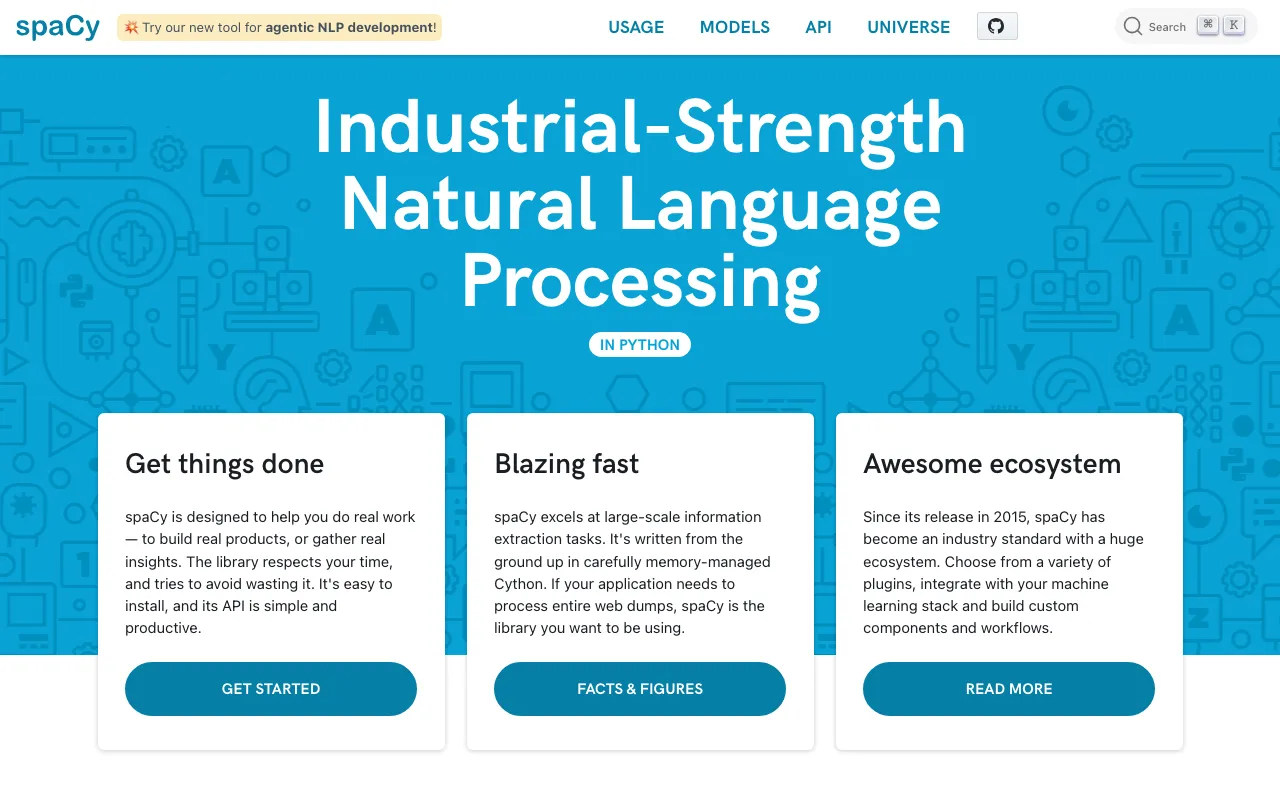
spaCy is a Python and Cython NLP library with pretrained pipelines for dozens of languages. It covers tagging, parsing, NER, classification, and related linguistic tasks.
spaCy is built for production NLP workflows rather than classroom prototypes. It ships pretrained pipelines and supports tokenization and training across many languages, with components for named entity recognition, part-of-speech tagging, dependency parsing, sentence segmentation, text classification, lemmatization, morphological analysis, entity linking, and related steps.
Models can leverage multitask learning with transformer back ends such as BERT, pretrained word vectors, and custom PyTorch or TensorFlow components. A training configuration system describes experiments explicitly, and pipelines can be packaged, versioned, and deployed like ordinary Python dependencies. Built-in visualizers help inspect syntax trees and entities.
The library emphasizes speed for large-scale extraction, implemented with memory-managed Cython internals. Optional GPU execution is documented for CUDA setups. Separate packages extend the stack with lookup tables, large language model bridges, and ecosystem plugins collected in the project universe listings.
Installations are available through pip and conda on macOS, Linux, and Windows for supported Python versions. Trained pipelines download as versioned model packages, and users load them by name or path inside application code.
End-to-end machine learning platform and tooling ecosystem
TensorFlow is a machine learning platform with Python and C++ APIs, optional GPU packages, and companion libraries for data, training, deployment, and visualization.

Run open AI models locally or in the cloud
Ollama runs open language models such as Gemma, Qwen, DeepSeek and gpt-oss on macOS, Windows and Linux, locally or in the cloud. It offers a CLI, a REST API, and Python and JavaScript libraries.

Shared model definitions for multimodal ML workloads
Transformers is a Python library that defines pretrained text, vision, audio, and multimodal models once in PyTorch for shared inference and training across the ecosystem.

LLM inference engine in C/C++ for local and cloud hardware
llama.cpp runs large language models and multimodal models locally or in the cloud with minimal setup. It includes a CLI, an OpenAI-compatible server with a built-in chat app, and a C library API.

General-purpose speech recognition and translation model
Whisper is a speech recognition model trained on diverse audio. It supports multilingual transcription, speech-to-English translation, and language identification via Python or the command line.

High-throughput, memory-efficient inference and serving engine for LLMs
vLLM is a library and server for running and serving large language models. It uses PagedAttention and continuous batching for throughput, offers an OpenAI-compatible API, and runs on many GPU, CPU and accelerator types.