
TensorFlow
End-to-end machine learning platform and tooling ecosystem
TensorFlow is a machine learning platform with Python and C++ APIs, optional GPU packages, and companion libraries for data, training, deployment, and visualization.
Bayesian optimization library for hyperparameter search
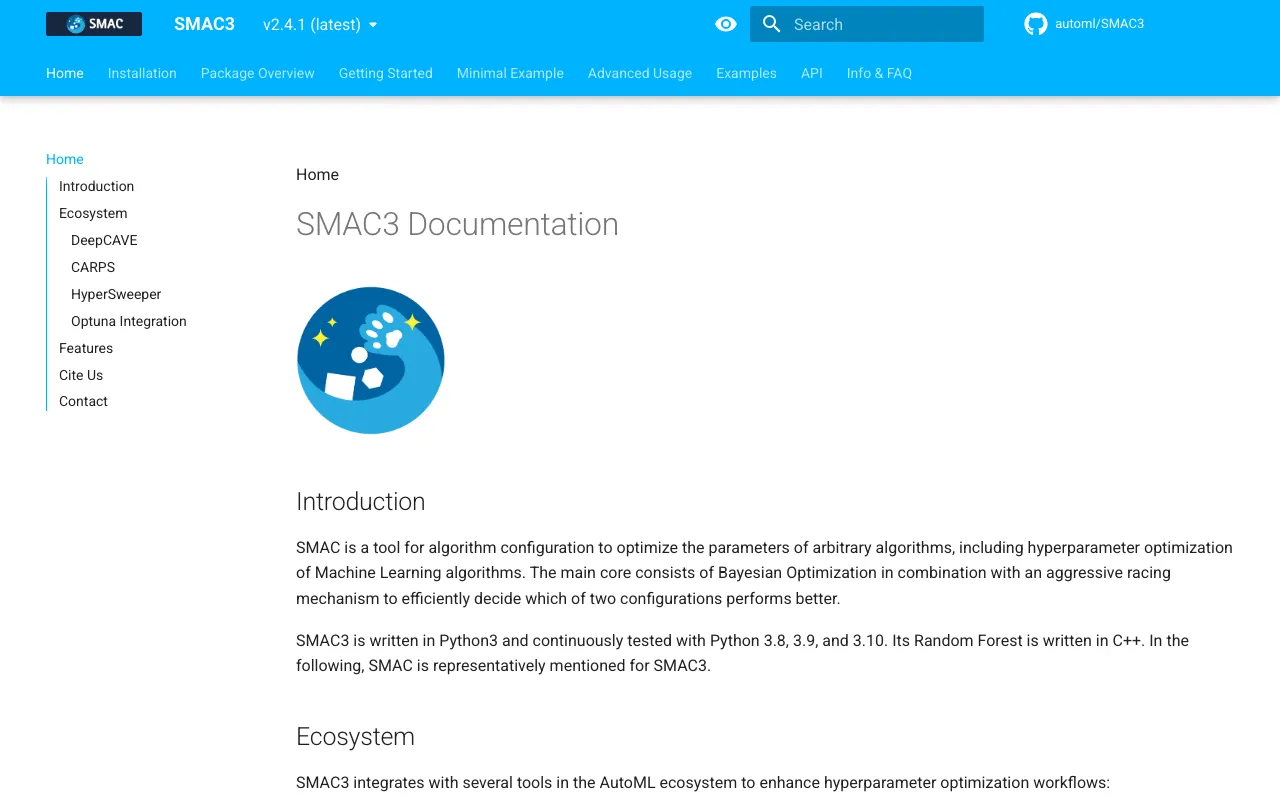
SMAC3 helps find strong hyperparameter settings for machine learning algorithms using Bayesian optimization and configuration racing. It is a Python package with optional cluster parallelization.
SMAC3 is a tool for algorithm configuration and hyperparameter optimization of machine learning models. Its core pairs Bayesian optimization with an aggressive racing mechanism to compare candidate configurations efficiently.
The package supports rich search spaces with floats, ordinals, categoricals, and conditional parameters. It offers multi-objective, multi-fidelity, and multi-threaded optimization, along with ask-and-tell interfaces and the ability to resume runs. User priors, callbacks, and optimization across many related tasks are supported.
Targets can be defined as Python callables or invoked via external scripts. Parallel evaluation is available locally and on clusters through Dask. SMAC3 integrates with the AutoML ecosystem, including visualization through DeepCAVE, benchmarking via CARPS, distributed evaluation with HyperSweeper, and use as a sampler within Optuna.
The project is developed by AutoML groups and maintains active development. Random forest surrogate components use sklearn by default, with optional legacy random forest backends available for specialized setups.
End-to-end machine learning platform and tooling ecosystem
TensorFlow is a machine learning platform with Python and C++ APIs, optional GPU packages, and companion libraries for data, training, deployment, and visualization.

Run open AI models locally or in the cloud
Ollama runs open language models such as Gemma, Qwen, DeepSeek and gpt-oss on macOS, Windows and Linux, locally or in the cloud. It offers a CLI, a REST API, and Python and JavaScript libraries.

Shared model definitions for multimodal ML workloads
Transformers is a Python library that defines pretrained text, vision, audio, and multimodal models once in PyTorch for shared inference and training across the ecosystem.

LLM inference engine in C/C++ for local and cloud hardware
llama.cpp runs large language models and multimodal models locally or in the cloud with minimal setup. It includes a CLI, an OpenAI-compatible server with a built-in chat app, and a C library API.

General-purpose speech recognition and translation model
Whisper is a speech recognition model trained on diverse audio. It supports multilingual transcription, speech-to-English translation, and language identification via Python or the command line.

High-throughput, memory-efficient inference and serving engine for LLMs
vLLM is a library and server for running and serving large language models. It uses PagedAttention and continuous batching for throughput, offers an OpenAI-compatible API, and runs on many GPU, CPU and accelerator types.