
TensorFlow
End-to-end machine learning platform and tooling ecosystem
TensorFlow is a machine learning platform with Python and C++ APIs, optional GPU packages, and companion libraries for data, training, deployment, and visualization.

Shapley-value explanations for machine learning predictions
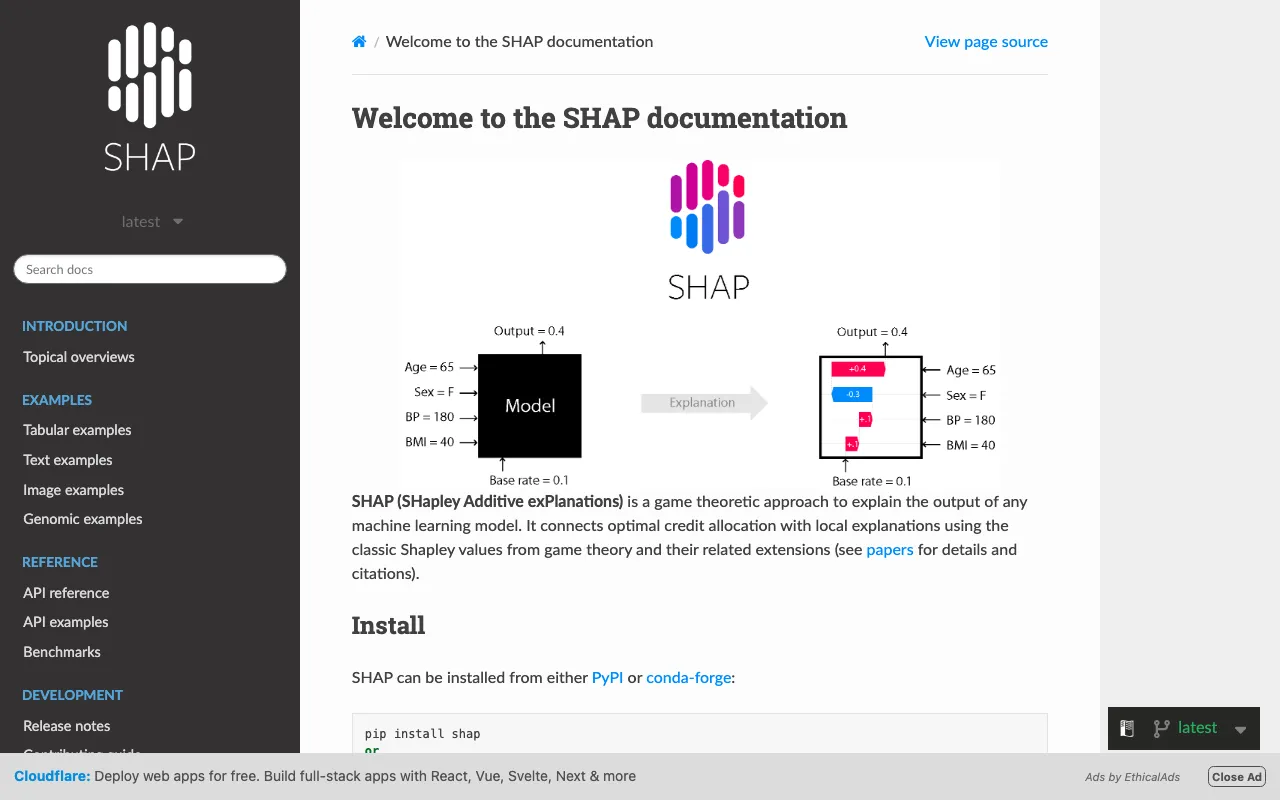
SHAP assigns per-feature contributions that explain individual model outputs using Shapley additive explanations. Python explainers cover trees, deep nets, linear models, and arbitrary black-box functions.
SHAP is a Python package that explains what drives each prediction from a trained model by allocating credit across input features. It frames explanations as Shapley values from cooperative game theory, linking global importance with local, per-sample attributions.
Specialized explainers speed up exact tree ensemble cases for XGBoost, LightGBM, CatBoost, scikit-learn, and PySpark models. DeepExplainer and GradientExplainer target TensorFlow and Keras networks, with preliminary PyTorch support, while LinearExplainer yields closed-form attributions for independent linear models.
KernelExplainer provides a model-agnostic route for any callable predictor, and extensions cover NLP transformers, interaction values for pairwise feature effects, and visualization helpers such as force, dependence, decision, and summary plots. Optional GPU acceleration for tree SHAP arrives through a companion cuda extra package.
Installation is available from PyPI or conda-forge, and documentation walks through tabular, text, image, and genomics examples alongside API references for explainers, plots, and masking utilities.
End-to-end machine learning platform and tooling ecosystem
TensorFlow is a machine learning platform with Python and C++ APIs, optional GPU packages, and companion libraries for data, training, deployment, and visualization.

Run open AI models locally or in the cloud
Ollama runs open language models such as Gemma, Qwen, DeepSeek and gpt-oss on macOS, Windows and Linux, locally or in the cloud. It offers a CLI, a REST API, and Python and JavaScript libraries.

Shared model definitions for multimodal ML workloads
Transformers is a Python library that defines pretrained text, vision, audio, and multimodal models once in PyTorch for shared inference and training across the ecosystem.

LLM inference engine in C/C++ for local and cloud hardware
llama.cpp runs large language models and multimodal models locally or in the cloud with minimal setup. It includes a CLI, an OpenAI-compatible server with a built-in chat app, and a C library API.

General-purpose speech recognition and translation model
Whisper is a speech recognition model trained on diverse audio. It supports multilingual transcription, speech-to-English translation, and language identification via Python or the command line.

High-throughput, memory-efficient inference and serving engine for LLMs
vLLM is a library and server for running and serving large language models. It uses PagedAttention and continuous batching for throughput, offers an OpenAI-compatible API, and runs on many GPU, CPU and accelerator types.