Servo
Rust embeddable web rendering engine with WebGPU
Servo is a parallel browser engine written in Rust for desktop, mobile, and embedded apps. It exposes a WebView API so other programs can embed web content.

Graphical Unix-like desktop operating system
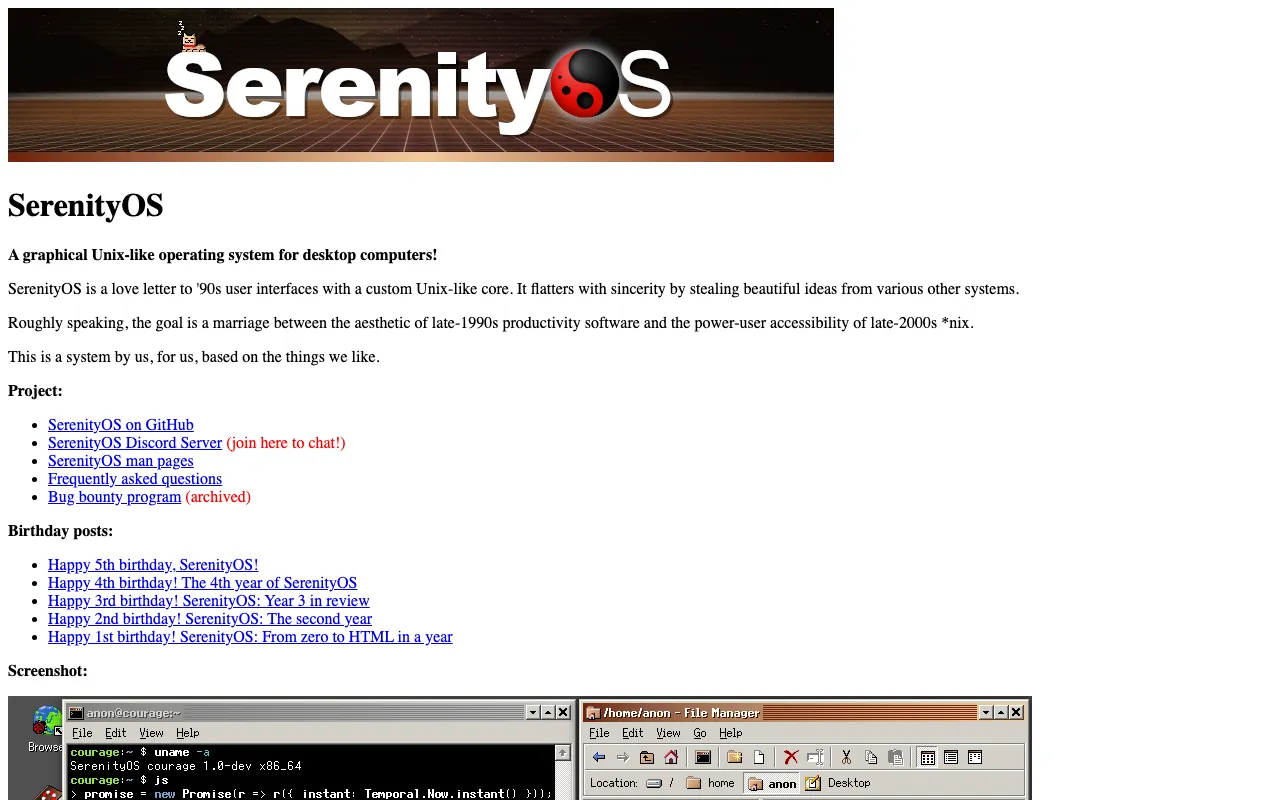
SerenityOS is a 64-bit graphical Unix-like system for x86, Arm, and RISC-V with a custom kernel, POSIX-oriented userspace, and a late-1990s-inspired desktop.
SerenityOS is a complete graphical operating system built around a custom Unix-like core. It targets 64-bit x86, Arm, and RISC-V hardware and combines a retro productivity aesthetic with modern security and multitasking features.
The kernel supports preemptive multithreading plus defenses such as W^X memory, pledge and unveil, KASLR, and TLS-focused networking. Userspace includes a window server, audio and web services, IPC between components, and broad POSIX compatibility with a LibC, shell, signals, pseudoterminals, and standard Unix-style utilities.
Daily software ships in-tree: a terminal, text editor, spreadsheet with JavaScript, mail client, calculator, multimedia viewers, games, and development tools including a C++ IDE and hex editor. The network stack handles IPv4 TCP and UDP with DNS, HTTP, Gemini, IMAP, and NTP, and hundreds of third-party programs have been ported.
Documentation is available through online manual pages and in-repo guides. Developers typically cross-build from Linux, macOS, or Windows with WSL2 and boot the system in QEMU; the companion Ladybird browser also runs on those host platforms and on Serenity itself.
Rust embeddable web rendering engine with WebGPU
Servo is a parallel browser engine written in Rust for desktop, mobile, and embedded apps. It exposes a WebView API so other programs can embed web content.

Browser extension SDK with React-oriented tooling
Plasmo Framework is an SDK for building browser extensions with declarative files, live reload, and multi-browser targeting.

Cross-browser Manifest V3 extension development framework and CLI
Extension.js is a CLI framework for building Chrome, Edge, Firefox, and Safari extensions from one codebase. It provides hot reload, manifest filtering, and store-ready packaging without hand-rolled bundler configs.

Chromium embedding components for Delphi and Lazarus
CEF4Delphi embeds Chromium-based browsers in Delphi or Lazarus and Free Pascal applications on Windows, Linux, and macOS. It supplies VCL, FireMonkey, and Lazarus components built on Chromium Embedded Framework binaries.

Open-source agent engineering toolkit for coding harnesses
ECC adds planning, verification, review, memory, skills, and security scanning to coding agents such as Claude Code, Codex, and Cursor. It installs as plugins, packages, and managed adapters across multiple harnesses.

JavaScript library for web and native user interfaces
React helps developers build interfaces from reusable components that manage their own state. Views update declaratively when underlying data changes.