
TensorFlow
End-to-end machine learning platform and tooling ecosystem
TensorFlow is a machine learning platform with Python and C++ APIs, optional GPU packages, and companion libraries for data, training, deployment, and visualization.

Python embeddings, reranking, and sparse retrieval toolkit
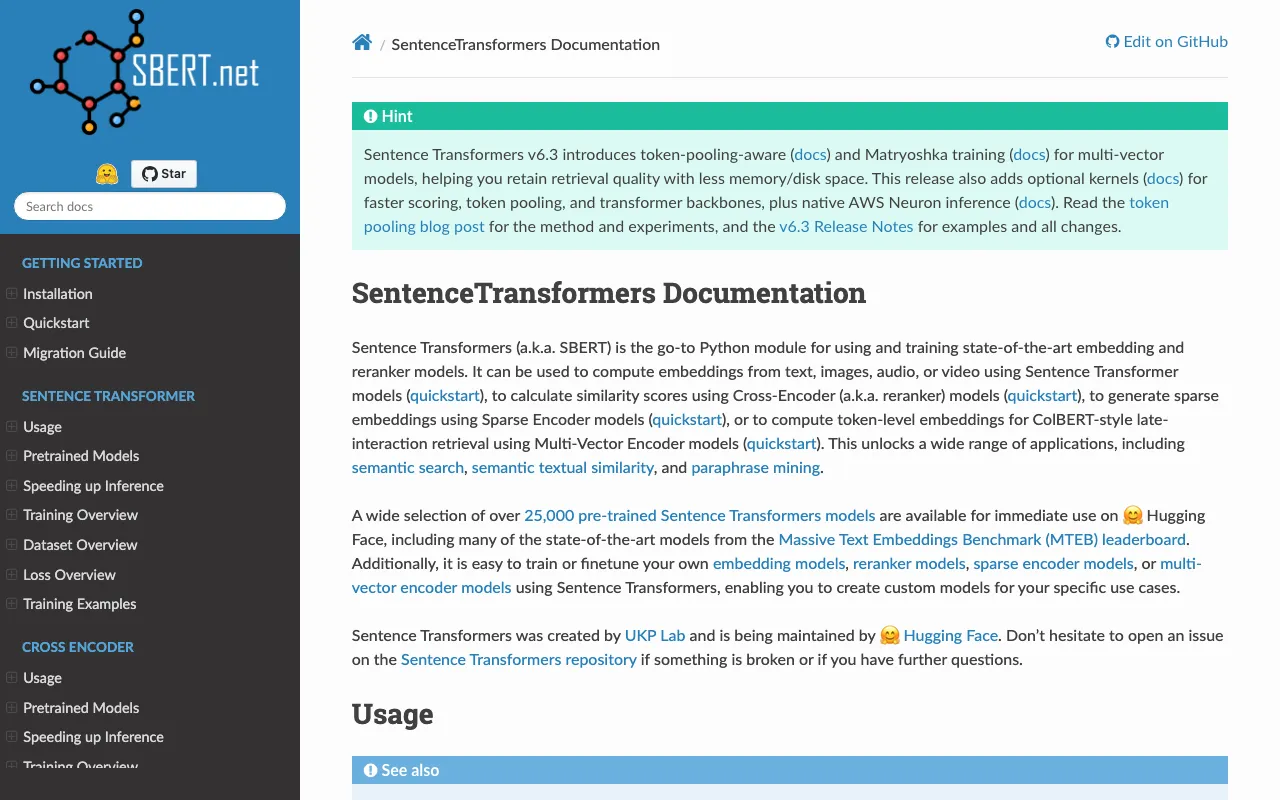
Sentence Transformers computes dense, sparse, and multi-vector embeddings plus cross-encoder scores for text and multimodal inputs. Thousands of pretrained models are available from Hugging Face.
Sentence Transformers is a Python framework for working with embedding and reranking models. It wraps transformer backbones so you can encode sentences, images, audio, or video, compare similarity, rank passages, or build hybrid retrieval stacks including ColBERT-style late interaction.
You load a pretrained model, call encode on texts or documents, and receive NumPy tensors for similarity search, clustering, paraphrase mining, and related tasks. CrossEncoder models score query–passage pairs or rank lists; SparseEncoder models produce high-dimensional sparse vectors; MultiVectorEncoder models support token-level retrieval patterns.
The project integrates with the Hugging Face Hub for model download and supports fine-tuning embedding, reranker, sparse, and multi-vector models with multiple loss functions and evaluation during training. Documentation covers installation via pip, optional extras for ONNX or training, and application examples from semantic search to multilingual image search.
It originated from research on sentence embeddings and is maintained by Hugging Face, with a large catalog of community and leaderboard models for immediate experimentation without training from scratch.
End-to-end machine learning platform and tooling ecosystem
TensorFlow is a machine learning platform with Python and C++ APIs, optional GPU packages, and companion libraries for data, training, deployment, and visualization.

Run open AI models locally or in the cloud
Ollama runs open language models such as Gemma, Qwen, DeepSeek and gpt-oss on macOS, Windows and Linux, locally or in the cloud. It offers a CLI, a REST API, and Python and JavaScript libraries.

Shared model definitions for multimodal ML workloads
Transformers is a Python library that defines pretrained text, vision, audio, and multimodal models once in PyTorch for shared inference and training across the ecosystem.

LLM inference engine in C/C++ for local and cloud hardware
llama.cpp runs large language models and multimodal models locally or in the cloud with minimal setup. It includes a CLI, an OpenAI-compatible server with a built-in chat app, and a C library API.

General-purpose speech recognition and translation model
Whisper is a speech recognition model trained on diverse audio. It supports multilingual transcription, speech-to-English translation, and language identification via Python or the command line.

High-throughput, memory-efficient inference and serving engine for LLMs
vLLM is a library and server for running and serving large language models. It uses PagedAttention and continuous batching for throughput, offers an OpenAI-compatible API, and runs on many GPU, CPU and accelerator types.