
TensorFlow
End-to-end machine learning platform and tooling ecosystem
TensorFlow is a machine learning platform with Python and C++ APIs, optional GPU packages, and companion libraries for data, training, deployment, and visualization.
Python toolkit for classical machine learning
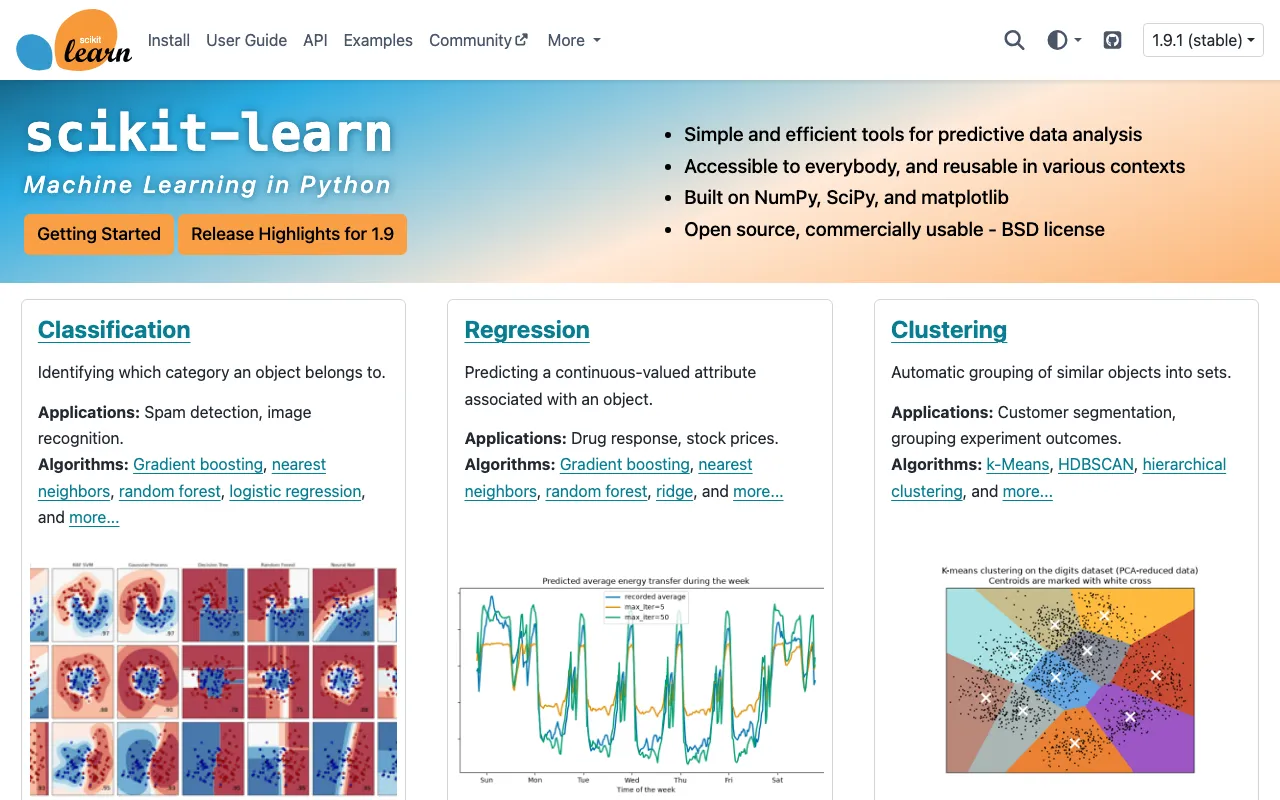
scikit-learn provides algorithms and utilities for classification, regression, clustering, and model selection in Python. It builds on NumPy and SciPy.
scikit-learn is a Python module focused on practical machine learning workflows. It bundles estimators for supervised tasks such as classification and regression, unsupervised clustering, and dimensionality reduction, plus tools to preprocess data, extract features, tune hyperparameters, and score models.
The design emphasizes consistent APIs: fit, predict, and transform patterns work across algorithms, and pipelines compose preprocessing with estimators. Plotting helpers that render learning curves and decision boundaries require Matplotlib; many examples also use pandas, seaborn, or scikit-image where noted in the docs.
Install via pip or conda after NumPy and SciPy are available. Documentation includes user guides, API reference, and examples for spam detection, customer segmentation, visualization, and other applied scenarios cited on the project site.
End-to-end machine learning platform and tooling ecosystem
TensorFlow is a machine learning platform with Python and C++ APIs, optional GPU packages, and companion libraries for data, training, deployment, and visualization.

Run open AI models locally or in the cloud
Ollama runs open language models such as Gemma, Qwen, DeepSeek and gpt-oss on macOS, Windows and Linux, locally or in the cloud. It offers a CLI, a REST API, and Python and JavaScript libraries.

Shared model definitions for multimodal ML workloads
Transformers is a Python library that defines pretrained text, vision, audio, and multimodal models once in PyTorch for shared inference and training across the ecosystem.

LLM inference engine in C/C++ for local and cloud hardware
llama.cpp runs large language models and multimodal models locally or in the cloud with minimal setup. It includes a CLI, an OpenAI-compatible server with a built-in chat app, and a C library API.

General-purpose speech recognition and translation model
Whisper is a speech recognition model trained on diverse audio. It supports multilingual transcription, speech-to-English translation, and language identification via Python or the command line.

High-throughput, memory-efficient inference and serving engine for LLMs
vLLM is a library and server for running and serving large language models. It uses PagedAttention and continuous batching for throughput, offers an OpenAI-compatible API, and runs on many GPU, CPU and accelerator types.