
TensorFlow
End-to-end machine learning platform and tooling ecosystem
TensorFlow is a machine learning platform with Python and C++ APIs, optional GPU packages, and companion libraries for data, training, deployment, and visualization.

Safe zero-copy tensor serialization format
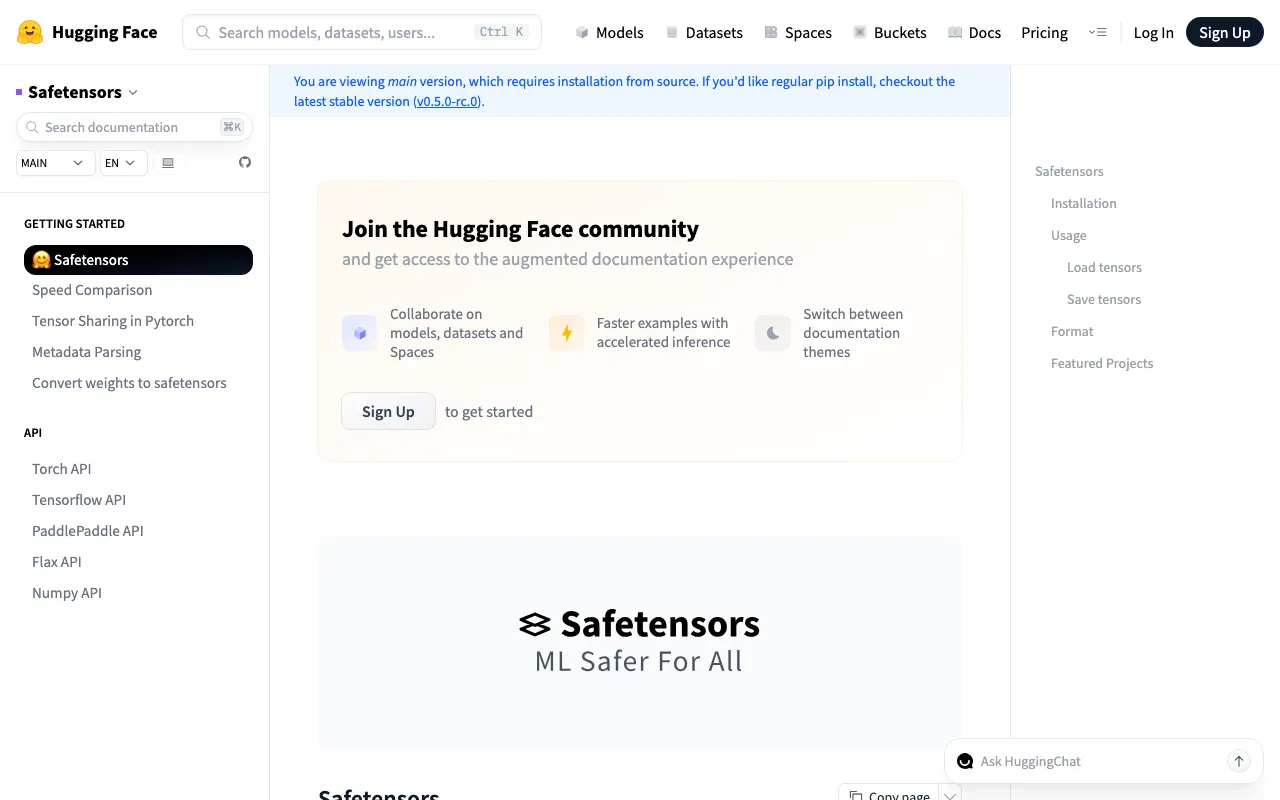
Safetensors stores ML weights in a pickle-free binary layout with JSON metadata and mmap-friendly tensor blobs. Python and Rust libraries read and write the format.
Safetensors defines a file format and libraries for saving and loading numeric tensors without Python pickle, while keeping tensor data accessible with minimal extra copies. A small header records dtype, shape, and byte offsets; payload bytes follow in one buffer with little-endian layout.
The design emphasizes safety when loading untrusted files, lazy loading of individual tensors in large checkpoints, layout control for distributed training, support for large files, and native bfloat16 and fp8 dtypes. Header size is capped to reduce JSON parsing abuse, and offsets are validated so mapped memory stays within file bounds.
Documentation contrasts the format with pickle, HDF5, MsgPack, Protobuf, NumPy npz, and other stacks on dimensions like zero-copy, lazy loading, and layout. PyTorch integrations can load via untyped storage from file; partial GPU loading is supported in multi-device setups.
Python packages install through pip or conda; Rust sources are available for native consumers. The format is adopted across Hugging Face ecosystems and numerous open ML tools for model weight distribution.
End-to-end machine learning platform and tooling ecosystem
TensorFlow is a machine learning platform with Python and C++ APIs, optional GPU packages, and companion libraries for data, training, deployment, and visualization.

Run open AI models locally or in the cloud
Ollama runs open language models such as Gemma, Qwen, DeepSeek and gpt-oss on macOS, Windows and Linux, locally or in the cloud. It offers a CLI, a REST API, and Python and JavaScript libraries.

Shared model definitions for multimodal ML workloads
Transformers is a Python library that defines pretrained text, vision, audio, and multimodal models once in PyTorch for shared inference and training across the ecosystem.

LLM inference engine in C/C++ for local and cloud hardware
llama.cpp runs large language models and multimodal models locally or in the cloud with minimal setup. It includes a CLI, an OpenAI-compatible server with a built-in chat app, and a C library API.

General-purpose speech recognition and translation model
Whisper is a speech recognition model trained on diverse audio. It supports multilingual transcription, speech-to-English translation, and language identification via Python or the command line.

High-throughput, memory-efficient inference and serving engine for LLMs
vLLM is a library and server for running and serving large language models. It uses PagedAttention and continuous batching for throughput, offers an OpenAI-compatible API, and runs on many GPU, CPU and accelerator types.