
Scrcpy
Android screen mirror and control from desktop
scrcpy shows Android device video and audio over USB or TCP/IP and forwards keyboard and mouse input. It needs no root or on-device app and runs on Linux, Windows, and macOS.

Open-source remote desktop with optional self-hosted servers
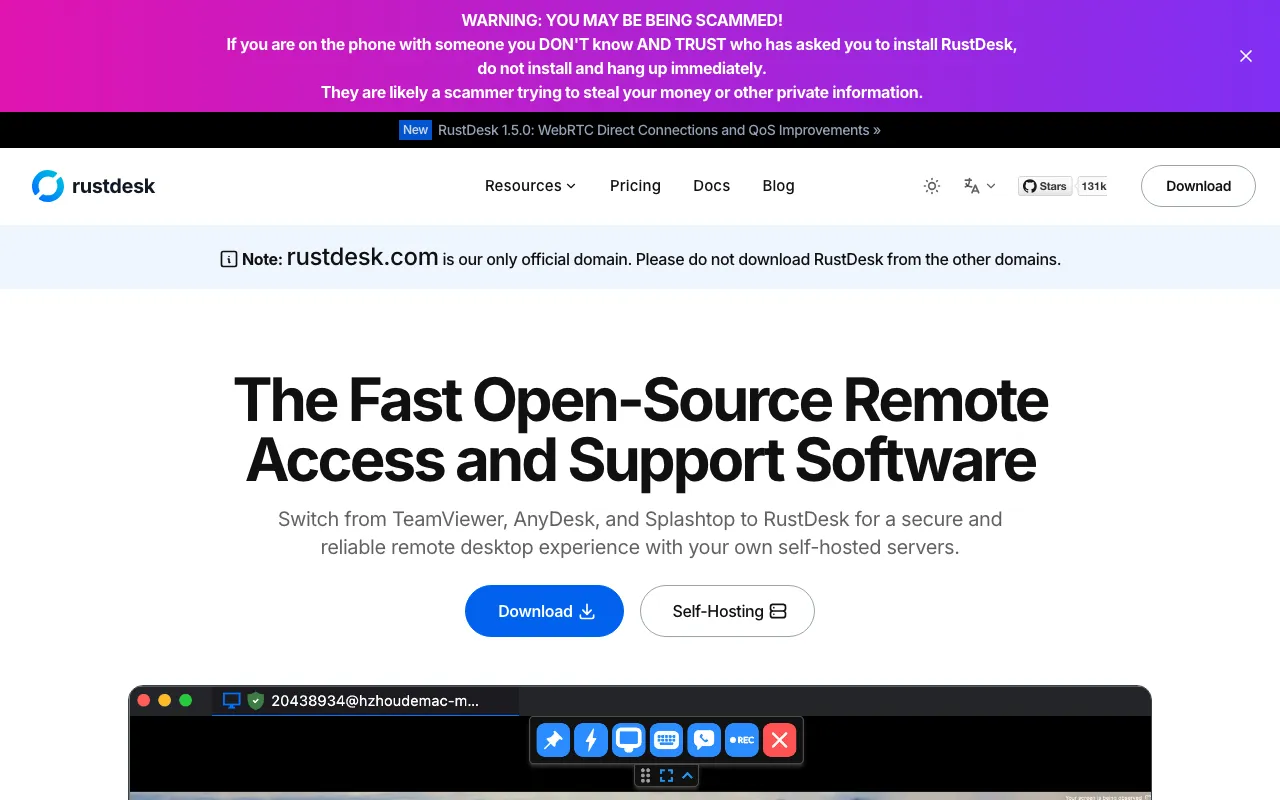
RustDesk is remote desktop software for Windows, macOS, Linux, and Android that can connect through project relay servers or infrastructure you run yourself.
RustDesk is an open-source remote desktop application written in Rust, aimed at remote access and support scenarios without mandatory third-party SaaS relay services. Client builds use Flutter for desktop and mobile interfaces, and it can work out of the box while giving you control over where connection data flows.
You may rely on the project’s rendezvous and relay servers, deploy your own, or implement custom rendezvous and relay software. On-premise deployment is supported with Docker-based installation steps, compose files, and configuration options for hosting a web client on your own domain.
Beyond basic screen sharing, the codebase organizes audio, clipboard, input, and video services, plus file transfer and cross-platform clipboard support. Desktop GUI work is centered on Flutter, with older Sciter-based UI deprecated.
The product is positioned against commercial remote desktop tools and emphasizes self-hosted servers, brandable custom clients, and multi-platform clients. Official downloads are tied to the rustdesk.com domain.
“RustDesk is open-source remote desktop software for your own self-hosted server, a TeamViewer and AnyDesk alternative for Windows, macOS, Linux and Android.” source
“Is RustDesk a self-hosted alternative to ScreenConnect? Yes.” source
“Switch from TeamViewer, AnyDesk, and Splashtop to RustDesk for a secure and reliable remote desktop experience with your own self-hosted servers.” source
 TeamViewer
“An open-source remote desktop application designed for self-hosting, as an alternative to TeamViewer.” source
Android screen mirror and control from desktop
scrcpy shows Android device video and audio over USB or TCP/IP and forwards keyboard and mouse input. It needs no root or on-device app and runs on Linux, Windows, and macOS.
Self-deployed reverse proxy for NAT and firewall bypass
frp pairs a public-facing frps server with frpc clients to expose TCP, UDP, HTTP, and HTTPS services behind NAT or firewalls, including P2P connect mode.

Self-hosted Moonlight game streaming host with hardware encoding
Sunshine runs on your machine as a self-hosted streaming host for Moonlight clients, capturing the desktop and encoding video with GPU or software paths.

WireGuard-based mesh VPN with identity-aware device connectivity
Tailscale builds private WireGuard networks so your devices can reach each other securely. It targets easier setup than traditional VPNs for individuals, teams, and infrastructure access.

QEMU-based virtual machines for Mac, iPhone, and iPad
UTM emulates and virtualizes guest operating systems on Apple devices, including Windows and Linux on Mac, with a separate slower edition for iOS without jailbreak.

Computer-use sandboxes, driver, and shared desktops
Cua combines Spaces desktops, a cross-platform automation driver, Lume VMs, and SDK sandboxes for agent computer-use. Hardware you own hosts virtual machines and containers agents can operate.