qmetrics.net

Cua

Computer-use sandboxes, driver, and shared desktops

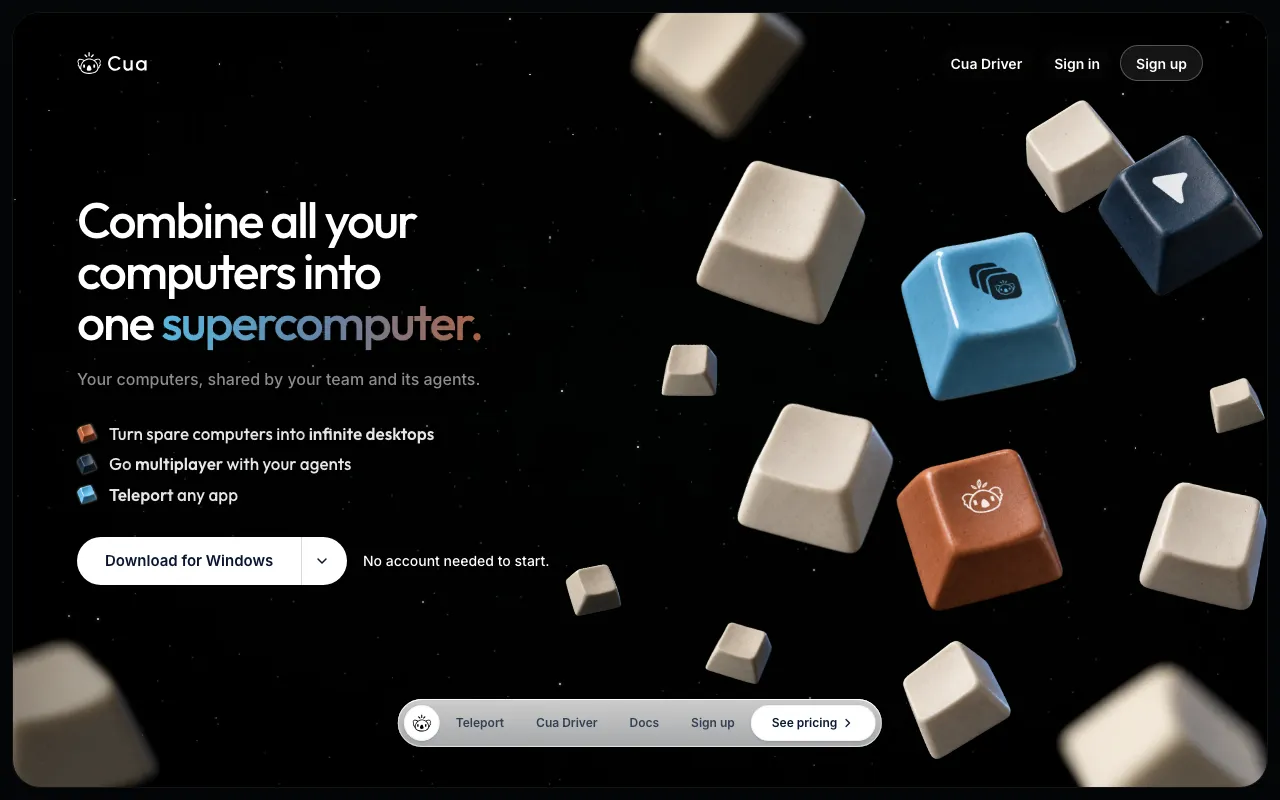
Cua screenshot

Cua combines Spaces desktops, a cross-platform automation driver, Lume VMs, and SDK sandboxes for agent computer-use. Hardware you own hosts virtual machines and containers agents can operate.

Overview

Cua is a family of tools for computer-use agents: Cua Spaces desktop app, Cua Driver for native app control, Lume for Apple Silicon VMs, a multi-language sandbox SDK, specialized CUA-S1 decision models, and Cua Bench evaluation tasks. Together they let agents move between code, APIs, and graphical interfaces within one workflow.

Cua Spaces runs macOS, Linux, or Omarchy images on Macs you connect, with teleport moving signed-in app sessions into isolated desktops and multiplayer cursors for people and agents. Cua Driver exposes inspection and input tools via CLI, MCP, and typed SDKs on macOS, Windows, and Linux with optional background delivery.

The cua command and Python, TypeScript, and Rust SDKs manage local VMs, containers, and remote hosts running the spaces daemon. Lume creates macOS or Linux guests through Apple’s Virtualization framework. Benchmarks and training exports live in Cua Bench without requiring live VMs for basic tasks.

Licensing splits MIT components (driver, Lume, SDK) from source-available Spaces under FSL-1.1-MIT. Paid tiers add relay hours and team controls while compute stays on customer-owned machines or cloud accounts.

Key features

  • Shared agent desktop Spaces
  • Cross-OS Cua Driver automation
  • Apple Silicon VM management
  • Python and TypeScript sandboxes
  • Teleport signed-in app sessions
  • MCP agent integrations
  • Computer-use benchmark suite
  • Specialized form decision models

Use cases

  • Remote desktops for coding agents
  • Safe GUI automation testing
  • Training computer-use policies
  • Team-shared agent workstations
  • Local VM labs on Apple Silicon

Tags

Similar software

DeepSeek Harness

Open-source plugin-based agent harness from DeepSeek

DeepSeek Harness is an open-source agent harness built on an everything-is-a-plugin architecture powered by Cordis. It offers a web UI, desktop app, and extensible plugins for daily work, coding, and automation.

★ 288k⟳ 6 days agoMIT

Hermes Agent

Self-improving open-source AI agent with memory, skills and messaging gateway

Open-source AI agent from Nous Research that keeps persistent memory, creates skills from experience, and runs from a terminal, desktop app or messaging platforms with any model provider.

★ 266.6k⟳ todayMIT
Open Source Alternative to:Anthropic ClaudeChatGPT+5

Firecrawl

Web scrape crawl and search infrastructure for AI agents

Firecrawl turns websites into LLM-ready markdown and structured data via API, CLI, and MCP. It supports scrape, crawl, map, batch jobs, optional cloud scale, and self-hosted server deployment.

★ 211.5k⟳ todayAGPL-3.0
Open Source Alternative to:TavilyZyte

TensorFlow

End-to-end machine learning platform and tooling ecosystem

TensorFlow is a machine learning platform with Python and C++ APIs, optional GPU packages, and companion libraries for data, training, deployment, and visualization.

★ 201.8k⟳ todayApache-2.0

MarkItDown

Python utility converting office and media files to Markdown

MarkItDown converts many file types into Markdown for LLM and text analysis pipelines. It aims to preserve headings, lists, tables, and links rather than perfect human layout.

★ 198.7k⟳ 21 days agoMIT

Transformers

Shared model definitions for multimodal ML workloads

Transformers is a Python library that defines pretrained text, vision, audio, and multimodal models once in PyTorch for shared inference and training across the ecosystem.

★ 169.4k⟳ todayApache-2.0