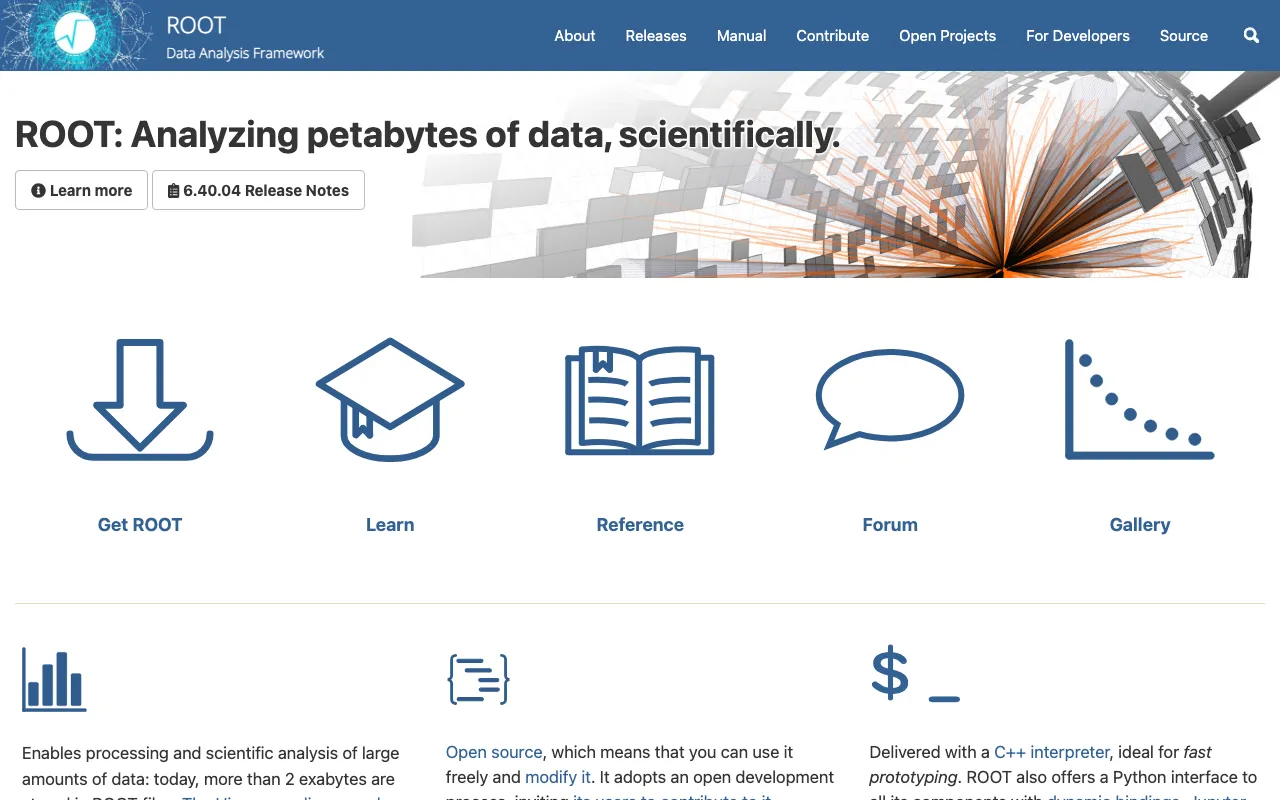
ROOT is a C++ toolkit for acquiring, storing, processing, and plotting scientific data. It pairs columnar file I/O with histogramming, fitting, statistics, and Python bindings.
Overview
ROOT is a unified software package for the scientific data lifecycle from acquisition through analysis to publication-style plots. It provides an efficient columnar storage system for data models, used at large-scale physics experiments where vast datasets are written in ROOT file format.
Analysis features include multi-dimensional histogramming, curve fitting, statistical modeling, and minimization so workflows can query and process data interactively or in batch. RDataFrame offers a parallel processing layer aimed at multi-core and distributed runs.
The core is performance-oriented C++ code with Cling, a C++-compliant interpreter, for rapid prototyping. Dynamic Python bindings via cppyy give on-demand C++ and Python interoperability in a shared execution environment. Jupyter notebook use is supported on the project site.
ROOT is open source and community-developed. Installers and getting-started material are published for new users; training events and documentation cover modern analysis patterns with the framework.
Key features
- Columnar ROOT file storage
- Multi-dimensional histogramming
- Fitting and statistical modeling
- RDataFrame parallel analysis
- Cling C++ interpreter
- Python bindings via cppyy
- Jupyter notebook support
- Publication-oriented plotting
Use cases
- High-energy physics data analysis
- Large-scale scientific dataset processing
- Interactive prototyping in C++ or Python
- Batch analysis on clusters
- Custom analysis macros and notebooks


 Miro