Robot Framework is a generic open-source automation framework for acceptance testing, acceptance test driven development, and robotic process automation. It uses plain-text syntax and extensible libraries.
Overview
Robot Framework is a generic open-source automation framework aimed at acceptance testing, acceptance test driven development (ATDD), and robotic process automation (RPA). Tests and tasks are written in a simple plain-text syntax and can be extended with generic and custom libraries.
The framework is meant to be operating system and application independent. It is implemented in Python, which is also the primary language used to extend it. A broad ecosystem of separate libraries and tools surrounds the core project.
You run tests or tasks from the command line with the robot command or via python -m robot, passing paths to files or directories and optional flags. The rebot utility combines and post-processes result outputs. Documentation includes a user guide, standard libraries, and API reference material.
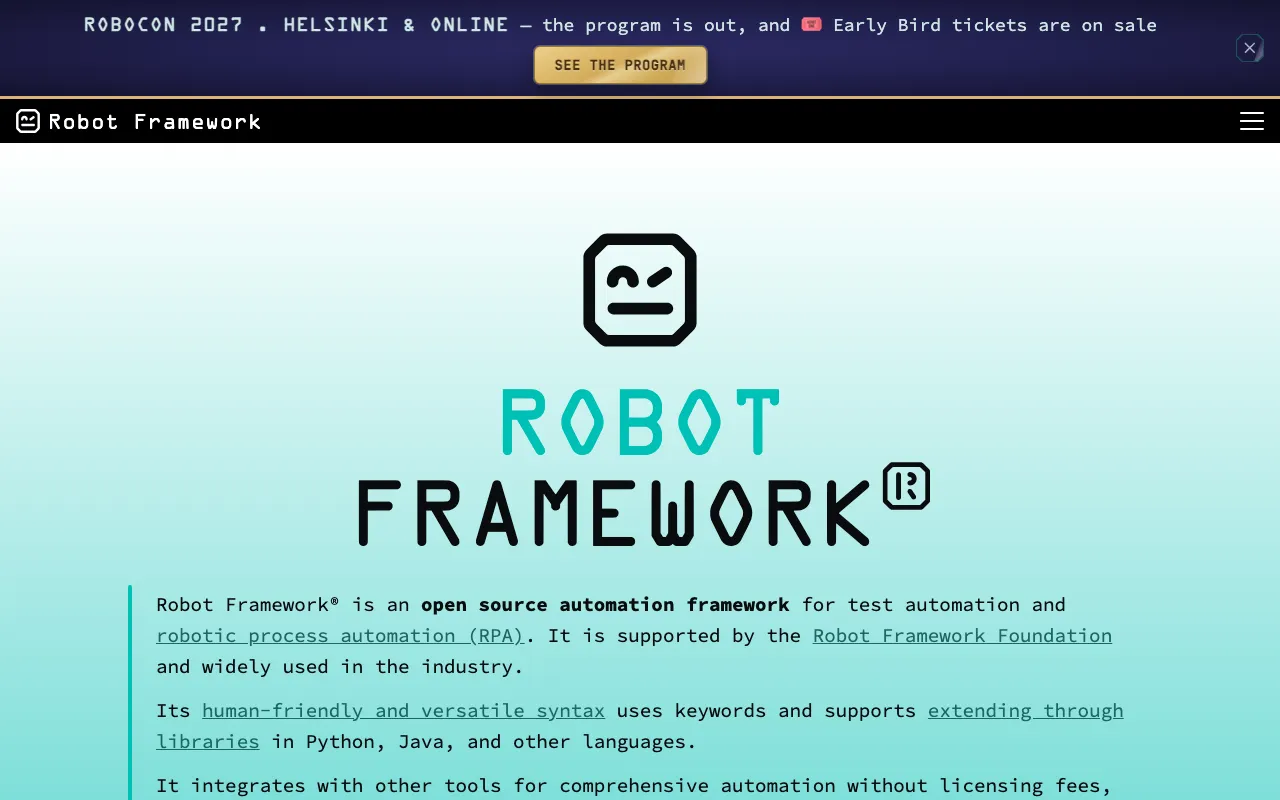
Installation is typically through pip once Python is available. The project is sponsored by the non-profit Robot Framework Foundation. On the public site, the foundation describes human-friendly keyword syntax and library extensions in Python, Java, and other languages, with community events and third-party libraries.
Key features
- Plain-text keyword syntax
- Python-based extensibility
- Command-line test execution
- rebot result post-processing
- Standard and custom libraries
- ATDD and RPA workflows
- GitHub Action integration
- Operating-system-independent design
Use cases
- Acceptance test automation
- Robotic process automation
- ATDD workflows
- CI-driven test runs
- Login and UI workflow tests



 ChatGPT