
TensorFlow
End-to-end machine learning platform and tooling ecosystem
TensorFlow is a machine learning platform with Python and C++ APIs, optional GPU packages, and companion libraries for data, training, deployment, and visualization.

Recommendation system examples and Python building blocks
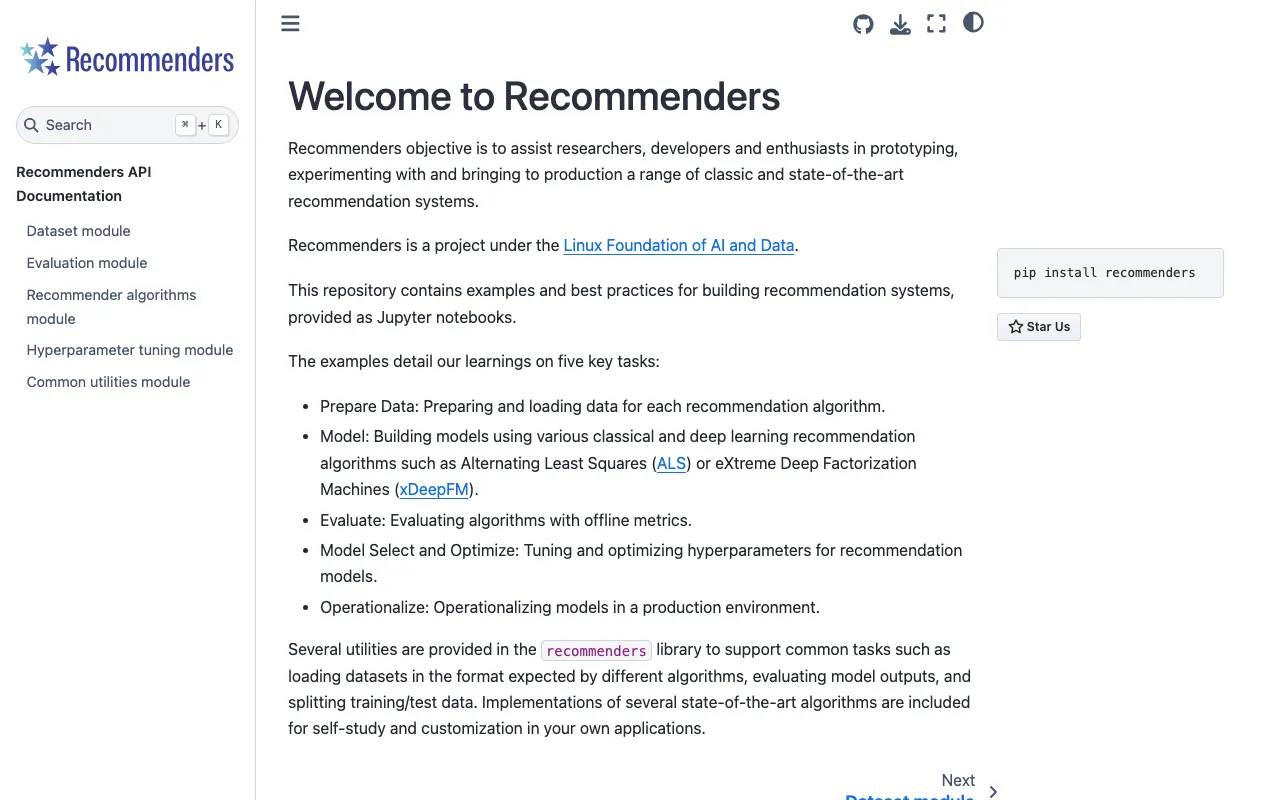
Helps researchers and developers prototype, experiment with, and ship classic and newer recommendation models. Installable Python package with Jupyter examples and utilities.
Recommenders supports end-to-end work on recommendation systems, from data preparation through evaluation, tuning, and operationalization. It is maintained as a project under the Linux Foundation of AI and Data.
Jupyter notebooks document practices across prepare data, model building, offline evaluation, hyperparameter optimization, and production deployment. The Python recommenders package supplies helpers for loading datasets in algorithm-specific formats, evaluating outputs, and splitting train and test data.
The included algorithm catalog spans collaborative filtering, content-based filtering, sequential models, and related approaches. Many entries ship quick-start and deep-dive notebooks, with optional GPU, Spark, and experimental extra packages for heavier setups.
Operationalization guidance covers running models in production environments, including cloud-oriented workflows noted in the materials. Scenario write-ups illustrate where similar systems have been applied in practice.
End-to-end machine learning platform and tooling ecosystem
TensorFlow is a machine learning platform with Python and C++ APIs, optional GPU packages, and companion libraries for data, training, deployment, and visualization.

Run open AI models locally or in the cloud
Ollama runs open language models such as Gemma, Qwen, DeepSeek and gpt-oss on macOS, Windows and Linux, locally or in the cloud. It offers a CLI, a REST API, and Python and JavaScript libraries.

Shared model definitions for multimodal ML workloads
Transformers is a Python library that defines pretrained text, vision, audio, and multimodal models once in PyTorch for shared inference and training across the ecosystem.

LLM inference engine in C/C++ for local and cloud hardware
llama.cpp runs large language models and multimodal models locally or in the cloud with minimal setup. It includes a CLI, an OpenAI-compatible server with a built-in chat app, and a C library API.

General-purpose speech recognition and translation model
Whisper is a speech recognition model trained on diverse audio. It supports multilingual transcription, speech-to-English translation, and language identification via Python or the command line.

High-throughput, memory-efficient inference and serving engine for LLMs
vLLM is a library and server for running and serving large language models. It uses PagedAttention and continuous batching for throughput, offers an OpenAI-compatible API, and runs on many GPU, CPU and accelerator types.