
Mermaid
Text-defined diagrams from Markdown-like syntax
Mermaid turns plain-text diagram definitions into flowcharts, sequence charts, Gantt charts, and many other diagram types. It renders in browsers, documentation tools, and GitHub Markdown.

Documentation build, version, and hosting platform for developers
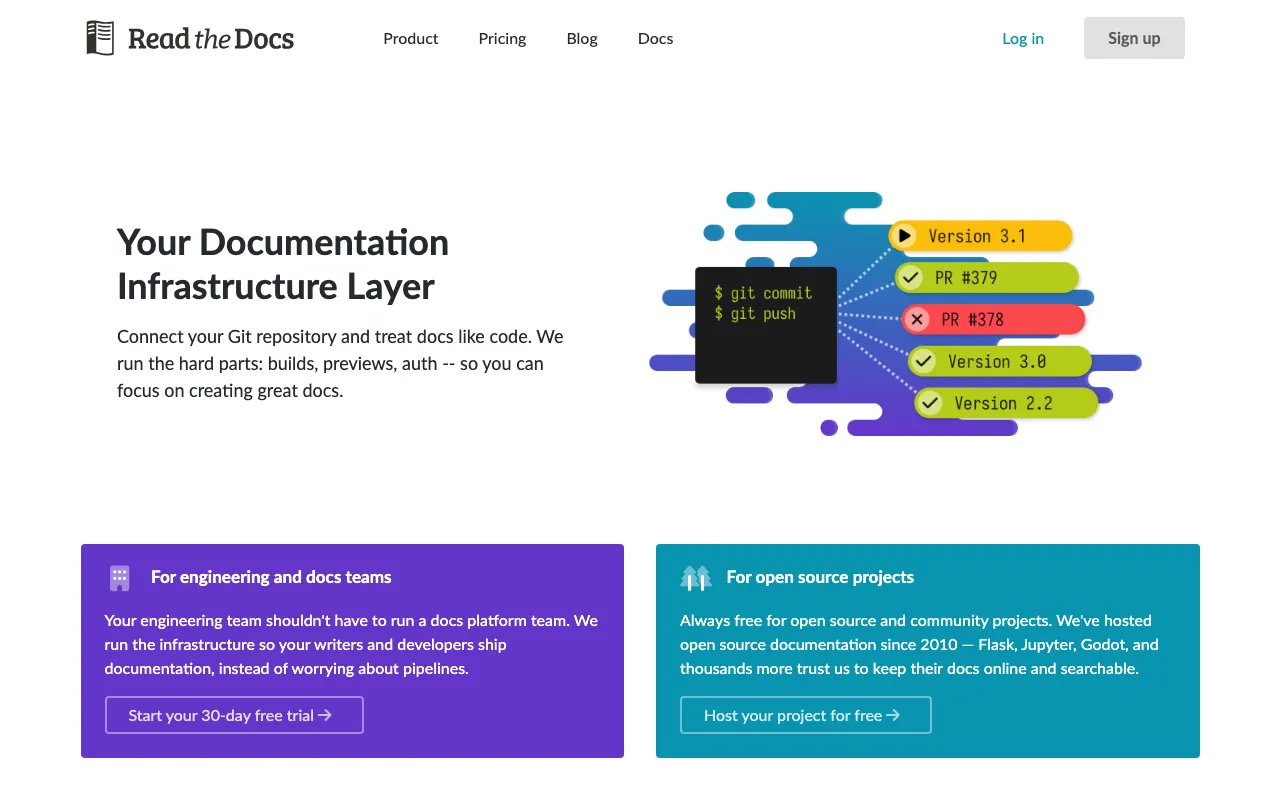
Read the Docs links to Git repositories and automatically builds and hosts documentation for open source and team projects. It supports Sphinx, MkDocs, and related writers under a docs-as-code workflow.
Read the Docs is a documentation building and hosting platform for software projects. It pulls content from connected Git repositories, runs builds with common documentation generators, and publishes the results so readers can browse versioned docs online.
The platform supports multiple documentation tools, including Sphinx, MkDocs, and Docusaurus. Projects configure builds through a YAML file that can pin OS images, Python or Node versions, Sphinx configuration paths, and install steps for doc dependencies. Commits to the linked repository trigger rebuilds so published docs stay aligned with code changes.
Versioned documentation can track branches and tags to mirror release cycles. Pull requests can receive preview builds with visual diffs against the live site so teams review rendered output before merging. Integrated search, access controls, single sign-on with GitHub or GitLab, and support for private repositories help teams manage who sees which docs. Additional options such as llms.txt, Markdown content negotiation, and agent-oriented features aim to make published docs easier for automated tools to consume.
Open source and community projects can use hosted documentation at no charge, while commercial offerings extend features such as private repos and SSO. Typical users include open source maintainers, engineering teams with internal manuals, and developers already using Sphinx or MkDocs within continuous integration workflows.
Text-defined diagrams from Markdown-like syntax
Mermaid turns plain-text diagram definitions into flowcharts, sequence charts, Gantt charts, and many other diagram types. It renders in browsers, documentation tools, and GitHub Markdown.

Local-first workspace merging docs, whiteboards and databases with optional AI
AFFiNE is an open-source, local-first workspace that combines docs, an edgeless whiteboard canvas and databases, with optional AI assistance. It can be self-hosted with Docker and supports real-time collaboration.

Lightweight spec layer for AI-assisted software work
OpenSpec helps teams and coding agents agree on requirements in plain Markdown before code changes. A CLI initializes projects and integrates with many AI tools through skills.

React-based static site generator for documentation
Docusaurus builds documentation sites, blogs, and marketing pages from MDX content. It ships preset layouts and plugins so teams can publish quickly.

Version-aware library documentation feed for coding agents
Pulls current docs and code examples into agent context via MCP tools or a ctx7 CLI skill, reducing stale API answers.

Community-driven simplified command-line help pages
tldr pages collects practical examples for common CLI tools. Official clients let you read those pages instead of full man pages.
 Coda
 Miro