
Context7
Version-aware library documentation feed for coding agents
Pulls current docs and code examples into agent context via MCP tools or a ctx7 CLI skill, reducing stale API answers.

Lightweight spec layer for AI-assisted software work
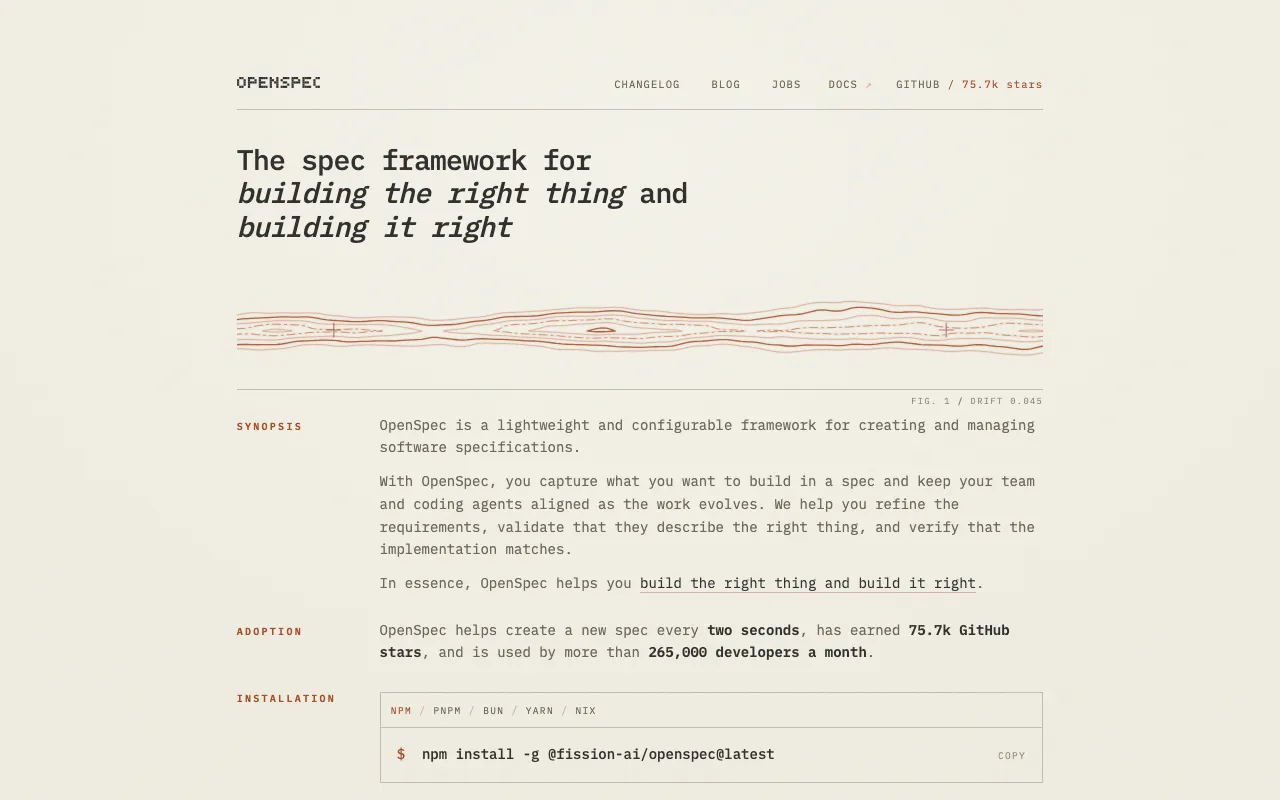
OpenSpec helps teams and coding agents agree on requirements in plain Markdown before code changes. A CLI initializes projects and integrates with many AI tools through skills.
OpenSpec supports spec-driven development for AI coding assistants. It adds a small specification workflow so humans and agents align on what to build before implementation, using requirements and scenarios in normal Markdown rather than a proprietary format.
Each change gets its own folder with proposal, specs, design, and task artifacts. You install the CLI, run init in a project, then invoke skills such as explore or propose from supported assistants. The tool works with a long list of coding agents and package installs via npm, Homebrew, and similar paths on macOS, Linux, and Windows.
Teams can keep specs in the application repo or use beta “stores” as separate git repositories for cross-repo features and shared requirements. Compared to heavier spec kits described in its docs, OpenSpec aims for lighter weight and freer iteration without rigid phase gates.
Telemetry can record anonymous command names and version unless disabled. The project positions itself against doing unscoped AI coding with no written requirements.
Version-aware library documentation feed for coding agents
Pulls current docs and code examples into agent context via MCP tools or a ctx7 CLI skill, reducing stale API answers.
Technical books to on-demand agent skills
Book-to-skill converts PDFs, EPUBs, folders, or remote MCP book reads into structured agent skills with chapters, glossaries, and cheatsheets. Agents load only the sections needed when you ask questions.

AI-generated wikis and docs from repository code
DeepWiki Open turns GitHub, GitLab, or Bitbucket repositories into navigable wikis with diagrams and code maps. Grok-Wiki adds a local desktop workspace for Ask sessions, docs, and CLI agents.

Agent skill for project-native GitHub README design
An agent skill that inspects a project, reorders copy and proof, and designs GitHub-safe README visuals with SVG, optional motion, and readable Markdown.
Agent skills methodology for disciplined coding
Superpowers adds composable skills and bootstrap instructions so coding agents brainstorm specs, plan in small tasks, follow test-driven development, and review work. Plugins install into many agent marketplaces and CLIs.

Open-source agent engineering toolkit for coding harnesses
ECC adds planning, verification, review, memory, skills, and security scanning to coding agents such as Claude Code, Codex, and Cursor. It installs as plugins, packages, and managed adapters across multiple harnesses.