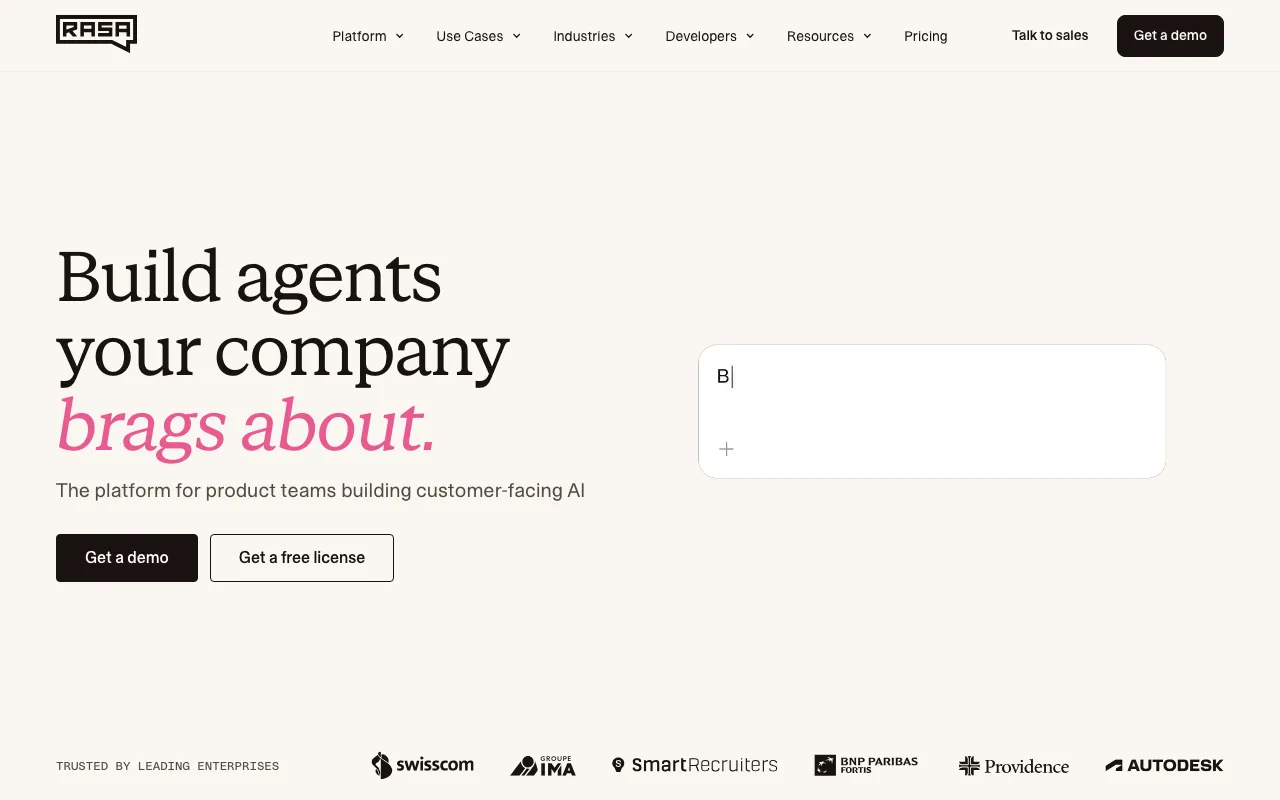
Rasa automates text and voice conversations with machine learning for understanding and dialogue. The classic stack connects to common chat channels while newer CALM tooling targets agent prototypes.
Overview
The legacy Rasa stack helps teams build contextual assistants that keep track of conversation state across many turns. It connects to channels such as Facebook Messenger, Slack, Google Hangouts, Webex Teams, Microsoft Bot Framework, Rocket.Chat, Mattermost, Telegram, Twilio, or custom endpoints.
Maintainers describe the classic open-source edition as in maintenance mode while directing new work toward Hello Rasa and CALM, which pair large language model understanding with defined business flows instead of intent-based NLU training. Hello Rasa runs in a browser playground with templates and export paths toward the commercial platform.
Enterprise positioning on the company site covers multi-channel agents, evaluation against simulated conversations, versioned releases, and deployment choices that keep models and data under customer control. Developers use CLI and SDK tooling, while Studio offers a visual workspace that syncs with a shared codebase.
Poetry manages dependencies for contributors who build from source. Documentation remains available for the classic framework alongside guides for the newer agent-building experience.
Key features
- NLU and dialogue management
- Slack Messenger Teams connectors
- CALM flows with LLM understanding
- Hello Rasa browser playground
- CLI and SDK developer tooling
- Studio visual agent editing
- Simulated conversation evaluation
- Custom channel integrations
Use cases
- Customer support chatbots
- Multi-channel enterprise assistants
- Banking and telecom agent templates
- Voice and text contact automation
- Prototyping CALM business flows


 Anthropic Claude
 ChatGPT