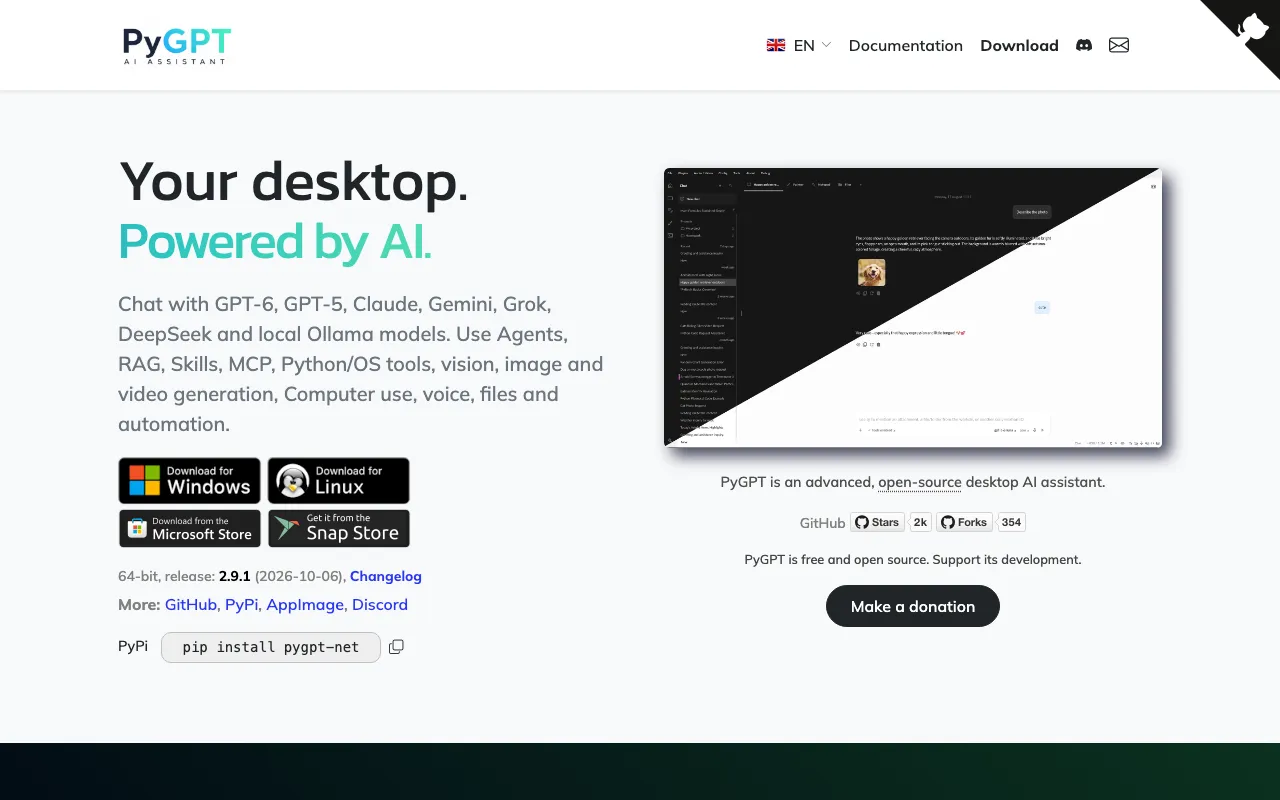
PyGPT is an open-source desktop AI assistant for Windows, Linux, and macOS. It chats with many cloud and local models and adds agents, RAG, plugins, and automation.
Overview
PyGPT runs locally as a desktop application with a conversational interface comparable to hosted chat products. It connects to models from OpenAI, Google Gemini, Anthropic Claude, xAI Grok, Perplexity, DeepSeek, Hugging Face, OpenAI-compatible APIs, LlamaIndex, and local Ollama installations, among others.
Work modes extend beyond chat into agents with orchestrator and swarm workflows, realtime voice, research, completion, image and video generation, computer use, experts, autonomous runs, and custom agents. Integrated LlamaIndex RAG indexes files, web pages, repositories, and conversation history across many document formats, with vector stores and embeddings built in.
Tooling includes a plugin system, Model Context Protocol connectors, Python and IPython execution, filesystem access, web search, vision and camera input, canvas and browser integration, speech recognition and synthesis across several providers, scheduling, memory, presets, and optional Docker sandboxing. Cloud features require your own provider API keys; local Ollama models do not need external keys.
Install options include prebuilt Windows and Linux binaries, Microsoft Store and Snap packages, AppImage on Linux, and pip installation on macOS or from source. The UI supports themes, split-screen chats, accessibility shortcuts, and extensive configuration profiles.
Key features
- Multi-provider chat and agents
- LlamaIndex RAG and vector stores
- MCP connectors and plugins
- Python, IPython, and OS tools
- Vision, image, and video generation
- Speech in and out with realtime mode
- Web search and computer use modes
- Built-in scheduler and memory
Use cases
- Local desktop AI chat with your API keys
- Document Q&A over private files
- Multi-agent task automation
- Voice-controlled assistant workflows
- Running local models via Ollama



 Anthropic Claude
 ChatGPT