qmetrics.net

PX4 Autopilot

Modular open autopilot stack for drones and rovers

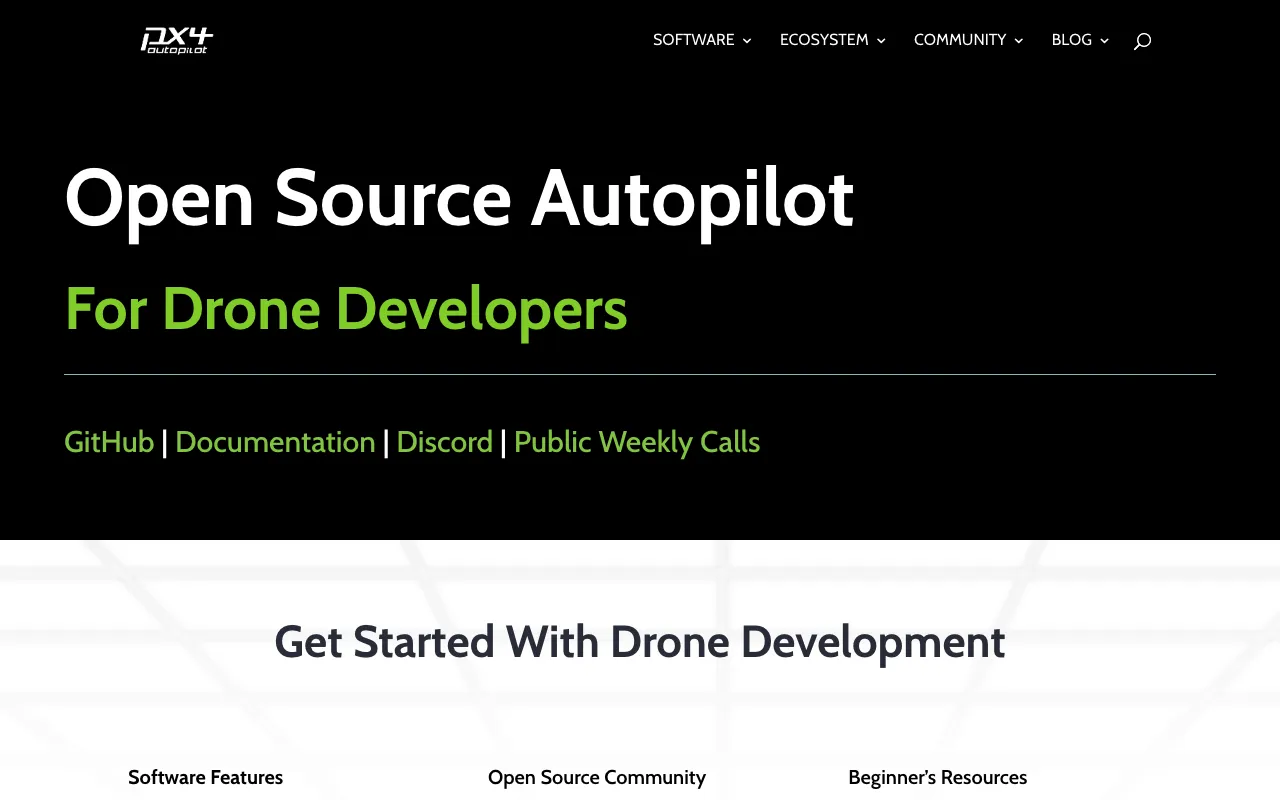
PX4 Autopilot screenshot

PX4 is flight and vehicle control firmware for multicopters, fixed-wing, VTOL, rovers, and more, with MAVLink and ROS 2 integration.

Overview

PX4 Autopilot is an autopilot software stack for drones and other unmanned vehicles. It supports multicopters, fixed-wing aircraft, VTOL configurations, rovers, and additional experimental frames such as boats, submarines, and airships, with varying levels of test coverage across frame types.

The architecture centers on uORB, a DDS-compatible publish and subscribe middleware where modules run in parallel and are designed to be thread safe. Configurations can be trimmed to include only needed modules. The stack runs on NuttX, Linux, and macOS and targets a wide range of autopilot boards and peripherals through the Pixhawk ecosystem.

Developers get MAVLink and DDS or ROS 2 integration, software-in-the-loop simulation, hardware-in-the-loop testing, and log analysis tooling. A quick simulation path is documented using Docker without local build dependencies, paired with QGroundControl for flight testing in sim.

Governance sits under the Dronecode Foundation within the Linux Foundation. User and developer guides cover building, configuration, porting, hardware compatibility, and contribution workflows.

Key features

  • uORB publish-subscribe middleware
  • Multicopter, fixed-wing, VTOL, rover support
  • MAVLink and DDS ROS 2 integration
  • SITL and HITL simulation tooling
  • Wide Pixhawk hardware compatibility
  • Modular configurable builds
  • Docker quickstart simulation
  • Dronecode Foundation governance

Use cases

  • Custom drone autopilot firmware
  • Research and academic UAV projects
  • Industrial survey aircraft stacks
  • ROS 2 connected vehicle control
  • Simulated flight before hardware tests
Tags

Similar software

RuView

WiFi CSI spatial sensing without cameras

RuView turns WiFi channel state into presence, motion, breathing, heart rate, and activity signals using low-cost ESP32 nodes. Processing can stay on edge hardware with optional visualization and smart-home bridges.

★ 105.3k⟳ 2 days agoMIT

Home Assistant

Local-first open home automation platform

Home Assistant connects smart home devices and services for local control and privacy. It suits Raspberry Pi or a server at home, with companion apps for phones and watches.

★ 92.6k⟳ todayApache-2.0
Open Source Alternative to:Google HomeHomey+3

openpilot

In-vehicle advanced driver assistance for supported cars

openpilot upgrades driver assistance on hundreds of supported vehicle models when paired with comma hardware and a car harness. It provides adaptive cruise and automated lane centering with driver monitoring.

★ 64.2k⟳ yesterdayMIT

XiaoZhi ESP32

ESP32 voice chatbot firmware using MCP

XiaoZhi AI is voice-interaction firmware for ESP32 boards. It uses large models such as Qwen or DeepSeek and controls devices through the MCP protocol.

★ 33.9k⟳ 2 days agoMIT

LibrePods

AirPods control and features on Linux and Android

LibrePods reimplements Apple’s AirPods control protocol so non-Apple devices can change listening modes, read batteries, and use accessibility-oriented options.

★ 31k⟳ 1 month agoGPL-3.0

LVGL

Embedded graphical UI library for MCUs and MPUs

LVGL is a portable C UI library for building screens on microcontrollers and application processors, with widgets, layouts, and optional GPU acceleration.

★ 25.3k⟳ todayMIT