qmetrics.net

LVGL

Embedded graphical UI library for MCUs and MPUs

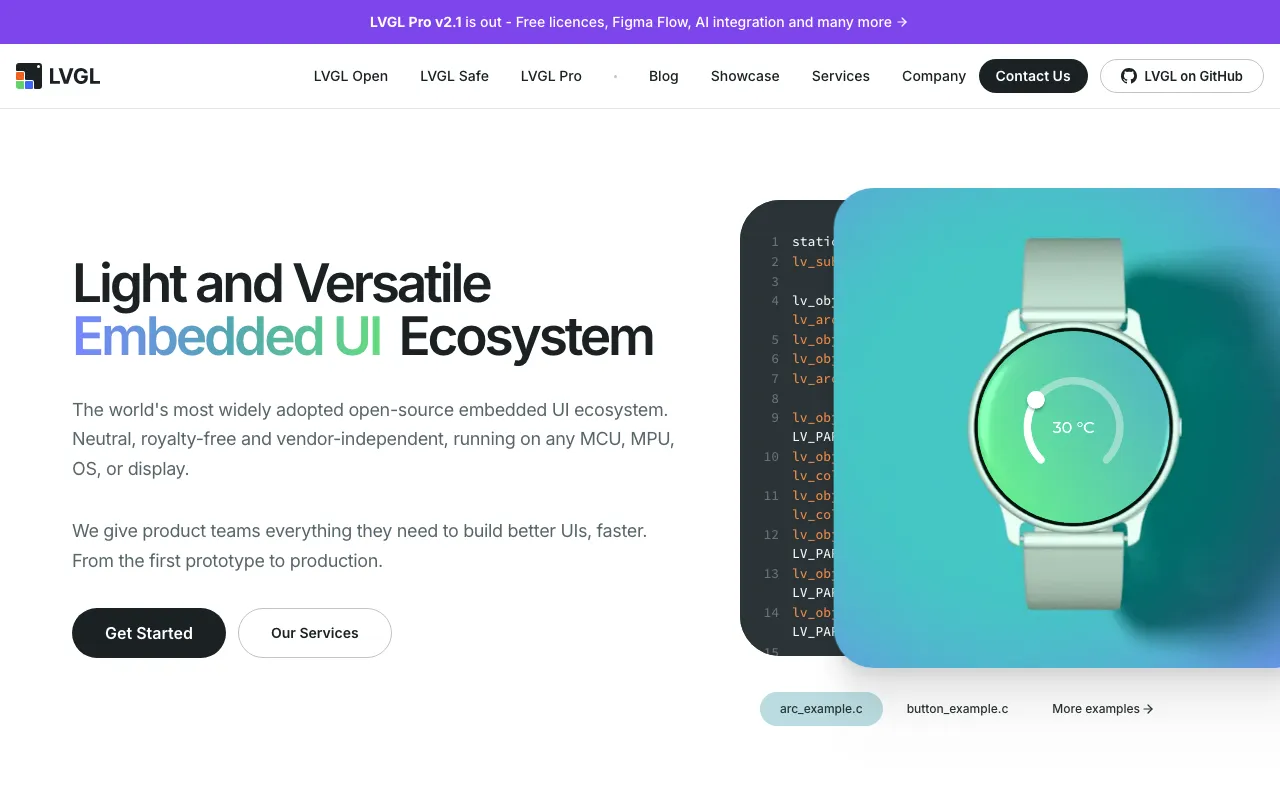
LVGL screenshot

LVGL is a portable C UI library for building screens on microcontrollers and application processors, with widgets, layouts, and optional GPU acceleration.

Overview

LVGL lets firmware teams draw full interfaces on resource-constrained hardware without tying to one silicon vendor. It ships with no external dependencies, targets both small MCUs and Linux-capable MPUs, and aims for modest RAM and flash budgets with partial-frame rendering buffers.

The library includes dozens of widgets, a large style property set, flexbox- and grid-like layouts, and bindings between UI elements and application data. Input covers mice, touch, keypads, encoders, and similar devices, and multiple displays can be managed together. Rendering supports gradients, images, shadows, smooth scrolling, UTF-8 text across several scripts, SVG, Lottie, and optional GPU backends.

Integrations appear across RTOS projects such as Zephyr and NuttX, vendor SDKs, and built-in display drivers for common LCD controllers, framebuffer and DRM paths on embedded Linux, and desktop simulators using SDL or similar APIs. A separate LVGL Pro toolkit offers visual editing, Figma import, an online viewer, and CLI export to plain C without adding runtime dependencies.

The core library uses an MIT-style license suitable for commercial products, while Pro tooling has distinct community and commercial terms.

Key features

  • Portable C library without dependencies
  • Thirty-plus built-in UI widgets
  • Flex and grid layout engines
  • Data binding between UI and app
  • GPU and vector graphics options
  • Built-in display and input drivers
  • Desktop simulator targets
  • Optional LVGL Pro visual editor

Use cases

  • Touchscreen interfaces on MCUs
  • Wearable and appliance displays
  • Embedded Linux panel UIs
  • Rapid UI prototyping on a PC

Tags

Similar software

Lichtblick

Robotics visualization and diagnosis for web and desktop

Lichtblick visualizes and diagnoses robotics data in the browser or as a desktop app on Linux, Windows, and macOS. It grew from a fork of Foxglove Studio and supports MCAP-related workflows.

★ 1.3k⟳ 3 days agoMPL-2.0

Excalidraw

Open-source collaborative whiteboard for hand-drawn style diagrams

Excalidraw is a virtual whiteboard for sketching diagrams and wireframes in a hand-drawn style. It offers an infinite canvas, real-time collaboration with end-to-end encryption, and is also published as an npm package for embedding.

★ 136.4k⟳ todayMIT
Open Source Alternative to:Miro

three.js

Cross-browser JavaScript library for 3D graphics

Three.js is a lightweight JavaScript 3D library for browsers. Default builds target WebGL and WebGPU, with optional SVG and CSS3D renderers as add-ons.

★ 119.5k⟳ todayMIT
Design & VisualizationDesktop/CLI app

RuView

WiFi CSI spatial sensing without cameras

RuView turns WiFi channel state into presence, motion, breathing, heart rate, and activity signals using low-cost ESP32 nodes. Processing can stay on edge hardware with optional visualization and smart-home bridges.

★ 105.3k⟳ 2 days agoMIT

Archify

Agent skill for interactive HTML diagrams and explainers

Archify is an open-source agent skill that turns descriptions, plans, or repositories into validated, self-contained interactive HTML maps and one-page explainers for Claude Code, Codex, Cursor, OpenCode, and Copilot.

★ 100.9k⟳ 2 days agoApache-2.0

Manim

Programmatic animation engine for explanatory math videos

ManimGL drives precise programmatic animations for explanatory math videos. The 3Blue1Brown variant installs via the manimgl package

★ 97k⟳ 2 months agoMIT
Frameworks & PlatformsDesktop/CLI app