
TensorFlow
End-to-end machine learning platform and tooling ecosystem
TensorFlow is a machine learning platform with Python and C++ APIs, optional GPU packages, and companion libraries for data, training, deployment, and visualization.

Automatic time series forecasting for R and Python
Prophet is in maintenance mode: “2026 Update: Prophet is in maintenance mode as of v1.4.0.” source
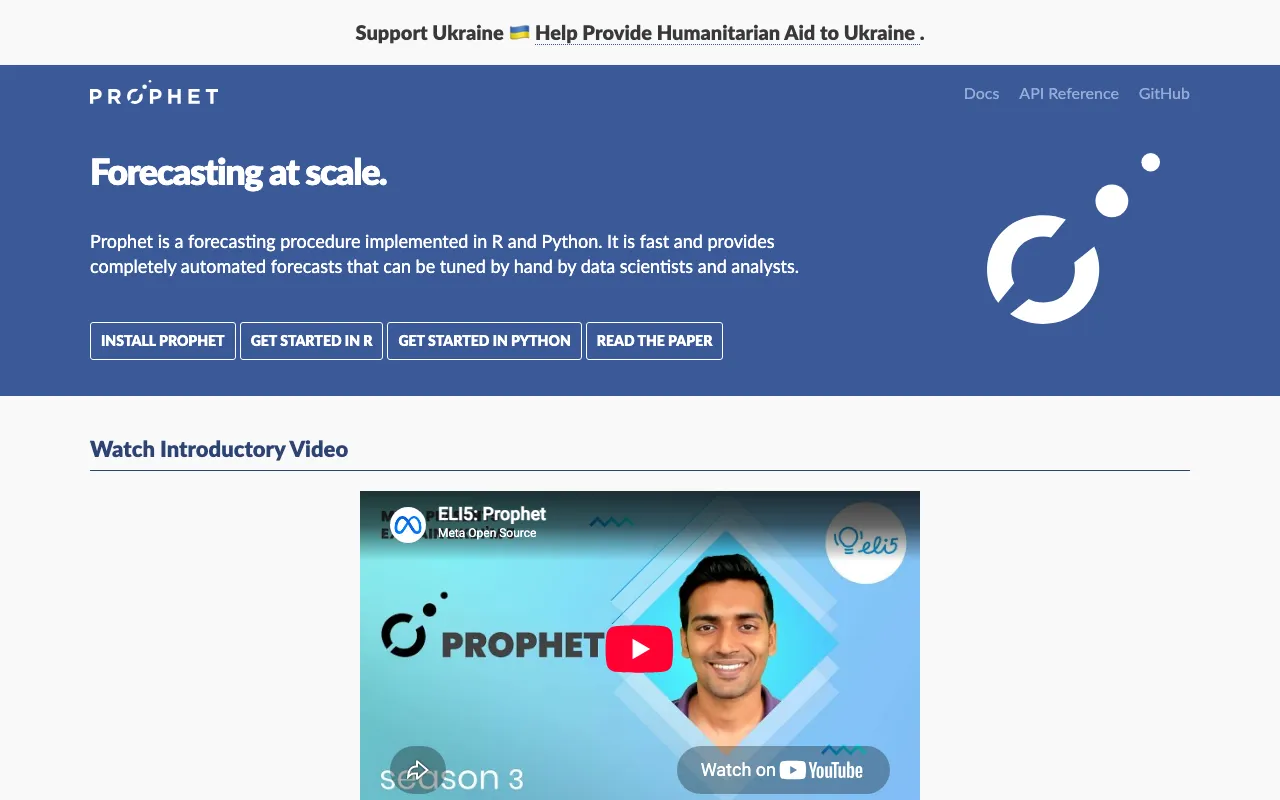
Prophet forecasts seasonal time series using an additive model with trends, holidays, and multiple seasonal patterns. It ships for R and Python via CRAN and PyPI.
Prophet fits nonlinear trends with yearly, weekly, and daily seasonality plus holiday effects. It targets series with strong seasonal patterns and multiple seasons of history, and tolerates missing points, trend shifts, and outliers.
Installations use CRAN or PyPI packages, with optional conda-forge builds. R users can switch to an experimental cmdstanr backend; Python builds rely on CmdStan through cmdstanpy. Cross-validation, extra regressors, custom seasonalities, and tunable parameters let analysts adjust forecasts without rebuilding the core procedure.
Models compile through Stan, and R and Python share the same underlying fitting code. A separate Spark-oriented reimplementation called Helter Skelter exists for large-scale JVM deployments.
As of maintenance mode, the maintainers accept bug fixes and dependency updates rather than new features. Analysts at Facebook have used Prophet for planning forecasts, and settings remain human-interpretable for tuning.
End-to-end machine learning platform and tooling ecosystem
TensorFlow is a machine learning platform with Python and C++ APIs, optional GPU packages, and companion libraries for data, training, deployment, and visualization.

Run open AI models locally or in the cloud
Ollama runs open language models such as Gemma, Qwen, DeepSeek and gpt-oss on macOS, Windows and Linux, locally or in the cloud. It offers a CLI, a REST API, and Python and JavaScript libraries.

Shared model definitions for multimodal ML workloads
Transformers is a Python library that defines pretrained text, vision, audio, and multimodal models once in PyTorch for shared inference and training across the ecosystem.

LLM inference engine in C/C++ for local and cloud hardware
llama.cpp runs large language models and multimodal models locally or in the cloud with minimal setup. It includes a CLI, an OpenAI-compatible server with a built-in chat app, and a C library API.

General-purpose speech recognition and translation model
Whisper is a speech recognition model trained on diverse audio. It supports multilingual transcription, speech-to-English translation, and language identification via Python or the command line.

High-throughput, memory-efficient inference and serving engine for LLMs
vLLM is a library and server for running and serving large language models. It uses PagedAttention and continuous batching for throughput, offers an OpenAI-compatible API, and runs on many GPU, CPU and accelerator types.