PPTAgent generates and revises PowerPoint decks through coding agents. A installable skill ties LibreOffice, Node tooling, and optional vision review into editable PPTX output.
Overview
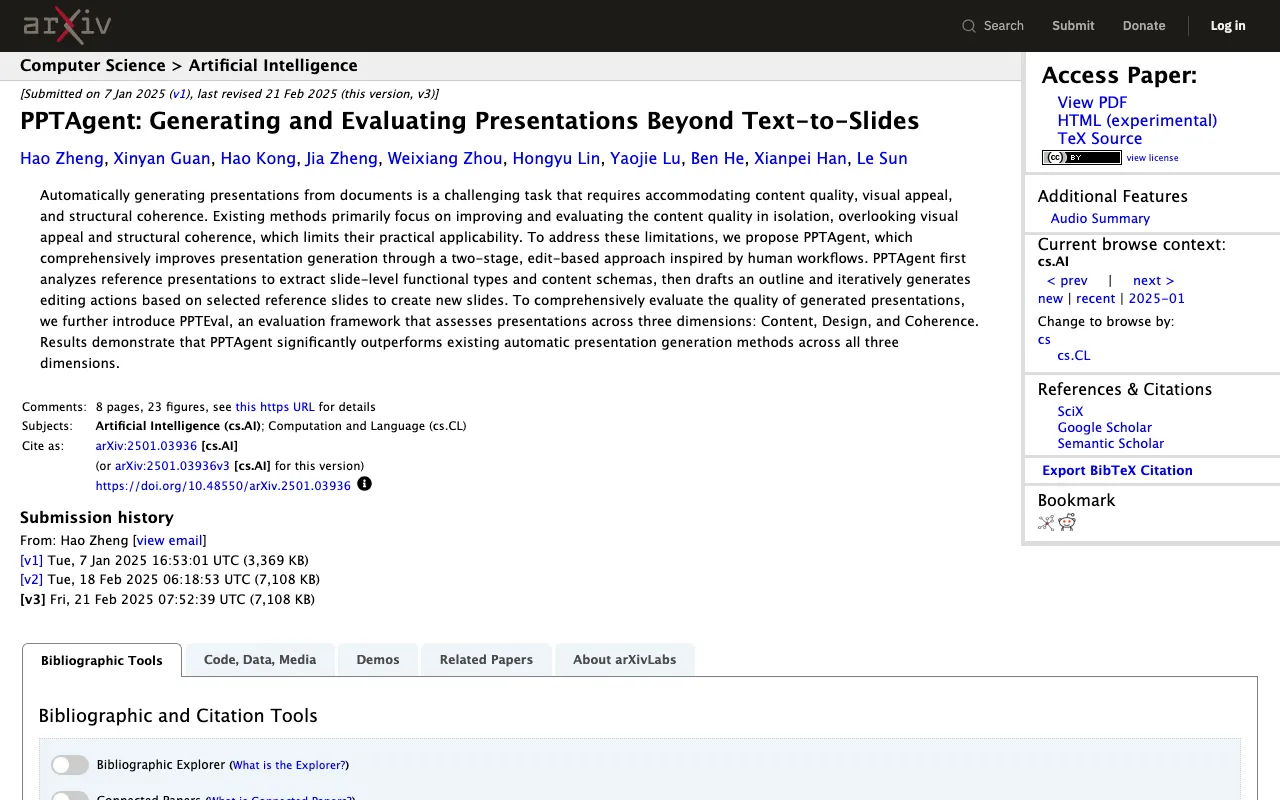
PPTAgent is an agentic framework for creating presentations beyond simple text-to-slides conversion. Research describes a two-stage, edit-based workflow that learns slide roles from reference decks, drafts an outline, and iteratively applies edits modeled on human presentation work. A related PPTEval framework scores content, design, and coherence.
The current distribution emphasizes PPTAgent Skill for Claude Code, Codex CLI, and OpenCode on Linux or macOS. Installation expects uv, npm, LibreOffice on PATH, and Chrome on macOS for conversion. The skill registers with the chosen agent, keeps dependencies under skills/pptagent/, and can export editable PPTX plus HTML sources and review artifacts.
Optional multimodal review uses external vision APIs configured in skills/pptagent/config.yaml, with Atria Dawn Preview documented as one text-model path. MCP server support and DeepPresenter-related capabilities are mentioned in release notes for broader research and asset-generation features. Pinned tags are noted for reproducing EMNLP and ACL paper codebases separately from the moving main branch.
Users drive generation through agent sessions: request a deck from source material, iterate on slides in the same session, and retain outputs such as answer.pptx, previews, and review reports in a task folder. Requirements include WSL-capable Linux or macOS rather than a hosted-only SaaS interface.
Key features
- Agent skill for slide authoring
- Editable PPTX export
- Reference-based slide editing workflow
- Visual review via vision models
- MCP server integration
- LibreOffice-based conversion pipeline
- Claude Code Codex OpenCode support
- HTML slide sources and preview outputs
Use cases
- Agent-driven PowerPoint from documents
- Iterative deck revision in coding sessions
- Research reproduction for presentation papers
- Multimodal quality review of slide layouts
- Offline or API-backed presentation export



 Anthropic Claude
 ChatGPT