qmetrics.net

Podcastfy

Python toolkit turning multimodal sources into podcast audio

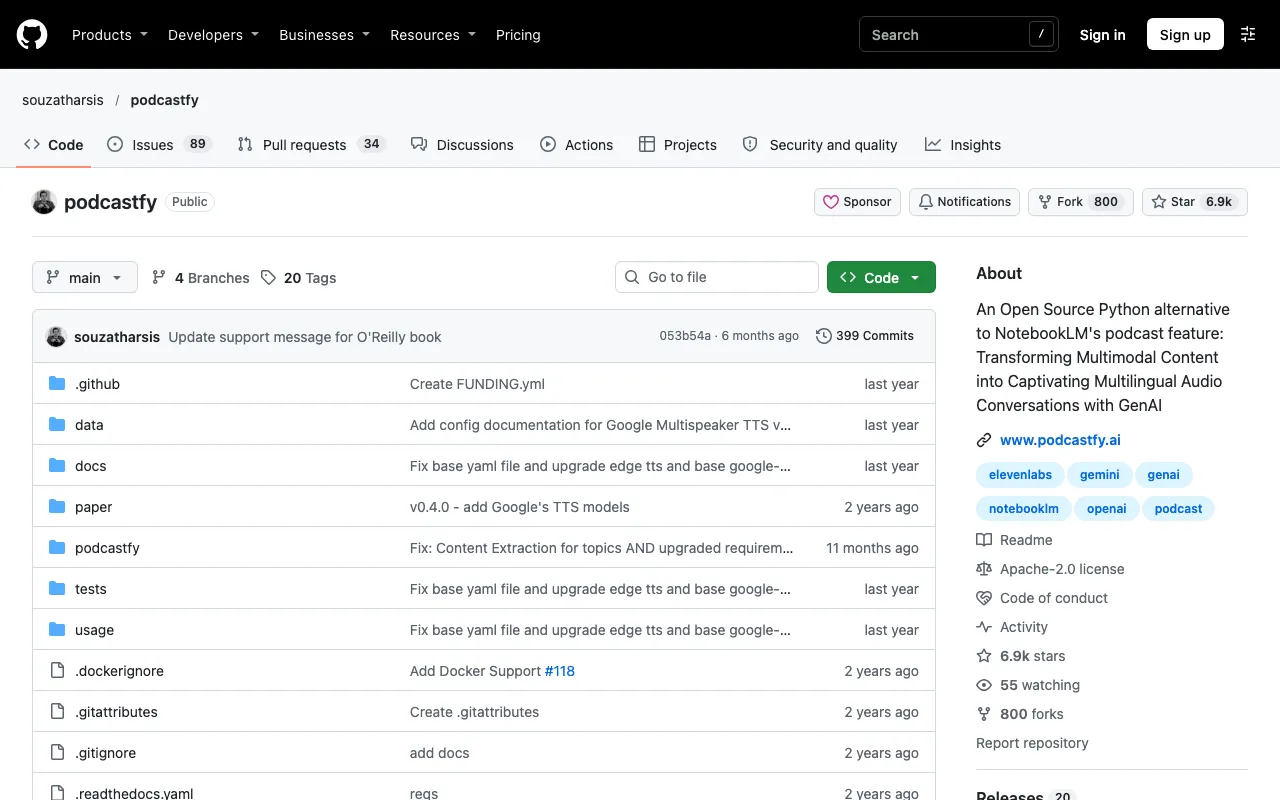
Podcastfy screenshot

Podcastfy converts websites, PDFs, images, YouTube links, or topics into multilingual conversational audio using configurable LLM and text-to-speech providers.

Overview

Podcastfy is an open-source Python package that turns multimodal inputs into multi-speaker audio conversations. Sources include text, images, websites, PDFs, YouTube videos, and user-supplied topics, with programmatic control over style and language.

You install the package from PyPI, set provider API keys, and call it from Python, the CLI, or an optional FastAPI service for URL-based generation. It can produce short clips or long-form episodes, generate transcripts with many cloud or local LLMs, and send text to TTS backends such as OpenAI, Google, ElevenLabs, or Microsoft Edge.

Customization covers conversation format, voices, structure, and configuration files for local Hugging Face models when you want more privacy. Docker assets and notebooks support batch or containerized workflows.

Open, scalable generation contrasts with closed UI research tools, and example use cases cover creators, educators, researchers, and accessibility-focused publishing.

Key features

  • Multimodal input to audio podcasts
  • Python package, CLI, and FastAPI beta
  • Short and longform episode lengths
  • 100+ LLM models for transcripts
  • Multiple TTS provider integrations
  • Multi-language conversation output
  • Local LLM option for transcripts
  • Configurable conversation style

Use cases

  • Turn articles or PDFs into audio
  • Generate multilingual podcast drafts
  • Automate audio summaries of research
  • Build accessibility audio from visual content

Open-source alternative to

NotebookLM
“An Open Source API alternative to NotebookLM's podcast feature: Transforming Multimodal Content into Captivating Multilingual Audio Conversations with GenAI” source


Tags

Compare Podcastfy

Similar software

DeepSeek Harness

Open-source plugin-based agent harness from DeepSeek

DeepSeek Harness is an open-source agent harness built on an everything-is-a-plugin architecture powered by Cordis. It offers a web UI, desktop app, and extensible plugins for daily work, coding, and automation.

★ 288k⟳ 6 days agoMIT

Hermes Agent

Self-improving open-source AI agent with memory, skills and messaging gateway

Open-source AI agent from Nous Research that keeps persistent memory, creates skills from experience, and runs from a terminal, desktop app or messaging platforms with any model provider.

★ 266.6k⟳ todayMIT
Open Source Alternative to:Anthropic ClaudeChatGPT+5

Firecrawl

Web scrape crawl and search infrastructure for AI agents

Firecrawl turns websites into LLM-ready markdown and structured data via API, CLI, and MCP. It supports scrape, crawl, map, batch jobs, optional cloud scale, and self-hosted server deployment.

★ 211.5k⟳ todayAGPL-3.0
Open Source Alternative to:TavilyZyte

TensorFlow

End-to-end machine learning platform and tooling ecosystem

TensorFlow is a machine learning platform with Python and C++ APIs, optional GPU packages, and companion libraries for data, training, deployment, and visualization.

★ 201.8k⟳ todayApache-2.0

MarkItDown

Python utility converting office and media files to Markdown

MarkItDown converts many file types into Markdown for LLM and text analysis pipelines. It aims to preserve headings, lists, tables, and links rather than perfect human layout.

★ 198.7k⟳ 21 days agoMIT

Transformers

Shared model definitions for multimodal ML workloads

Transformers is a Python library that defines pretrained text, vision, audio, and multimodal models once in PyTorch for shared inference and training across the ecosystem.

★ 169.4k⟳ todayApache-2.0