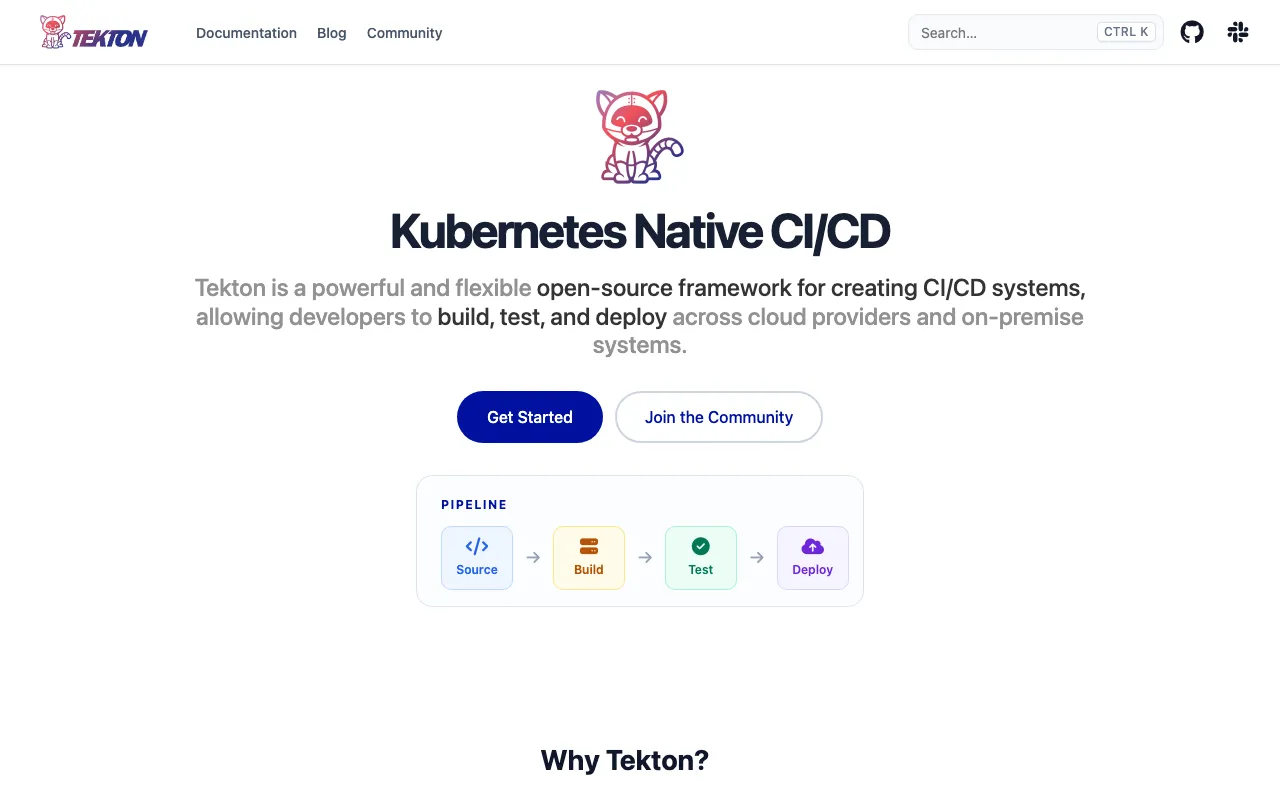
Tekton Pipelines declares CI/CD-style pipelines as Kubernetes resources. Tasks run in containers and can be reused, swapped, and executed across clusters.
Overview
Tekton Pipelines, part of the Tekton project, provides Kubernetes-style resources for describing continuous integration and delivery flows. Workloads run on a Kubernetes cluster and treat containers as the primary building blocks.
Pipelines are decoupled from any single environment: one pipeline definition can target different clusters, individual tasks can run alone for testing, and inputs such as Git repositories can change between runs without rewriting the whole workflow.
Typed resources let implementers swap backends—for example, choosing different image build tools—while keeping the surrounding pipeline contract stable. Tekton installs as a cluster extension and follows the Kubernetes resource model, so capacity scales with cluster nodes.
Operators install Tekton Pipelines on their Kubernetes infrastructure using the upstream installation guide and tutorials. A community catalog supplies reusable pipeline building blocks, and documentation covers API stability, deprecations, and migration between API versions.
Key features
- Kubernetes CRD pipeline definitions
- Container-based Task execution
- Portable tasks across clusters
- Swappable typed pipeline resources
- Scales with cluster node capacity
- Community Tekton Catalog components
- Isolated task runs for testing
- Documented API migrations
Use cases
- Kubernetes-native CI/CD
- Reusable build and test tasks
- Multi-cluster deployment pipelines
- Swappable build tool implementations
- Cloud and on-prem automation