qmetrics.net

Helm

Package manager for Kubernetes chart releases

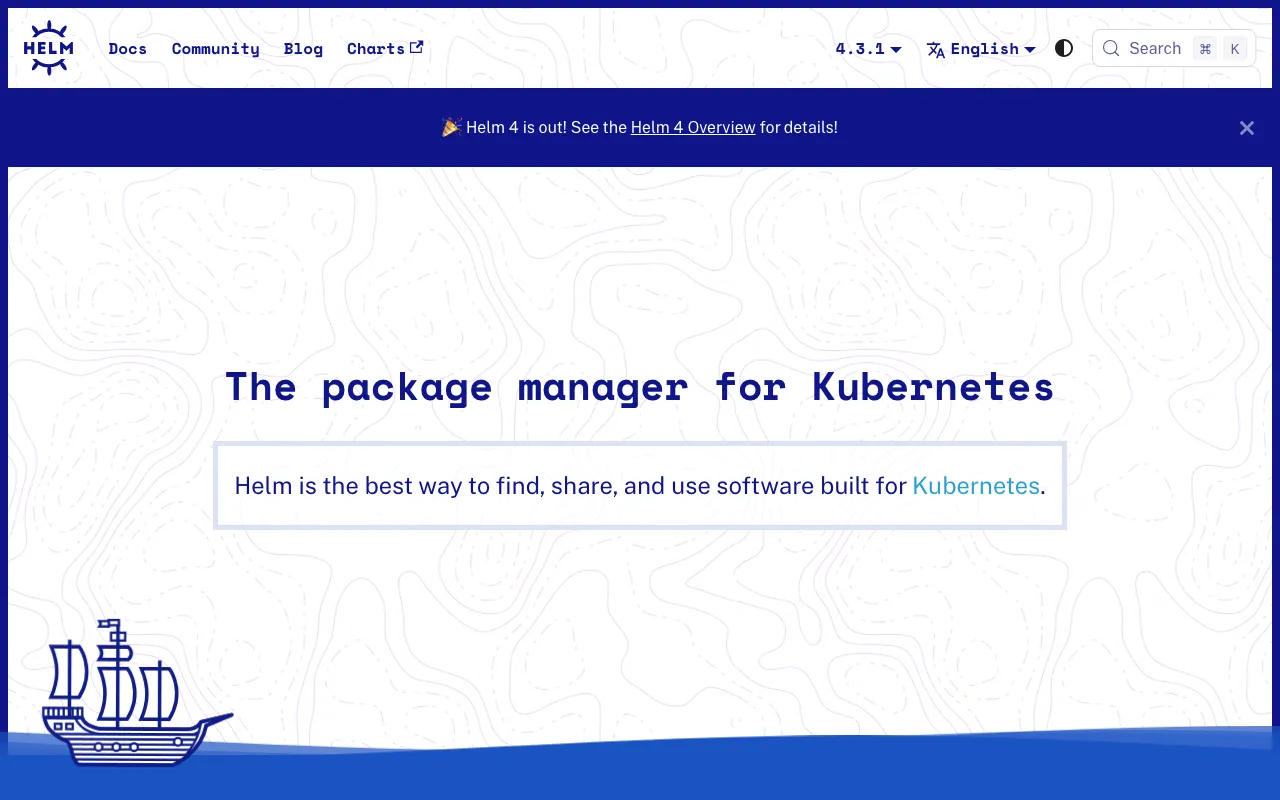
Helm screenshot

Helm installs, upgrades, and manages Kubernetes applications packaged as Charts. It renders templates, talks to the Kubernetes API, and tracks named releases on your machine or in CI.

Overview

Helm is a client tool for Kubernetes that treats Charts as versioned packages of pre-configured cluster resources. You use it to define repeatable application installs, share applications as Charts, manage manifest templates, and coordinate upgrades and rollbacks of releases.

A Chart bundles metadata such as Chart.yaml with one or more template files that expand into Kubernetes manifests. Charts can live on disk or be pulled from remote chart repositories, similar to package indexes on traditional operating systems. The Helm client renders those templates and applies them through the Kubernetes API.

Helm runs wherever you need it—on a laptop, in CI/CD, or other automation—and functions like a package manager for Kubernetes workloads, comparable to apt, yum, or Homebrew. The project is a graduated CNCF effort maintained by the Helm community. Charts are commonly discovered through public hubs such as Artifact Hub, and the tool supports release rollback for reverting to prior chart versions.

Key features

  • Chart-based Kubernetes packaging
  • Templated manifest rendering
  • Named release lifecycle management
  • In-place upgrades and custom hooks
  • Release rollback support
  • Public and private chart repositories
  • Binary and package-manager installs
  • CNCF graduated project

Use cases

  • Installing complex Kubernetes apps
  • Versioned repeatable cluster deployments
  • Sharing internal applications as charts
  • Automating releases in CI/CD
  • Rolling back failed chart upgrades

Tags

Similar software

Docker Compose

Multi-container Docker application definition tool

Docker Compose defines and runs multi-container applications described in a Compose file. A single docker compose up command starts the configured services, networks, and volumes together.

★ 39.1k⟳ todayApache-2.0
Build & DeploymentDesktop/CLI app

Podman

Daemonless OCI container and pod manager

Podman manages containers, images, volumes, and pods on Linux and via virtual machines on Mac and Windows. It offers a Docker-compatible CLI without a background daemon.

★ 33.4k⟳ todayApache-2.0
Build & DeploymentDesktop/CLI app

Argo CD

Declarative GitOps continuous delivery for Kubernetes

Argo CD keeps Kubernetes applications aligned with manifests stored in Git. It compares live cluster state to the desired revision and syncs or reports drift through a UI and CLI.

★ 24.7k⟳ todayApache-2.0

Dagger

Programmable software delivery engine with container workflows

Dagger automates building, testing, and shipping codebases using a typed API and language SDKs. Pipelines run on a laptop, in CI, or on remote infrastructure with shared caching.

★ 16.7k⟳ todayApache-2.0

Skaffold

CLI workflow for Kubernetes application development

Skaffold is a command-line tool that builds, pushes, and deploys containerized apps to local or remote Kubernetes clusters while you change code. It stays client-side with no in-cluster agent.

★ 15.9k⟳ 7 days agoApache-2.0
Build & DeploymentDesktop/CLI app

Semaphore UI

Web UI for Ansible, Terraform, and DevOps automation

Semaphore UI is a web interface for running and managing DevOps automation. Teams use it for Ansible, Terraform, OpenTofu, Terragrunt, Bash, PowerShell, and Python jobs.

★ 14.5k⟳ 4 days agoMIT
Build & DeploymentSelf-hostable
Open Source Alternative to:Ansible Automation Platform