qmetrics.net

Pipecat

Python framework for realtime voice and multimodal agents

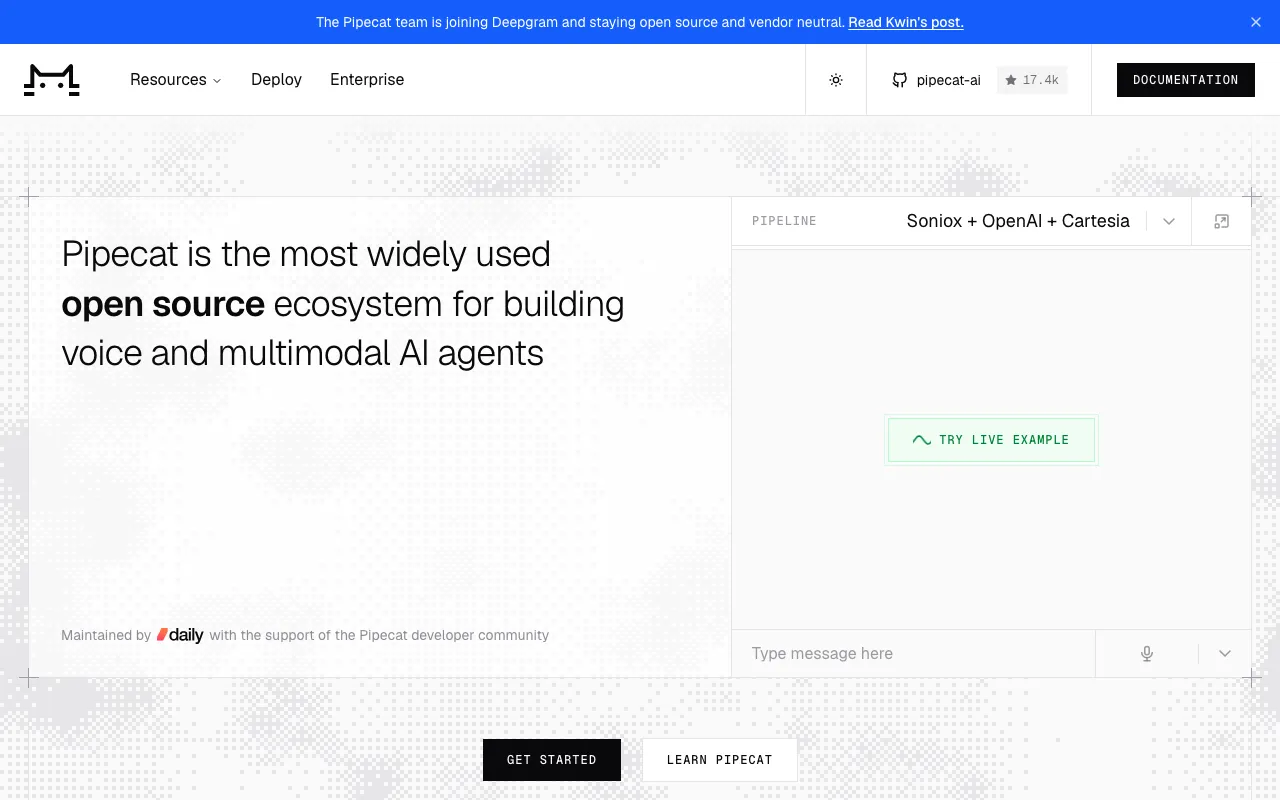
Pipecat screenshot

Pipecat orchestrates speech, language, and media services into low-latency conversational agents. Pipelines can span single bots, multi-agent handoffs, and distributed deployments.

Overview

Pipecat is a Python framework for building real-time voice and multimodal conversational agents. You compose pipelines that connect speech recognition, language models, text-to-speech, video, transports, and tooling so responses can stream while a user is still speaking.

Typical applications include voice assistants, multi-agent systems with parallel workers, companions, interactive storytelling, customer intake flows, and structured dialogues. Pipecat Flows adds stateful conversation paths; client SDKs exist for JavaScript, React, and React Native, plus UI component registries for voice interfaces.

Integrations cover a large catalog of speech, LLM, TTS, speech-to-speech, WebRTC and WebSocket transports, telephony serializers, vision, memory, VAD, and telemetry backends. A CLI can scaffold projects, register documentation MCP servers for coding agents, and support deployment workflows including managed cloud offerings.

Agents can run on your own machines wherever Python runs, including on your own infrastructure. Real-time behavior relies on frame-based streaming through the pipeline rather than batching entire turns.

Key features

  • Composable realtime pipelines
  • Multi-agent coordination
  • Broad AI service adapters
  • WebRTC and WebSocket transports
  • Pipecat Flows for structured dialog
  • Client SDKs and UI kit
  • CLI project scaffolding
  • OpenTelemetry and metrics hooks

Use cases

  • Voice customer support bots
  • Meeting or coaching assistants
  • Phone and web voice agents
  • Multimodal companion apps

Does the same job as

Pipecat doesn't name these products itself, but its own description shows it does the same job.

Tags

Compare Pipecat

Similar software

DeepSeek Harness

Open-source plugin-based agent harness from DeepSeek

DeepSeek Harness is an open-source agent harness built on an everything-is-a-plugin architecture powered by Cordis. It offers a web UI, desktop app, and extensible plugins for daily work, coding, and automation.

★ 288k⟳ 6 days agoMIT

Hermes Agent

Self-improving open-source AI agent with memory, skills and messaging gateway

Open-source AI agent from Nous Research that keeps persistent memory, creates skills from experience, and runs from a terminal, desktop app or messaging platforms with any model provider.

★ 266.6k⟳ todayMIT
Open Source Alternative to:Anthropic ClaudeChatGPT+5

Open WebUI

Self-hosted AI interface for Ollama and OpenAI-compatible models

Open WebUI is a self-hosted AI platform that runs offline and connects to local models through Ollama or to cloud models through OpenAI-compatible APIs. It can be extended with Python.

★ 159.7k⟳ 3 days agoBSD-3-Clause
Open Source Alternative to:Anthropic ClaudeChatGPT+4

MiroFish

Multi-agent swarm intelligence prediction engine

MiroFish builds parallel digital worlds from real-world seed material so multi-agent simulations can explore future outcomes. Users upload seeds and state prediction needs in natural language.

★ 86.9k⟳ 1 month agoAGPL-3.0

LobeHub

Open-source platform for super-agents that work inside team chats

LobeHub adds AI agents to team chat apps like Discord, Slack and Telegram. Agents pick up tasks, hand coding to tools such as Claude Code, report back, and keep lessons from corrections.

★ 86.2k⟳ todayApache-2.0

AnythingLLM

All-in-one private AI app for chatting with documents and running agents

AnythingLLM is an AI application for chatting with your documents and using AI agents, connecting to local or cloud LLMs. It runs as a desktop app or a self-hosted multi-user Docker deployment.

★ 68.7k⟳ 3 days agoMIT
Open Source Alternative to:Anthropic ClaudeGemini+4