
TensorFlow
End-to-end machine learning platform and tooling ecosystem
TensorFlow is a machine learning platform with Python and C++ APIs, optional GPU packages, and companion libraries for data, training, deployment, and visualization.

Reasoning-based document retrieval without vector indexes
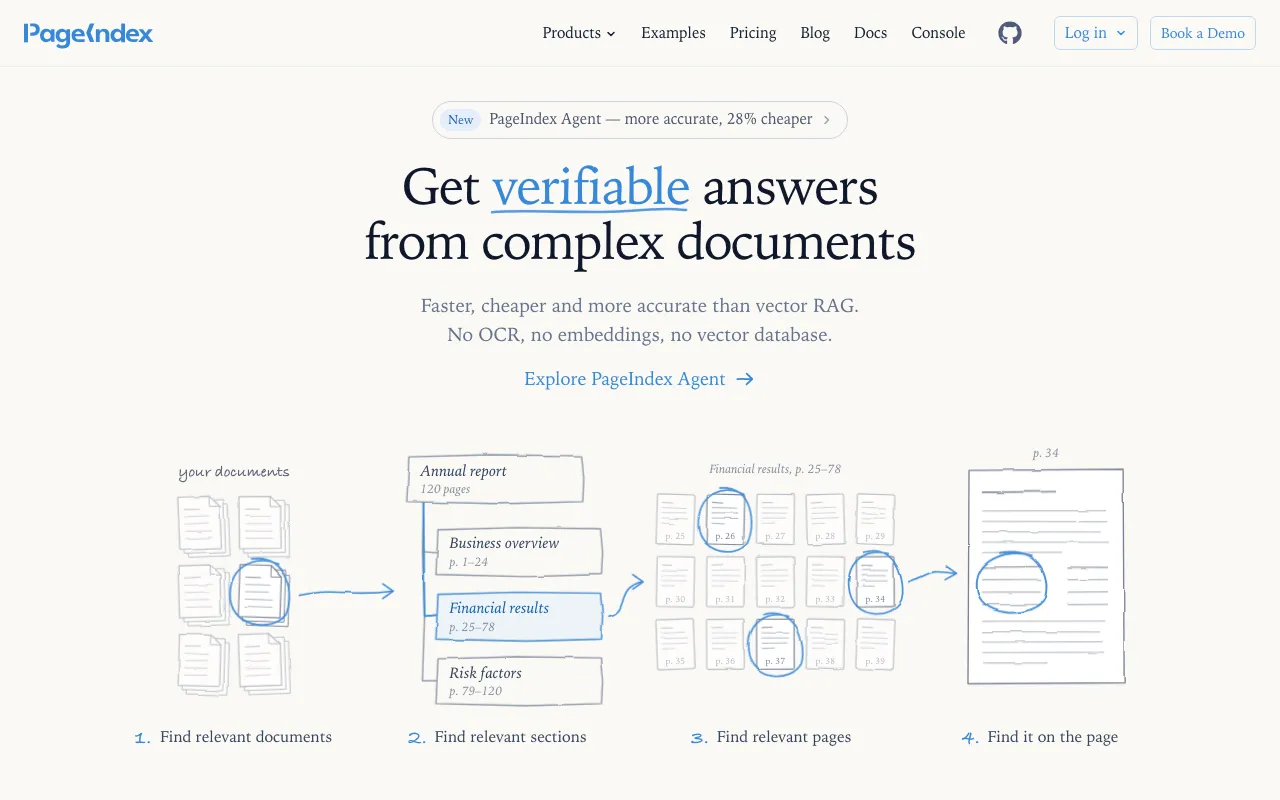
PageIndex builds a hierarchical tree index from PDFs and answers questions by having a language model reason over that structure instead of embedding chunks in a vector database.
PageIndex targets long, complex professional documents where similarity search can miss relevant but dissimilar passages. It first derives a tree-shaped index from document layout, then uses model reasoning to walk the tree and retrieve the sections needed to answer a question, with citations tied to explicit pages.
The open SDK runs indexing locally on text-based PDFs using your own model API keys, storing indexes on disk and exposing chat, streaming, multi-document queries, and agent tool bindings. Optional cloud indexing adds visual page reading without a separate OCR step, cloud storage, richer citations with evidence boxes, and APIs for page search and structured field extraction.
Compared to typical vector RAG, PageIndex emphasizes traceable retrieval paths and conversation-aware context rather than opaque nearest-neighbor matches. It integrates with common agent SDKs through plain Python tools and supports multiple model providers via a unified client configuration.
Typical document types mentioned include financial filings, legal and regulatory texts, technical manuals, and academic material. Local indexing cost scales with page count, while each later query reuses the built tree instead of resending entire files to the model.
End-to-end machine learning platform and tooling ecosystem
TensorFlow is a machine learning platform with Python and C++ APIs, optional GPU packages, and companion libraries for data, training, deployment, and visualization.

Run open AI models locally or in the cloud
Ollama runs open language models such as Gemma, Qwen, DeepSeek and gpt-oss on macOS, Windows and Linux, locally or in the cloud. It offers a CLI, a REST API, and Python and JavaScript libraries.

Shared model definitions for multimodal ML workloads
Transformers is a Python library that defines pretrained text, vision, audio, and multimodal models once in PyTorch for shared inference and training across the ecosystem.

LLM inference engine in C/C++ for local and cloud hardware
llama.cpp runs large language models and multimodal models locally or in the cloud with minimal setup. It includes a CLI, an OpenAI-compatible server with a built-in chat app, and a C library API.

General-purpose speech recognition and translation model
Whisper is a speech recognition model trained on diverse audio. It supports multilingual transcription, speech-to-English translation, and language identification via Python or the command line.

High-throughput, memory-efficient inference and serving engine for LLMs
vLLM is a library and server for running and serving large language models. It uses PagedAttention and continuous batching for throughput, offers an OpenAI-compatible API, and runs on many GPU, CPU and accelerator types.