
TensorFlow
End-to-end machine learning platform and tooling ecosystem
TensorFlow is a machine learning platform with Python and C++ APIs, optional GPU packages, and companion libraries for data, training, deployment, and visualization.

Python library for Bayesian time series forecasting
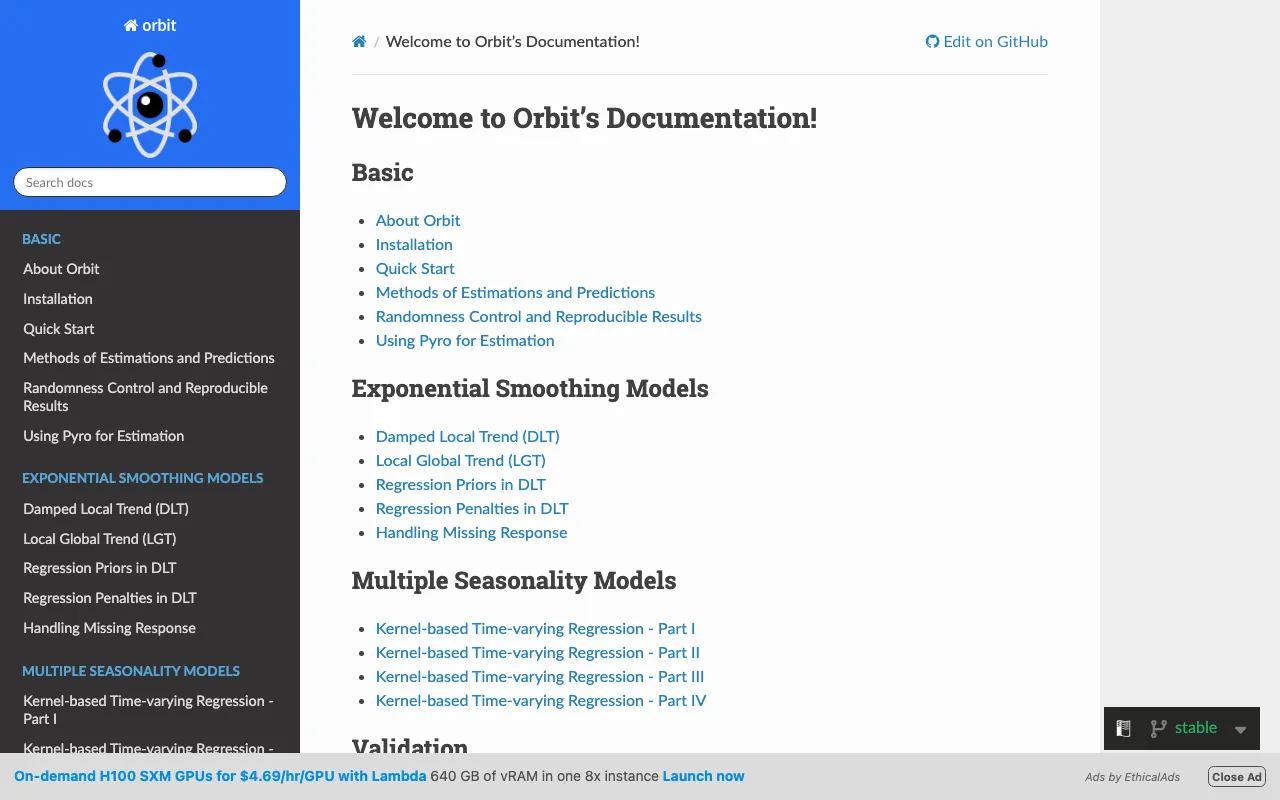
Orbit is a Python package for Bayesian time series forecasting with an initialize-fit-predict workflow, backed by probabilistic programming under the hood.
Orbit targets analysts and engineers who need principled forecasts and uncertainty estimates from time series data. It wraps probabilistic programming so common forecasting workflows stay familiar while models remain Bayesian.
Concrete model implementations include exponential smoothing (ETS), local global trend (LGT), damped local trend (DLT), and kernel time-based regression (KTR). Estimation supports full Markov chain Monte Carlo sampling, MAP point estimates, and variational inference on approximate distributions.
You install the library with standard Python packaging tools or conda from conda-forge. Quick-start material centers on fitting a damped local trend model, running full Bayesian prediction, nowcasting with regression, and backtesting on benchmark data sets; additional walkthroughs live in tutorials and examples.
Documentation covers estimation methods, reproducible randomness, Pyro-based estimation, seasonality, diagnostics, backtests, and utilities to build custom models. The project is positioned for long-term support while some experimental APIs may still change.
End-to-end machine learning platform and tooling ecosystem
TensorFlow is a machine learning platform with Python and C++ APIs, optional GPU packages, and companion libraries for data, training, deployment, and visualization.

Run open AI models locally or in the cloud
Ollama runs open language models such as Gemma, Qwen, DeepSeek and gpt-oss on macOS, Windows and Linux, locally or in the cloud. It offers a CLI, a REST API, and Python and JavaScript libraries.

Shared model definitions for multimodal ML workloads
Transformers is a Python library that defines pretrained text, vision, audio, and multimodal models once in PyTorch for shared inference and training across the ecosystem.

LLM inference engine in C/C++ for local and cloud hardware
llama.cpp runs large language models and multimodal models locally or in the cloud with minimal setup. It includes a CLI, an OpenAI-compatible server with a built-in chat app, and a C library API.

General-purpose speech recognition and translation model
Whisper is a speech recognition model trained on diverse audio. It supports multilingual transcription, speech-to-English translation, and language identification via Python or the command line.

High-throughput, memory-efficient inference and serving engine for LLMs
vLLM is a library and server for running and serving large language models. It uses PagedAttention and continuous batching for throughput, offers an OpenAI-compatible API, and runs on many GPU, CPU and accelerator types.