
TensorFlow
End-to-end machine learning platform and tooling ecosystem
TensorFlow is a machine learning platform with Python and C++ APIs, optional GPU packages, and companion libraries for data, training, deployment, and visualization.

Define-by-run hyperparameter optimization for machine learning
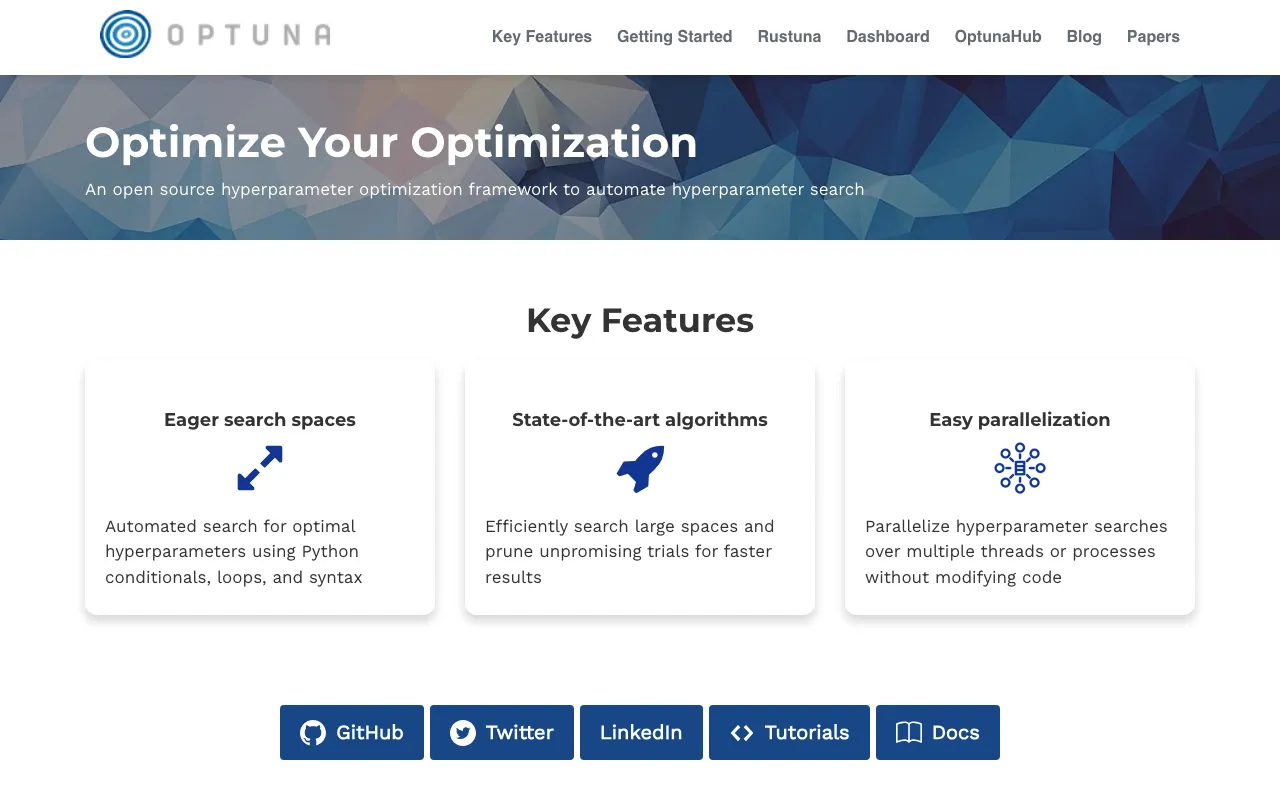
Optuna automates hyperparameter search for machine learning workflows. It exposes an imperative API where search spaces are built dynamically as trials run.
Optuna is a software framework for automatic hyperparameter optimization aimed at machine learning workloads. It uses a define-by-run style API so you describe objective functions and suggest parameter values inside Python code, including conditionals and loops, instead of declaring a fixed schema up front.
A study runs many trials, each evaluating the objective once, to find better hyperparameter sets. The stack supports sampling and pruning algorithms, parallel workers with little code change, and plotting helpers to inspect optimization history. It installs as a lightweight Python package and works across ML stacks such as scikit-learn, PyTorch, TensorFlow, Keras, XGBoost, and LightGBM.
Related components mentioned alongside the core project include a separate web dashboard for live study views, a hub for sharing Optuna extensions, and an experimental Rust-based implementation focused on faster sampling and leaner storage. These orbit the main Python framework but the primary product is the optimization library itself.
End-to-end machine learning platform and tooling ecosystem
TensorFlow is a machine learning platform with Python and C++ APIs, optional GPU packages, and companion libraries for data, training, deployment, and visualization.

Run open AI models locally or in the cloud
Ollama runs open language models such as Gemma, Qwen, DeepSeek and gpt-oss on macOS, Windows and Linux, locally or in the cloud. It offers a CLI, a REST API, and Python and JavaScript libraries.

Shared model definitions for multimodal ML workloads
Transformers is a Python library that defines pretrained text, vision, audio, and multimodal models once in PyTorch for shared inference and training across the ecosystem.

LLM inference engine in C/C++ for local and cloud hardware
llama.cpp runs large language models and multimodal models locally or in the cloud with minimal setup. It includes a CLI, an OpenAI-compatible server with a built-in chat app, and a C library API.

General-purpose speech recognition and translation model
Whisper is a speech recognition model trained on diverse audio. It supports multilingual transcription, speech-to-English translation, and language identification via Python or the command line.

High-throughput, memory-efficient inference and serving engine for LLMs
vLLM is a library and server for running and serving large language models. It uses PagedAttention and continuous batching for throughput, offers an OpenAI-compatible API, and runs on many GPU, CPU and accelerator types.