
Octelium
Self-hosted zero-trust secure access and tunnel platform
Octelium unifies VPN, ZTNA, secure tunnels, API and AI gateways, and PaaS-style deployments on Kubernetes you host yourself.

Open-source zero-trust overlay networking platform
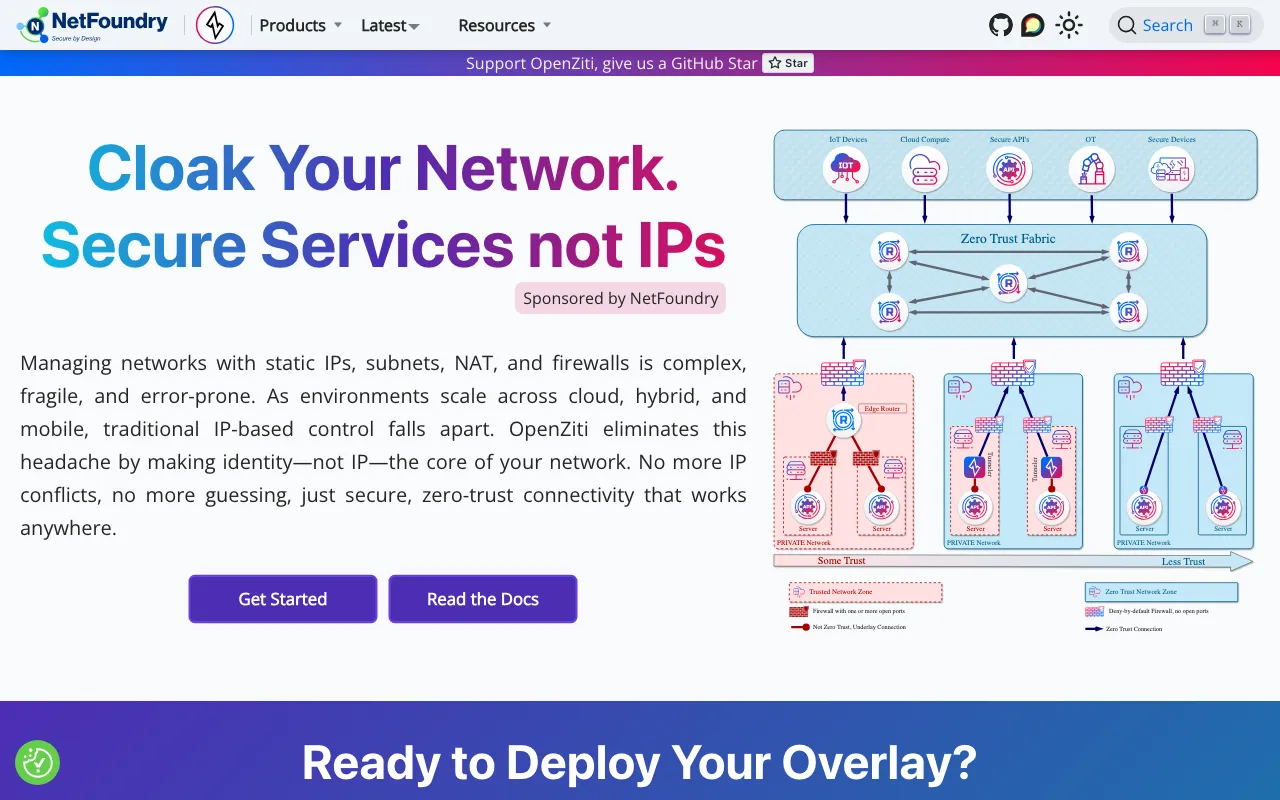
OpenZiti hides services behind cryptographic identity, policy, and end-to-end encryption. It supports tunnelers for existing apps and SDKs for embedded zero trust.
OpenZiti is an open-source zero-trust networking platform that makes services unreachable to unauthorized parties. Each user, service, device, or workload receives a cryptographic identity; connections are authorized by policy and encrypted end to end, using identity rather than IP location as the basis for access.
A controller manages identities, policies, and topology while edge routers form an encrypted mesh fabric for data traffic. Services can stay dark with no listening ports, registering outbound to the overlay so port scans and public endpoints are avoided. Management is available through REST APIs and a web-based admin console.
Teams can adopt three models in one network: edge routers at a trusted zone boundary, host tunnelers beside unmodified applications, or SDKs compiled into clients and servers for in-process encryption. Tunnelers exist for common desktop and mobile operating systems; SDKs cover several programming languages.
Typical goals include replacing broad VPN access with per-service authorization, securing machine-to-machine and IoT identity, linking multi-cloud and hybrid sites on one overlay, and reaching self-hosted resources without opening home router ports. The stack is intended to be fully operable on your own infrastructure.
OpenZiti doesn't name these products itself, but its own description shows it does the same job.
Self-hosted zero-trust secure access and tunnel platform
Octelium unifies VPN, ZTNA, secure tunnels, API and AI gateways, and PaaS-style deployments on Kubernetes you host yourself.

Distributed reverse proxy and edge security control plane
OpenFlare is an open-source reverse proxy and edge gateway with a central control plane and edge agents. It offers zero-reload config sync, WAF rules, tunnels, static Pages hosting, and ACME certificates.
Free domain registration with DNS learning resources
DigitalPlat FreeDomain lets people register free domains under several extensions, point custom nameservers at a DNS provider, and follow guides from setup through deployment.

Cross-platform Tauri desktop GUI for Clash Meta proxying
Clash Verge Rev is a desktop GUI for the Clash Meta proxy kernel on Windows, macOS, and Linux. It offers profile management, system proxy modes, and keeps configuration on your device.
Desktop GUI client for proxy cores
v2rayN is a graphical client for Windows, Linux, and macOS that works with Xray, sing-box, and related proxy stacks. Prebuilt packages ship for common CPU architectures.
Self-deployed reverse proxy for NAT and firewall bypass
frp pairs a public-facing frps server with frpc clients to expose TCP, UDP, HTTP, and HTTPS services behind NAT or firewalls, including P2P connect mode.