Open3D-ML
Open3D extension for 3D machine learning pipelines
Open3D-ML extends Open3D with tools for 3D data and ML, including semantic point cloud segmentation and 3D object detection with pretrained models and training pipelines.

Modular parallel Python t-SNE embedding library
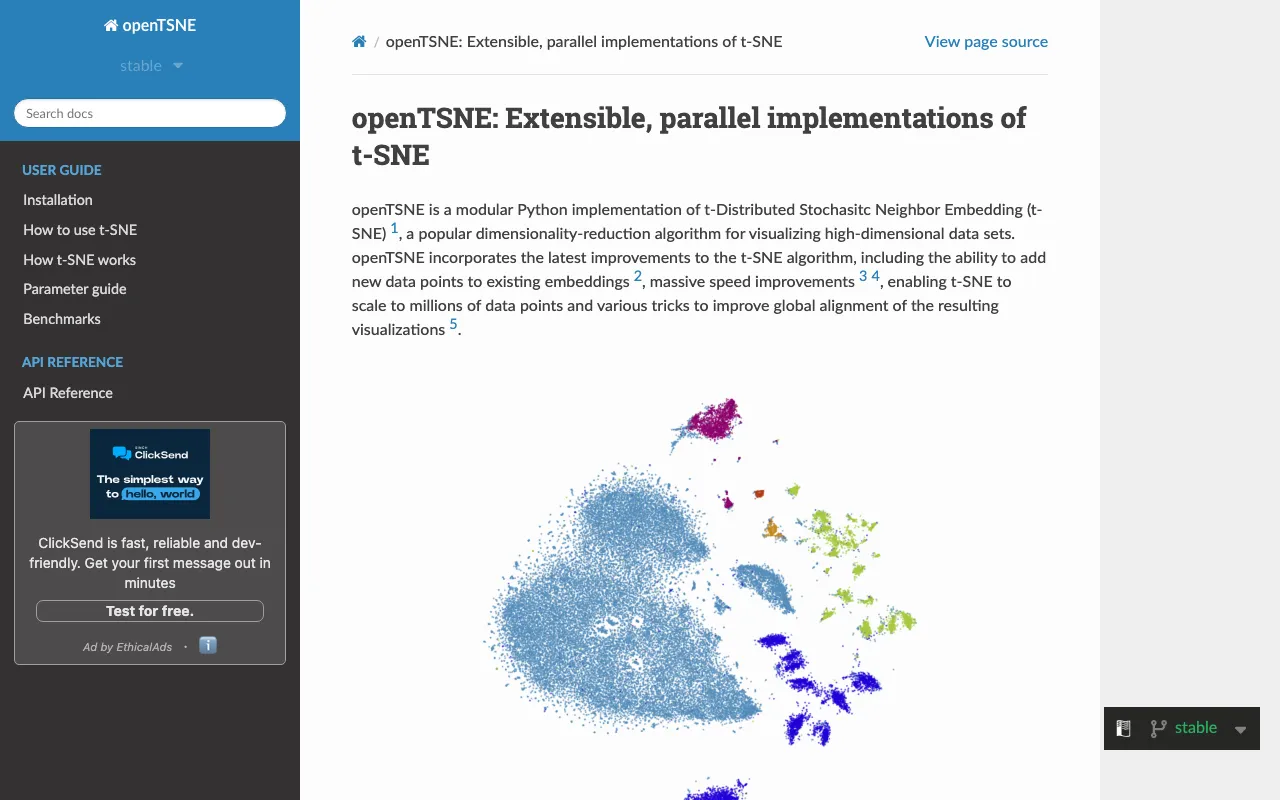
openTSNE implements t-SNE dimensionality reduction in Python with speed improvements, multithreading, and extensions for large data and new points.
openTSNE is a Python library for t-Distributed Stochastic Neighbor Embedding, used to visualize high-dimensional data in two or three dimensions. The design is modular and incorporates published accelerations, including tree-based and interpolation-based methods, so embeddings can scale to very large point counts when configured appropriately.
Capabilities highlighted in the documentation include adding new observations to an existing embedding, multiscale kernels to preserve global cluster structure, and parallel execution when the compiled components are built with OpenMP-capable compilers. Optional FFTW3 integration speeds Fourier steps used during optimization; otherwise SciPy FFT routines are used with lower performance on many-core runs.
Installation is available via conda-forge and PyPI for supported Python versions. A minimal workflow loads numeric data (for example from scikit-learn), constructs a TSNE object, and calls fit to obtain coordinates suitable for scatter plots. Advanced guides cover global structure preservation, very large datasets, parameter choices such as perplexity and exaggeration, and comparison notes relative to other implementations.
The project targets bioinformatics and machine learning practitioners who need interpretable 2D layouts of single-cell transcriptomes and similar tables, as well as engineers embedding openTSNE into analysis notebooks or pipelines.
Open3D extension for 3D machine learning pipelines
Open3D-ML extends Open3D with tools for 3D data and ML, including semantic point cloud segmentation and 3D object detection with pretrained models and training pipelines.

End-to-end machine learning platform and tooling ecosystem
TensorFlow is a machine learning platform with Python and C++ APIs, optional GPU packages, and companion libraries for data, training, deployment, and visualization.

Run open AI models locally or in the cloud
Ollama runs open language models such as Gemma, Qwen, DeepSeek and gpt-oss on macOS, Windows and Linux, locally or in the cloud. It offers a CLI, a REST API, and Python and JavaScript libraries.

Shared model definitions for multimodal ML workloads
Transformers is a Python library that defines pretrained text, vision, audio, and multimodal models once in PyTorch for shared inference and training across the ecosystem.

LLM inference engine in C/C++ for local and cloud hardware
llama.cpp runs large language models and multimodal models locally or in the cloud with minimal setup. It includes a CLI, an OpenAI-compatible server with a built-in chat app, and a C library API.

Open-source collaborative whiteboard for hand-drawn style diagrams
Excalidraw is a virtual whiteboard for sketching diagrams and wireframes in a hand-drawn style. It offers an infinite canvas, real-time collaboration with end-to-end encryption, and is also published as an npm package for embedding.
 Miro