Kubernetes
Open-source container scheduling and management system
Kubernetes (K8s) manages containerized applications across many hosts. It automates deployment, scaling, and ongoing operations for grouped containers.

Open-source cloud platform for compute, network, and storage
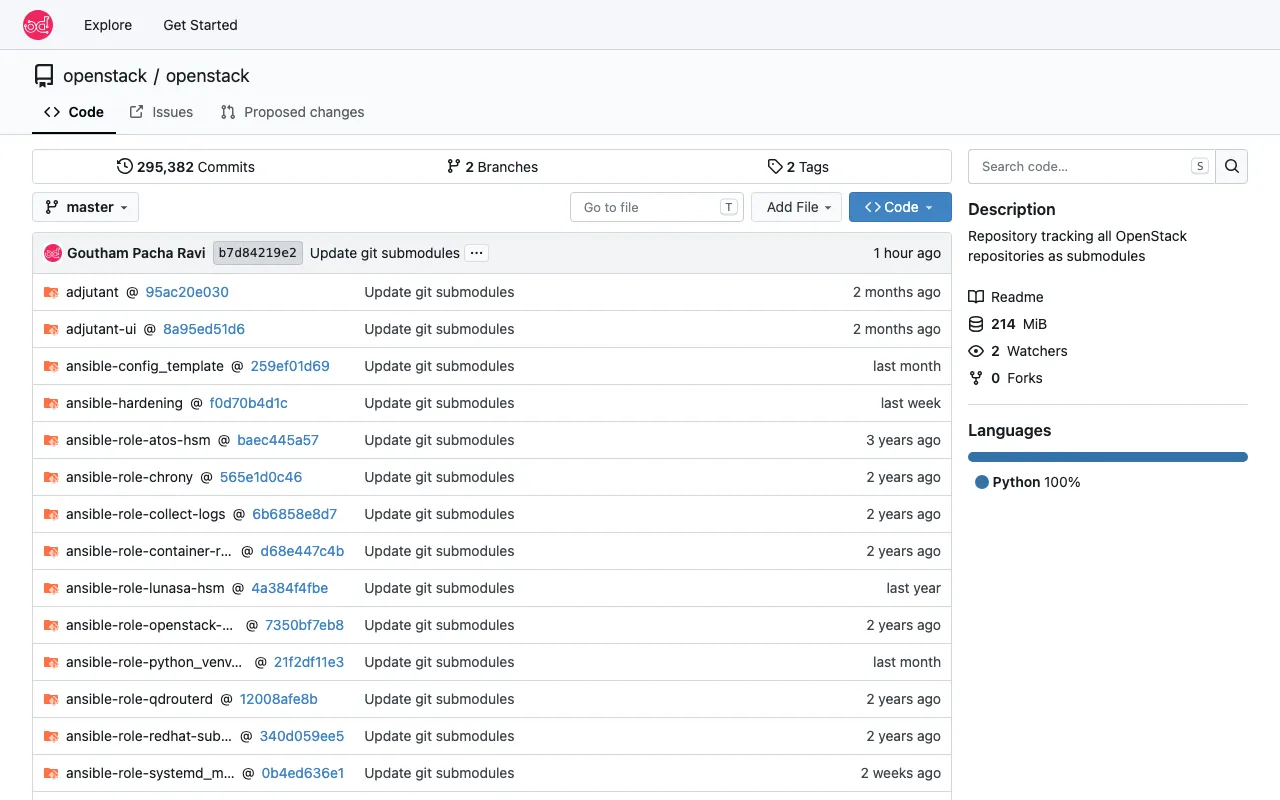
OpenStack bundles interoperable components that organizations deploy to deliver computing, networking, and storage. End users reach those resources through programmable APIs.
OpenStack is a collection of interoperable components aimed at private and public cloud infrastructure. When deployed together, the stack supplies computing capacity, networking, and storage that operators can offer to applications and teams.
Individual projects cover areas such as identity, block storage, object storage, networking, and orchestration, and they are designed to work together rather than as isolated tools. Operators typically choose the components they need and integrate them into a single cloud environment.
Consumers interact with the running cloud through programmable APIs instead of manual provisioning alone. That model supports automation, self-service request patterns, and integration with higher-level application platforms.
Organizations adopt OpenStack to run infrastructure under their own policies and hardware choices while still using a modular, component-based architecture familiar across the ecosystem.
Open-source container scheduling and management system
Kubernetes (K8s) manages containerized applications across many hosts. It automates deployment, scaling, and ongoing operations for grouped containers.

Self-hostable PaaS for apps, databases, and one-click services
Coolify deploys static sites, databases, and full-stack apps on servers you control, with a dashboard similar to managed hosting platforms. Configurations stay on your machines over SSH.
Automated Windows VMs inside Docker with KVM acceleration
Dockur Windows runs full Windows desktops or servers in a container with hands-free ISO install. It supports many releases, RDP, shared folders, and flexible networking.

Web UI for Docker, Swarm, and Kubernetes fleets
Portainer Community Edition offers a browser-based console to manage Docker, Swarm, Podman, Kubernetes, and ACI environments from one place. A commercial edition adds enterprise governance, GitOps, and support.

Self-hostable PaaS for apps and databases
Dokploy is a self-hostable platform-as-a-service for deploying applications and databases on your own VPS. It supports Docker, Compose, multi-server setups, backups, and monitoring.

Service mesh for securing and observing microservices
Istio layers onto Kubernetes and other platforms to manage traffic, security, and telemetry for microservices with minimal application code changes.
 Heroku
 Netlify