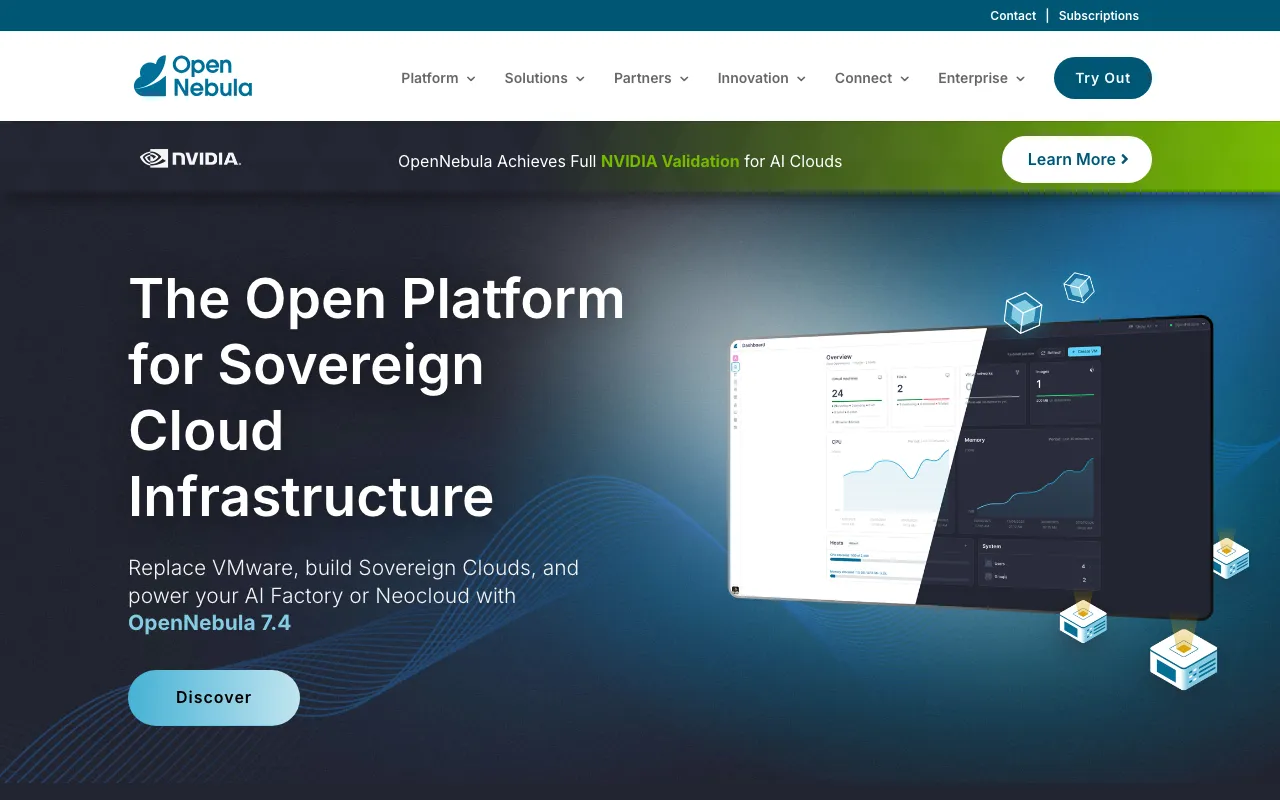
OpenNebula manages private clouds, edge sites, and hybrid deployments. It unifies virtual machines, Kubernetes clusters, and GPU workloads from one control plane.
Overview
OpenNebula is a cloud management platform for building and operating private clouds, edge infrastructure, distributed cloud deployments, and AI-focused compute environments. It gives operators a single place to run virtualized, containerized, and GPU-backed workloads across on-premises, edge, and hybrid setups.
The platform exposes a web interface, command-line tools, a REST API, Terraform integration, and other automation hooks. Federated architecture supports multiple sites and regions. Built-in high availability, automated provisioning, role-based access control with quotas and isolation, and a marketplace of virtual appliances and templates are part of the feature set.
Kubernetes clusters can be deployed and lifecycle-managed from the same environment. The stack also targets AI factory scenarios with support for GPU workloads, model training, LLM inference, and related services. Evaluation can start with miniONE, which deploys a full environment on one server; production setups follow documented installation and upgrade paths.
The vendor positions OpenNebula as an open option for sovereign cloud infrastructure, with stated parity to enterprise virtualization feature sets and tooling to move workloads from proprietary hypervisor stacks.
Key features
- Unified VM, container, and GPU workload management
- Web UI, CLI, REST API, and Terraform provider
- Multi-site federated cloud operations
- Built-in high availability
- Integrated Kubernetes cluster lifecycle
- Secure multi-tenancy with RBAC and quotas
- Marketplace templates and appliances
- Automated infrastructure provisioning
Use cases
- Private and hybrid enterprise clouds
- Edge and distributed infrastructure
- AI factory and GPU cluster operations
- VMware replacement migrations
- Multi-tenant cloud governance


 Heroku
 Netlify