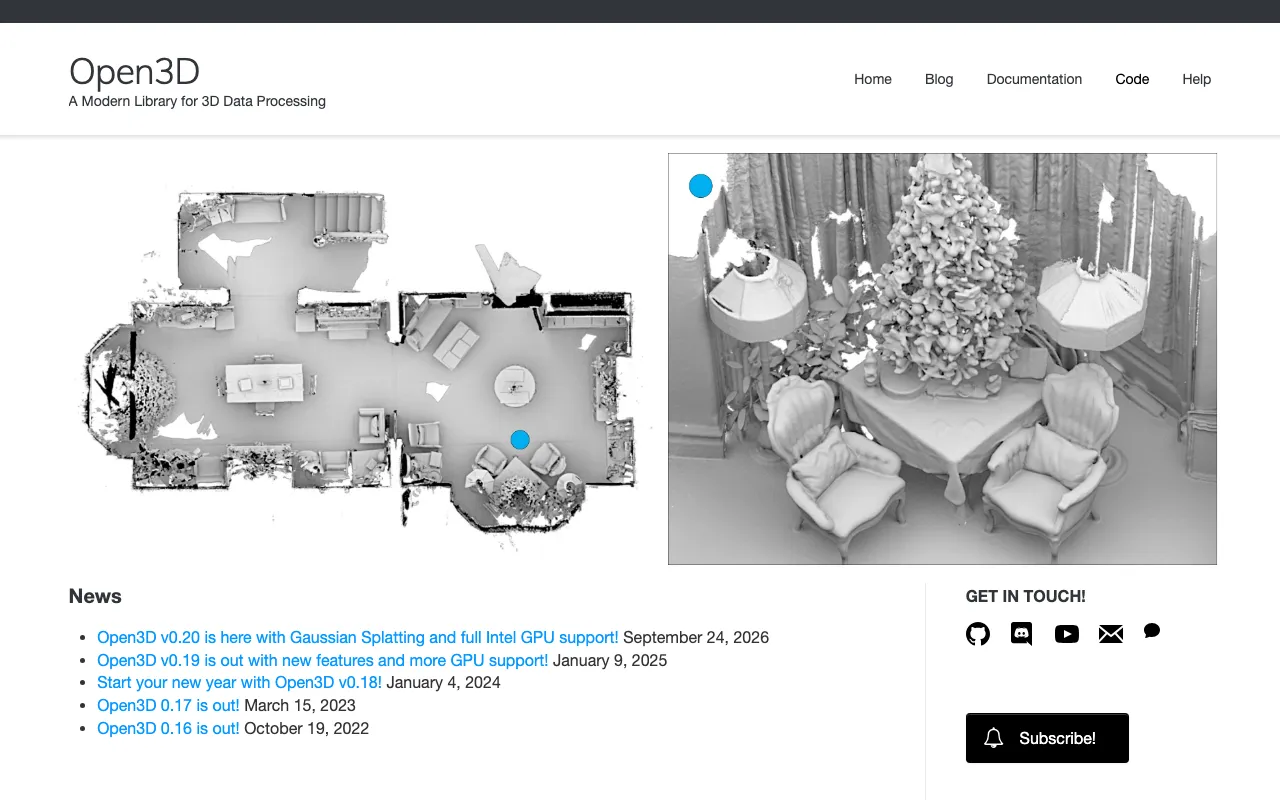
Open3D is an open-source library for software that works with 3D data. It exposes data structures and algorithms in C++ and Python with an optimized, parallelized backend.
Overview
Open3D supports rapid development of applications that process 3D data. Its frontend offers selected data structures and algorithms in C++ and Python, while the backend is tuned for parallel execution.
Core capabilities include 3D data structures and processing algorithms, scene reconstruction, surface alignment, visualization, physically based rendering, and GPU acceleration for core 3D work. Open3D-ML extends the core with machine learning tooling for 3D tasks when used with PyTorch or TensorFlow.
Pre-built Python packages are available via pip for Ubuntu, macOS, and Windows. C++ users can use binary packages or integrate the library into their projects. Open3D-Viewer is a separate viewer application for Debian-based systems, macOS, and Windows.
Components can be combined into end-to-end pipelines for reconstruction, registration, segmentation, and related 3D workflows.
Key features
- 3D data structures and algorithms
- Scene reconstruction
- Surface alignment and registration
- 3D visualization and PBR
- PyTorch and TensorFlow ML support
- GPU-accelerated 3D operations
- C++ and Python APIs
- Standalone Open3D-Viewer app
Use cases
- Point cloud processing
- Mesh manipulation
- 3D visualization pipelines
- 3D machine learning workflows
- Research and cloud 3D processing


 Miro