
TensorFlow
End-to-end machine learning platform and tooling ecosystem
TensorFlow is a machine learning platform with Python and C++ APIs, optional GPU packages, and companion libraries for data, training, deployment, and visualization.
Unified gateway for multiple LLM provider APIs
One API has had no code changes for over 18 months (last commit 1 year ago).
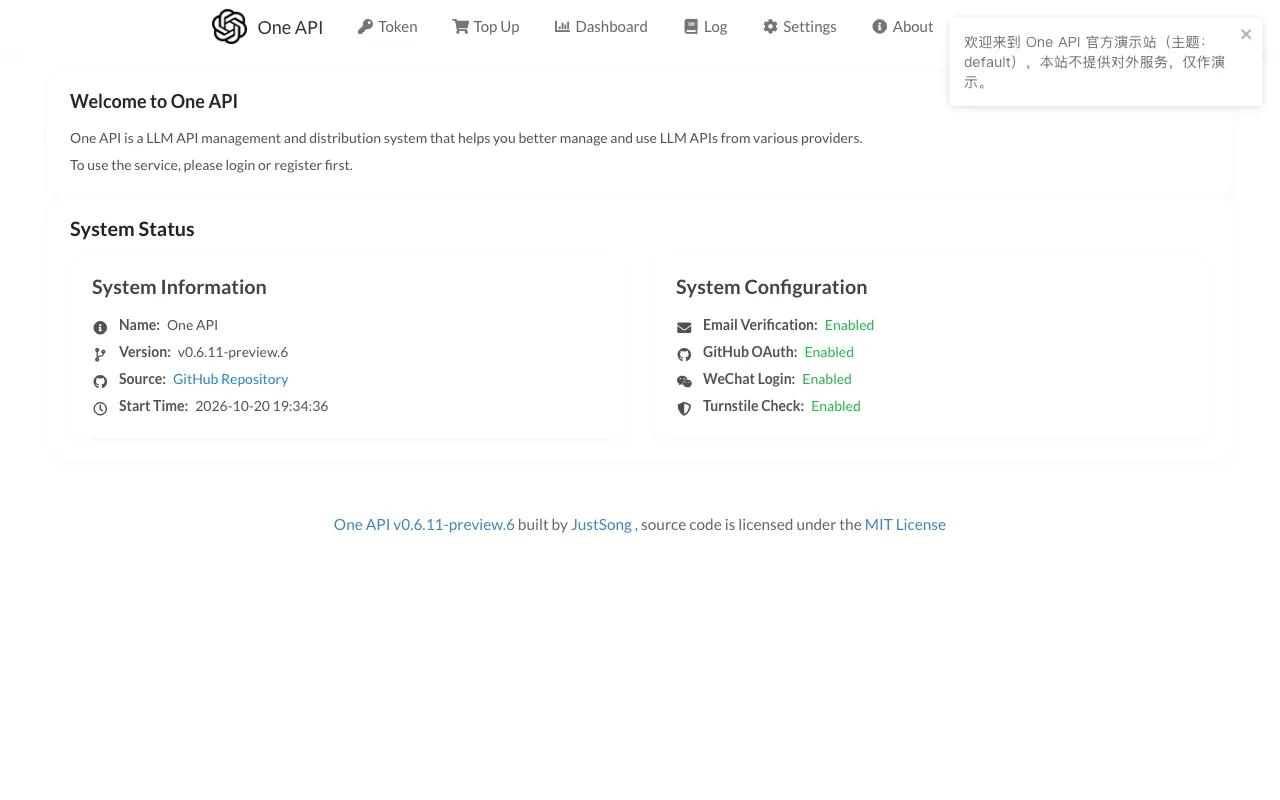
One API is a management and relay service that exposes many large-language-model vendors through one OpenAI-compatible HTTP API. It handles keys, channels, quotas, and user accounts from a web console.
One API centralizes access to diverse LLM backends—covering OpenAI, Azure OpenAI, Anthropic Claude, Google Gemini, DeepSeek, domestic Chinese models, and others listed in project docs—behind a single OpenAI-style interface. Administrators add upstream channel keys in the console, create access tokens for clients, and route traffic with optional load balancing across channels.
The web UI supports user registration and login (including email and third-party OAuth options documented in the project), per-token quotas and IP restrictions, channel and user grouping with configurable rate multipliers, redemption codes for balance top-ups, usage ledgers, announcements, and customizable branding pages. Streaming responses are supported so clients can render incremental output, and failed requests can retry automatically per configuration.
Deployment is built around a single executable or Docker image listening on a configurable port, with optional MySQL or PostgreSQL instead of SQLite for production, Redis caching, and multi-node master–slave layouts sharing one database. Environment variables control session secrets, sync intervals, rate limits, proxies, and operational tuning for high concurrency installs.
Downstream apps such as ChatGPT-style web front ends or bots point their API base URL and token at a self-hosted One API instance, optionally pinning a specific channel on admin-issued tokens. The admin API also allows automation without modifying core source when a system access token is configured.
End-to-end machine learning platform and tooling ecosystem
TensorFlow is a machine learning platform with Python and C++ APIs, optional GPU packages, and companion libraries for data, training, deployment, and visualization.

Run open AI models locally or in the cloud
Ollama runs open language models such as Gemma, Qwen, DeepSeek and gpt-oss on macOS, Windows and Linux, locally or in the cloud. It offers a CLI, a REST API, and Python and JavaScript libraries.

Shared model definitions for multimodal ML workloads
Transformers is a Python library that defines pretrained text, vision, audio, and multimodal models once in PyTorch for shared inference and training across the ecosystem.

LLM inference engine in C/C++ for local and cloud hardware
llama.cpp runs large language models and multimodal models locally or in the cloud with minimal setup. It includes a CLI, an OpenAI-compatible server with a built-in chat app, and a C library API.

General-purpose speech recognition and translation model
Whisper is a speech recognition model trained on diverse audio. It supports multilingual transcription, speech-to-English translation, and language identification via Python or the command line.

Promise-based HTTP client for browser and Node.js
Axios is a promise-based HTTP client for JavaScript environments in the browser and Node.js. It supports common request methods, configurable defaults, and interceptors for request and response handling.