
TensorFlow
End-to-end machine learning platform and tooling ecosystem
TensorFlow is a machine learning platform with Python and C++ APIs, optional GPU packages, and companion libraries for data, training, deployment, and visualization.

Scientific computing arrays and numerical Python tools
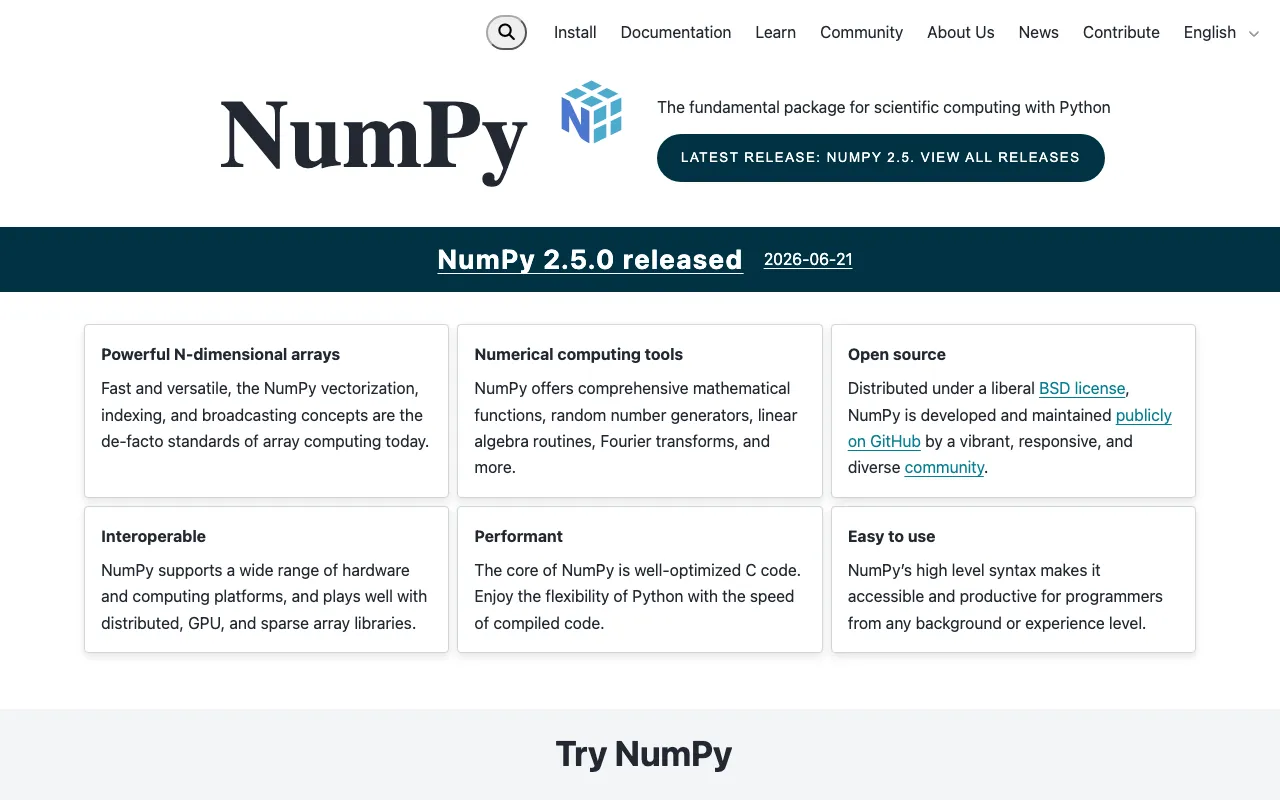
Core Python package for N-dimensional arrays, broadcasting, linear algebra, Fourier transforms, and random numbers used across science and data work.
NumPy is the foundational Python package for scientific and numerical computing. Its central N-dimensional array type and broadcasting rules underpin much of the Python data and machine learning stack.
The library ships vectorized operations, linear algebra routines, Fourier transforms, random number generators, and hooks to integrate C, C++, and Fortran code. High-level Python syntax sits on optimized native implementations intended to combine flexibility with compiled speed.
NumPy interoperates with GPU, distributed, and sparse array libraries and serves as a common API surface other array frameworks emulate. The project website highlights adoption across domains from data science to imaging, networks, geospatial tools, and quantum computing ecosystems.
An in-browser interactive shell on the project site lets visitors try small array examples without a local install, while typical use remains `import numpy` inside Python applications and notebooks.
End-to-end machine learning platform and tooling ecosystem
TensorFlow is a machine learning platform with Python and C++ APIs, optional GPU packages, and companion libraries for data, training, deployment, and visualization.

Run open AI models locally or in the cloud
Ollama runs open language models such as Gemma, Qwen, DeepSeek and gpt-oss on macOS, Windows and Linux, locally or in the cloud. It offers a CLI, a REST API, and Python and JavaScript libraries.

Shared model definitions for multimodal ML workloads
Transformers is a Python library that defines pretrained text, vision, audio, and multimodal models once in PyTorch for shared inference and training across the ecosystem.

LLM inference engine in C/C++ for local and cloud hardware
llama.cpp runs large language models and multimodal models locally or in the cloud with minimal setup. It includes a CLI, an OpenAI-compatible server with a built-in chat app, and a C library API.

General-purpose speech recognition and translation model
Whisper is a speech recognition model trained on diverse audio. It supports multilingual transcription, speech-to-English translation, and language identification via Python or the command line.

High-throughput, memory-efficient inference and serving engine for LLMs
vLLM is a library and server for running and serving large language models. It uses PagedAttention and continuous batching for throughput, offers an OpenAI-compatible API, and runs on many GPU, CPU and accelerator types.