
TensorFlow
End-to-end machine learning platform and tooling ecosystem
TensorFlow is a machine learning platform with Python and C++ APIs, optional GPU packages, and companion libraries for data, training, deployment, and visualization.

User-friendly neural time series forecasting for Python
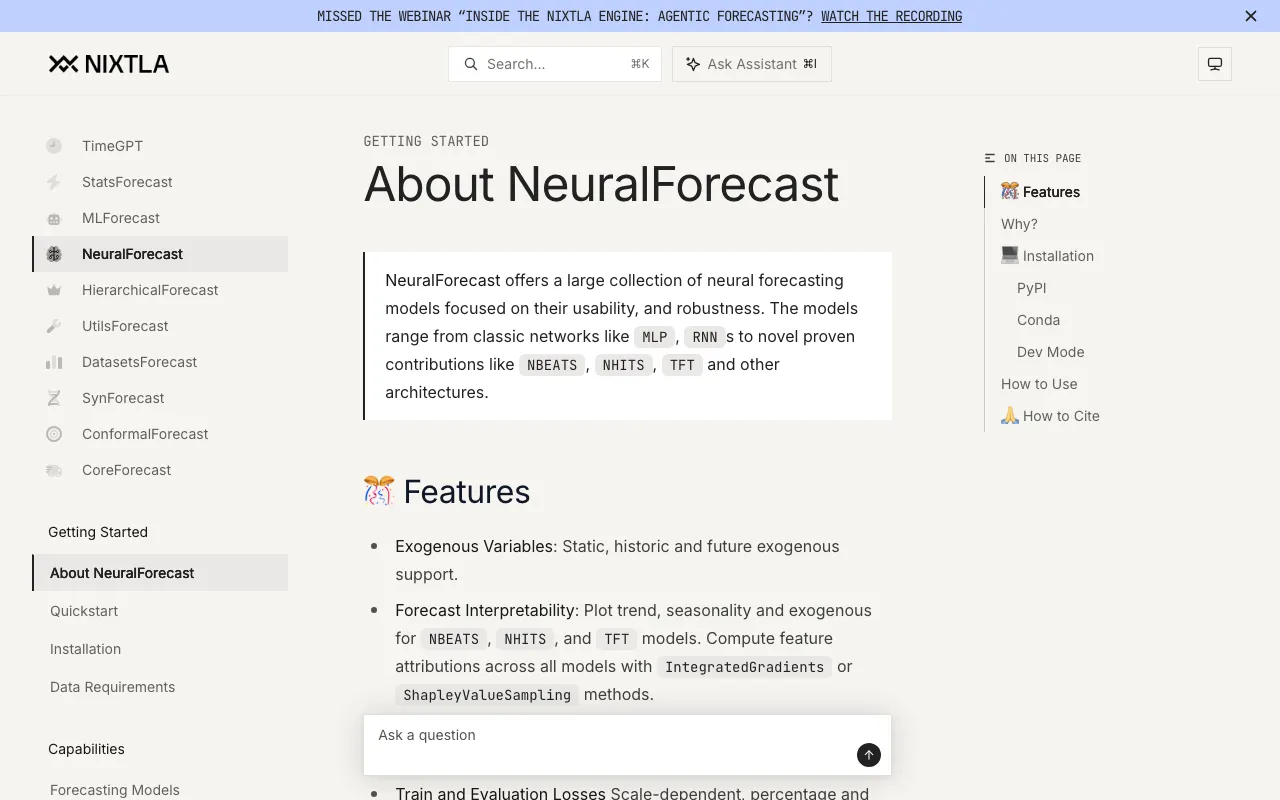
NeuralForecast is a Python library with many neural models for time series forecasting. It emphasizes usable implementations, sklearn-style fit and predict, and ties to the Nixtla forecasting stack.
NeuralForecast gathers neural forecasting models in one Python package, from classical recurrent networks through transformer-style architectures. The focus stated in the source is accuracy, usability, and robustness rather than research-only code paths.
You install it from PyPI or conda and work with a familiar sklearn-like API: construct a NeuralForecast object, call fit on panel time series data, then predict. Inputs and outputs align with StatsForecast, MLForecast, and HierarchicalForecast for mixed statistical and neural pipelines.
Documented capabilities include exogenous and static covariates, probabilistic forecasting via quantile losses and parametric distributions, multiple train and evaluation loss types, and interpretability for trend, seasonality, and exogenous components on selected models. Ray and Optuna integrations support distributed hyperparameter tuning.
Companion packages utilsforecast and coreforecast help with plotting and data preparation. Saved models from recent releases use safetensors and JSON metadata instead of pickle by default, with migration paths for older checkpoints.
End-to-end machine learning platform and tooling ecosystem
TensorFlow is a machine learning platform with Python and C++ APIs, optional GPU packages, and companion libraries for data, training, deployment, and visualization.

Run open AI models locally or in the cloud
Ollama runs open language models such as Gemma, Qwen, DeepSeek and gpt-oss on macOS, Windows and Linux, locally or in the cloud. It offers a CLI, a REST API, and Python and JavaScript libraries.

Shared model definitions for multimodal ML workloads
Transformers is a Python library that defines pretrained text, vision, audio, and multimodal models once in PyTorch for shared inference and training across the ecosystem.

LLM inference engine in C/C++ for local and cloud hardware
llama.cpp runs large language models and multimodal models locally or in the cloud with minimal setup. It includes a CLI, an OpenAI-compatible server with a built-in chat app, and a C library API.

General-purpose speech recognition and translation model
Whisper is a speech recognition model trained on diverse audio. It supports multilingual transcription, speech-to-English translation, and language identification via Python or the command line.

High-throughput, memory-efficient inference and serving engine for LLMs
vLLM is a library and server for running and serving large language models. It uses PagedAttention and continuous batching for throughput, offers an OpenAI-compatible API, and runs on many GPU, CPU and accelerator types.