
TensorFlow
End-to-end machine learning platform and tooling ecosystem
TensorFlow is a machine learning platform with Python and C++ APIs, optional GPU packages, and companion libraries for data, training, deployment, and visualization.
NeMo orchestration framework for synthetic datasets
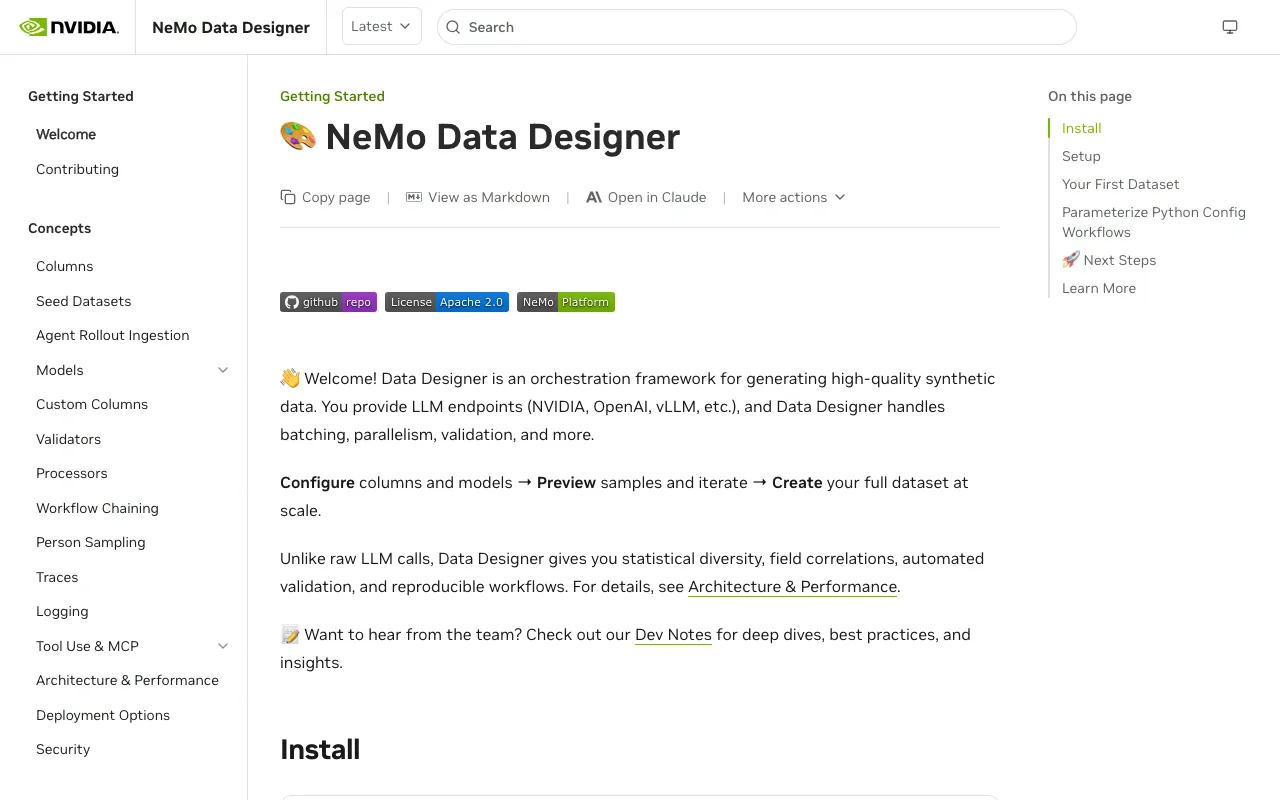
NeMo Data Designer builds structured synthetic datasets with samplers, LLMs, validators, and seed data, using your chosen model endpoints.
NeMo Data Designer is an orchestration framework for generating synthetic data. You configure columns and model providers, preview samples, then create full datasets at scale. It goes beyond one-off LLM prompts by supporting statistical samplers, field dependencies, validation, and reproducible workflows.
You can generate text, structured fields, and images from samplers, language models, image models, or seed files. Multimodal pipelines can include image, audio, and video context. Generation can call local or remote MCP servers and record interaction traces. Outputs are validated with Python, SQL, custom checks, or LLM judges, and runs can be previewed, resumed, and monitored.
Install via pip as data-designer, set API keys for providers such as NVIDIA Build, OpenAI, or OpenRouter, and use the CLI or Python DataDesigner API. Optional plugin packages extend sources and processing steps. A companion agent skill helps coding agents design schemas and run generation.
Unlike bare API calls, the framework emphasizes diversity across fields, correlations, and automated validation. Documentation covers deployment as a library versus a microservice option.
End-to-end machine learning platform and tooling ecosystem
TensorFlow is a machine learning platform with Python and C++ APIs, optional GPU packages, and companion libraries for data, training, deployment, and visualization.

Run open AI models locally or in the cloud
Ollama runs open language models such as Gemma, Qwen, DeepSeek and gpt-oss on macOS, Windows and Linux, locally or in the cloud. It offers a CLI, a REST API, and Python and JavaScript libraries.

Shared model definitions for multimodal ML workloads
Transformers is a Python library that defines pretrained text, vision, audio, and multimodal models once in PyTorch for shared inference and training across the ecosystem.

LLM inference engine in C/C++ for local and cloud hardware
llama.cpp runs large language models and multimodal models locally or in the cloud with minimal setup. It includes a CLI, an OpenAI-compatible server with a built-in chat app, and a C library API.

High-throughput, memory-efficient inference and serving engine for LLMs
vLLM is a library and server for running and serving large language models. It uses PagedAttention and continuous batching for throughput, offers an OpenAI-compatible API, and runs on many GPU, CPU and accelerator types.
OpenAI-compatible AI gateway with provider routing
OmniRoute exposes one endpoint that routes chat requests across many LLM providers with quota-aware fallback and compression.