
TensorFlow
End-to-end machine learning platform and tooling ecosystem
TensorFlow is a machine learning platform with Python and C++ APIs, optional GPU packages, and companion libraries for data, training, deployment, and visualization.
Multi-GPU collective communication primitives
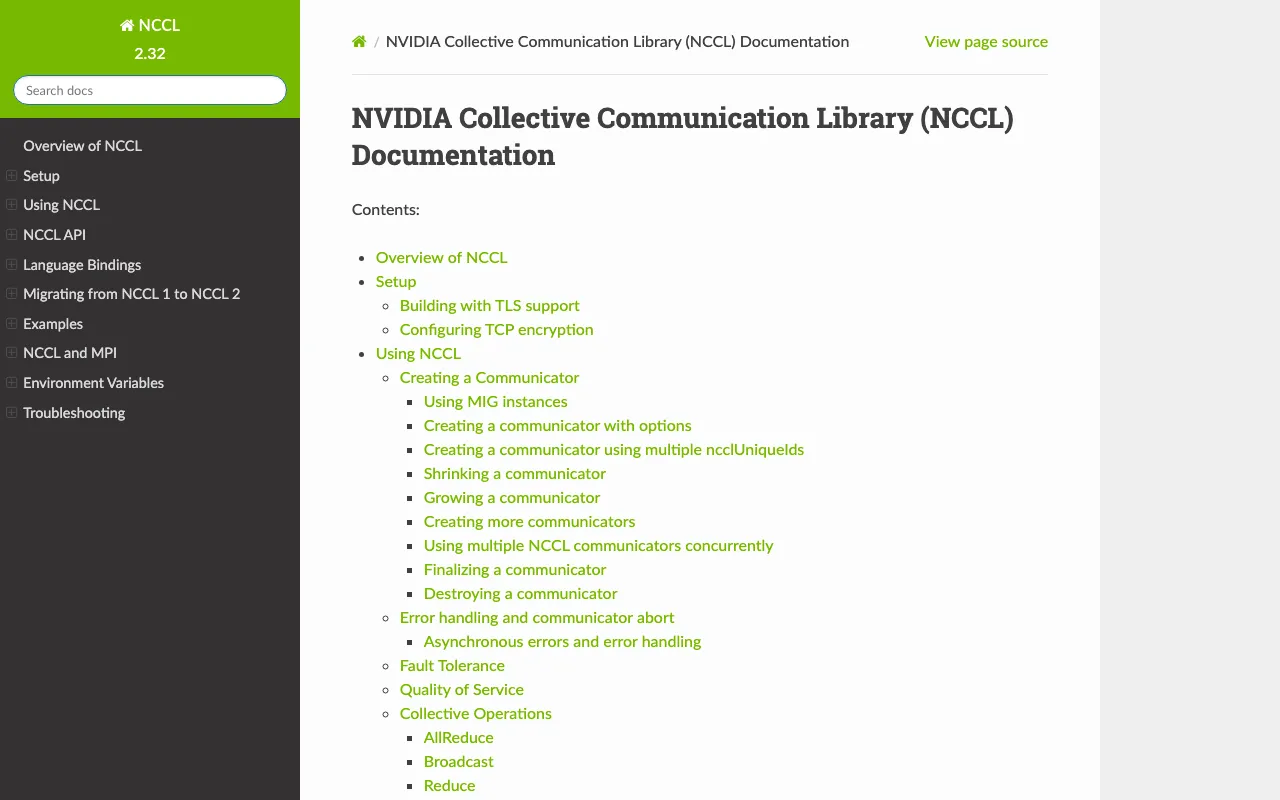
NCCL provides standard GPU collective communication routines such as all-reduce and broadcast. It targets high bandwidth over PCIe, NVLink, InfiniBand, or TCP.
NVIDIA Collective Communication Library (NCCL) is a stand-alone library of communication routines for GPUs. It implements collectives including all-reduce, all-gather, reduce, broadcast, reduce-scatter, all-to-all, gather, scatter, and arbitrary send-receive patterns.
The implementation is tuned for bandwidth on PCIe, NVLink, NVswitch, InfiniBand Verbs, and TCP/IP sockets. It supports many GPUs on one machine or spread across nodes, and can be used from single-process or multi-process programs such as those coordinated with MPI.
Official documentation covers communicator lifecycle, collective and point-to-point APIs, group semantics, CUDA stream usage, buffer registration, fault-tolerance options, Python bindings (NCCL4Py), and interoperability notes with MPI and CUDA Graphs. Environment variables document tuning for sockets, InfiniBand, debugging, and topology.
Prebuilt binaries are referenced in the project materials, and source builds compile with CUDA toolchains into installable packages for common Linux distributions or as Python wheels. Tests are maintained in a separate repository.
End-to-end machine learning platform and tooling ecosystem
TensorFlow is a machine learning platform with Python and C++ APIs, optional GPU packages, and companion libraries for data, training, deployment, and visualization.

Run open AI models locally or in the cloud
Ollama runs open language models such as Gemma, Qwen, DeepSeek and gpt-oss on macOS, Windows and Linux, locally or in the cloud. It offers a CLI, a REST API, and Python and JavaScript libraries.

Shared model definitions for multimodal ML workloads
Transformers is a Python library that defines pretrained text, vision, audio, and multimodal models once in PyTorch for shared inference and training across the ecosystem.

LLM inference engine in C/C++ for local and cloud hardware
llama.cpp runs large language models and multimodal models locally or in the cloud with minimal setup. It includes a CLI, an OpenAI-compatible server with a built-in chat app, and a C library API.

General-purpose speech recognition and translation model
Whisper is a speech recognition model trained on diverse audio. It supports multilingual transcription, speech-to-English translation, and language identification via Python or the command line.

High-throughput, memory-efficient inference and serving engine for LLMs
vLLM is a library and server for running and serving large language models. It uses PagedAttention and continuous batching for throughput, offers an OpenAI-compatible API, and runs on many GPU, CPU and accelerator types.