
Spleeter
Pretrained music source separation library
Spleeter splits mixed audio into stems such as vocals, drums, bass, and other parts using pretrained TensorFlow models. It runs from the command line, as a Python package, or via Docker.

Multilingual multi-speaker spoken dialogue synthesis model
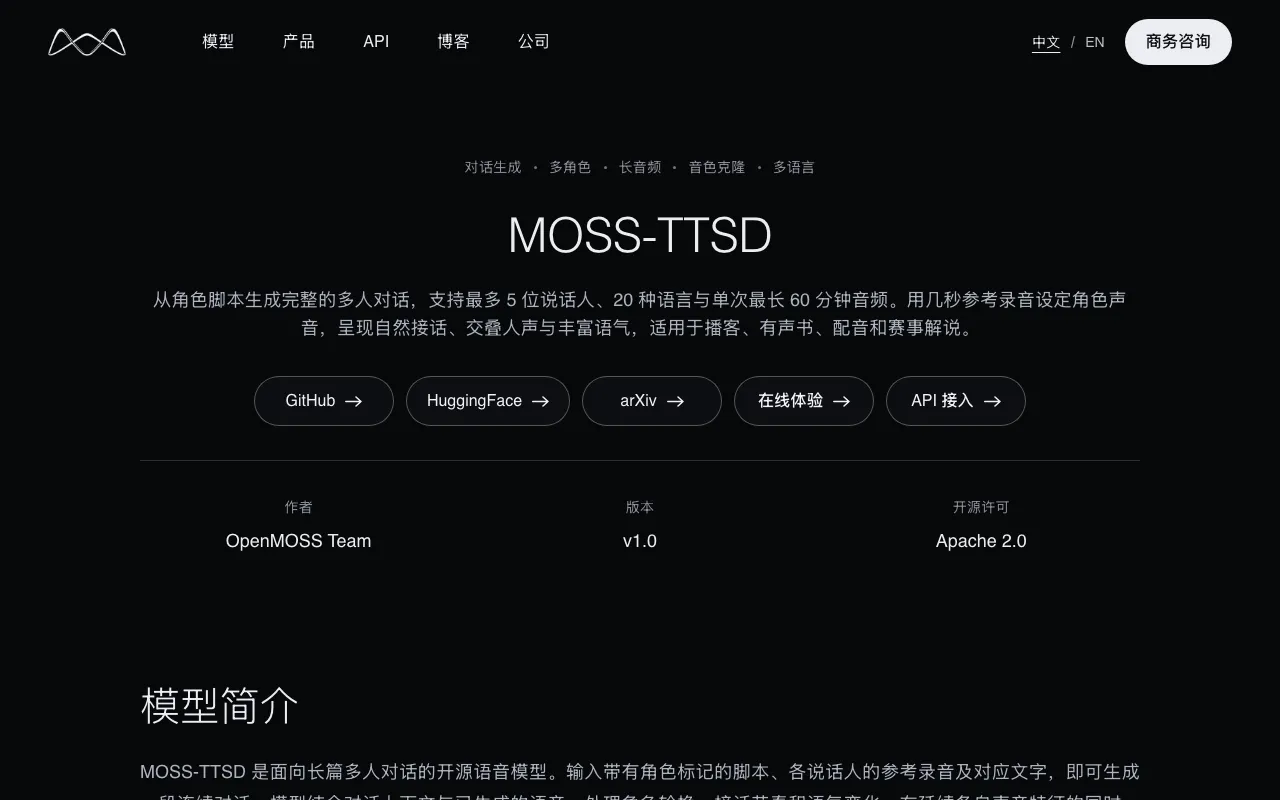
MOSS-TTSD generates long, multi-speaker conversational audio from dialogue scripts with reference voices. It supports up to five speakers and twenty languages in one session.
MOSS-TTSD is part of the open MOSS-TTS family and focuses on long-form spoken dialogue rather than single-voice narration. You supply per-speaker reference audio and text prefixes plus a script marked with [S1]–[S5] tags; the model continues each voice identity through turns, overlap, and extended context.
It is tuned for podcasts, sports and esports commentary, audiobooks, dubbing, and similar multi-party audio. Documented context reaches long single-session generation on the order of an hour, with voice cloning from short reference clips and cross-lingual use of those timbres across supported languages.
Inference runs from JSONL batch scripts with modes such as voicecloneandcontinuation, or through an optional fused SGLang end-to-end service that returns base64 WAV audio from a generation API. Fine-tuning code has been published for full-parameter, LoRA, and multi-node training on earlier versions.
The project ships under Apache 2.0 with a usage disclaimer warning against impersonation and other misuse. Evaluation tables compare speaker attribution and similarity metrics against other open and proprietary dialogue systems named in the documentation.
Pretrained music source separation library
Spleeter splits mixed audio into stems such as vocals, drums, bass, and other parts using pretrained TensorFlow models. It runs from the command line, as a Python package, or via Docker.
Native C++ local inference for audio models
A ggml-based C++ runtime for speech, music, and audio tasks with CLI, server API, and built-in WebUI—no Python required.
Command-line audio and video downloader for many sites
yt-dlp downloads audio and video from thousands of sites via the command line. It extends the youtube-dl lineage with added options, extractors, and release binaries for major platforms.

End-to-end machine learning platform and tooling ecosystem
TensorFlow is a machine learning platform with Python and C++ APIs, optional GPU packages, and companion libraries for data, training, deployment, and visualization.

Run open AI models locally or in the cloud
Ollama runs open language models such as Gemma, Qwen, DeepSeek and gpt-oss on macOS, Windows and Linux, locally or in the cloud. It offers a CLI, a REST API, and Python and JavaScript libraries.

Shared model definitions for multimodal ML workloads
Transformers is a Python library that defines pretrained text, vision, audio, and multimodal models once in PyTorch for shared inference and training across the ecosystem.