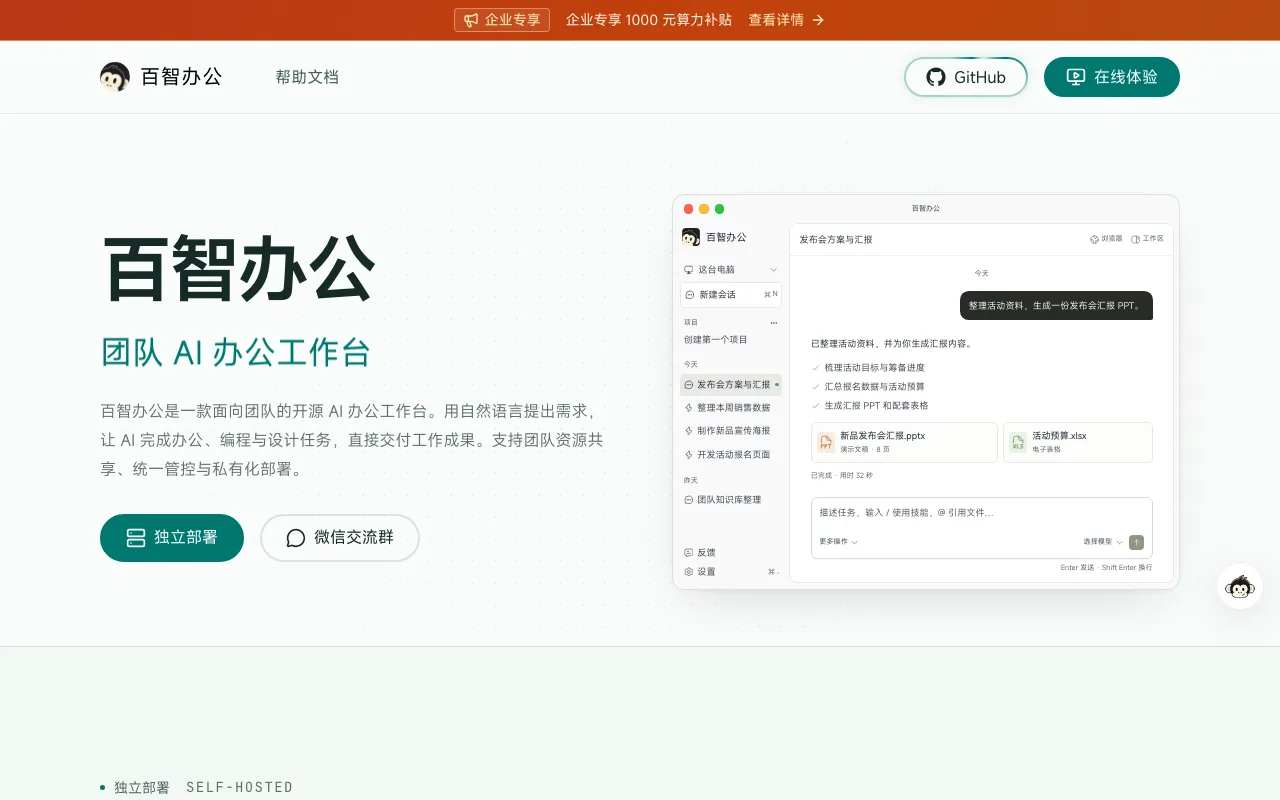
Baizhi Office (MonkeyAI) is a team AI workbench where members describe goals in natural language and receive finished office, coding, and design outputs. It offers shared AI resources, admin controls, and private deployment.
Overview
Baizhi Office, also branded MonkeyAI, is an open-source AI office platform built for teams. People state what they need in everyday language, supply materials, and the system carries out tasks across office work, software development, and creative design, returning concrete deliverables instead of chat-only replies.
For office work it can produce presentations, documents, spreadsheets, and organized files from scattered inputs. For programming it supports architecture thinking, implementation, testing, and fixes driven by requirements. For design it covers posters, graphic work, interaction design, and short-form video style production around a brief.
Teams connect through web and client apps while administrators run an enterprise panel. The panel centralizes shared large language models, knowledge bases, skills, experts, MCP connectors, and rules, along with usage metering, permissions, audit trails, and usage statistics. Groups may attach their own model endpoints and business tools to match internal processes.
The product is meant to be operated on your own infrastructure. Deployment is documented with lightweight hardware guidance, Docker Compose from source, and ongoing backup and upgrade notes. Data, access policy, and runtime environment stay under the customer’s control, with optional paid tiers for larger seat counts and extra services.
Key features
- Natural-language tasks with finished deliverables
- Office outputs including PPT, docs, and spreadsheets
- AI-assisted coding from design through fixes
- Visual and interaction design production
- Shared models, knowledge, skills, and MCP links
- Enterprise panel for billing, rights, and audit
- Documented private server deployment
- Cross-device clients plus browser access
Use cases
- Turn source materials into briefing decks and tables
- Implement features and tests from written requirements
- Create campaign visuals from a creative brief
- Govern team AI usage in a private deployment
- Reuse org models and tools across members


 ChatGPT

 Anthropic Claude