
TensorFlow
End-to-end machine learning platform and tooling ecosystem
TensorFlow is a machine learning platform with Python and C++ APIs, optional GPU packages, and companion libraries for data, training, deployment, and visualization.

Open-source, self-hostable experiment tracking for machine learning
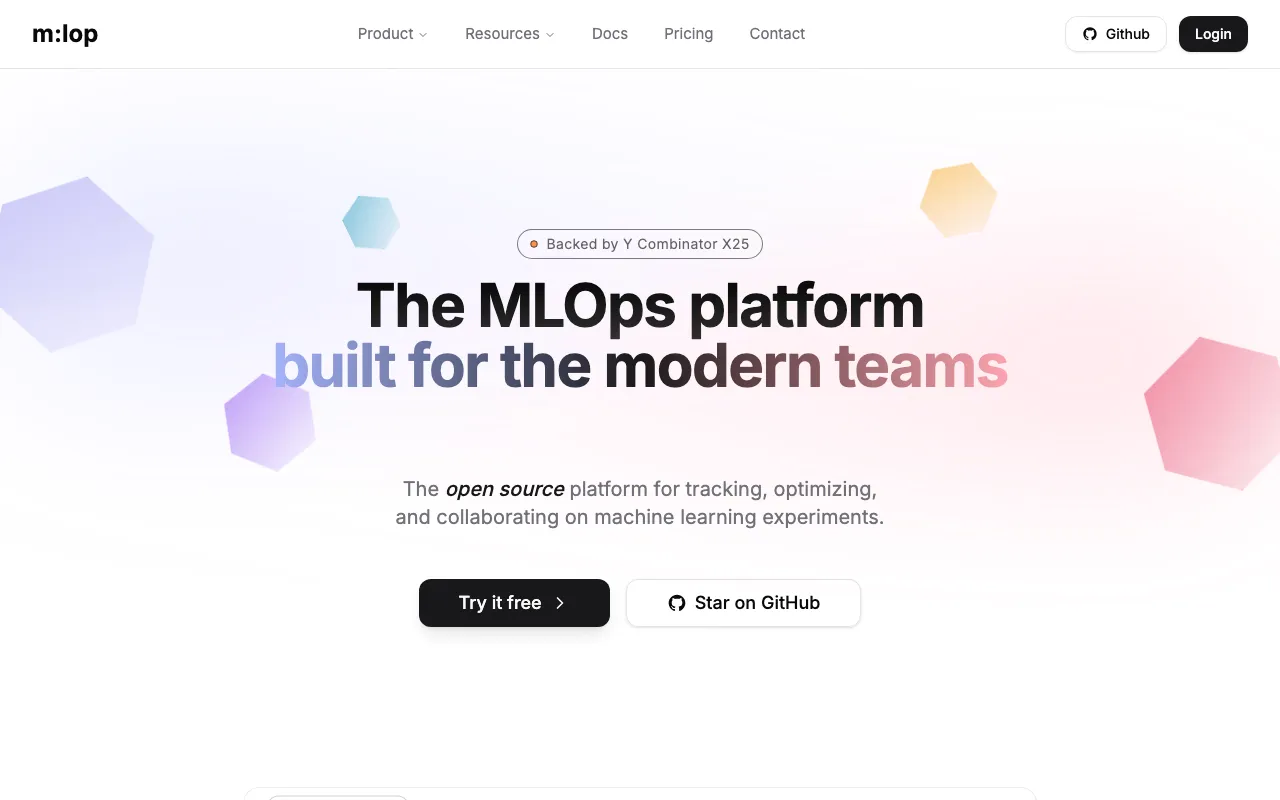
mlop is an MLOps platform for tracking machine learning experiments, metrics, parameters and media. It can be self-hosted with docker-compose or used as a hosted service, and offers a Weights & Biases-compatible API.
mlop is an experiment tracking and lifecycle management platform for training machine learning models. A Python client lets you initialize a run, log metrics and media such as images, and finish the run. The platform records the results so you can follow model performance over time.
The website describes real-time tracking of parameters and gradients, multi-media tracking, and reproducibility information such as git status and uncommitted files for each experiment. Alerting and email notifications are meant to flag problems in model performance. A compute offering is listed as private beta and inference as coming soon.
mlop can be self-hosted using docker-compose, and a hosted account is also available. The project says its API is compatible with the Weights & Biases API, which is meant to make migration easier. It describes a design focused on high and stable data throughput. The documentation includes introductory and PyTorch tutorials.
End-to-end machine learning platform and tooling ecosystem
TensorFlow is a machine learning platform with Python and C++ APIs, optional GPU packages, and companion libraries for data, training, deployment, and visualization.

Run open AI models locally or in the cloud
Ollama runs open language models such as Gemma, Qwen, DeepSeek and gpt-oss on macOS, Windows and Linux, locally or in the cloud. It offers a CLI, a REST API, and Python and JavaScript libraries.

Shared model definitions for multimodal ML workloads
Transformers is a Python library that defines pretrained text, vision, audio, and multimodal models once in PyTorch for shared inference and training across the ecosystem.

LLM inference engine in C/C++ for local and cloud hardware
llama.cpp runs large language models and multimodal models locally or in the cloud with minimal setup. It includes a CLI, an OpenAI-compatible server with a built-in chat app, and a C library API.

General-purpose speech recognition and translation model
Whisper is a speech recognition model trained on diverse audio. It supports multilingual transcription, speech-to-English translation, and language identification via Python or the command line.

High-throughput, memory-efficient inference and serving engine for LLMs
vLLM is a library and server for running and serving large language models. It uses PagedAttention and continuous batching for throughput, offers an OpenAI-compatible API, and runs on many GPU, CPU and accelerator types.