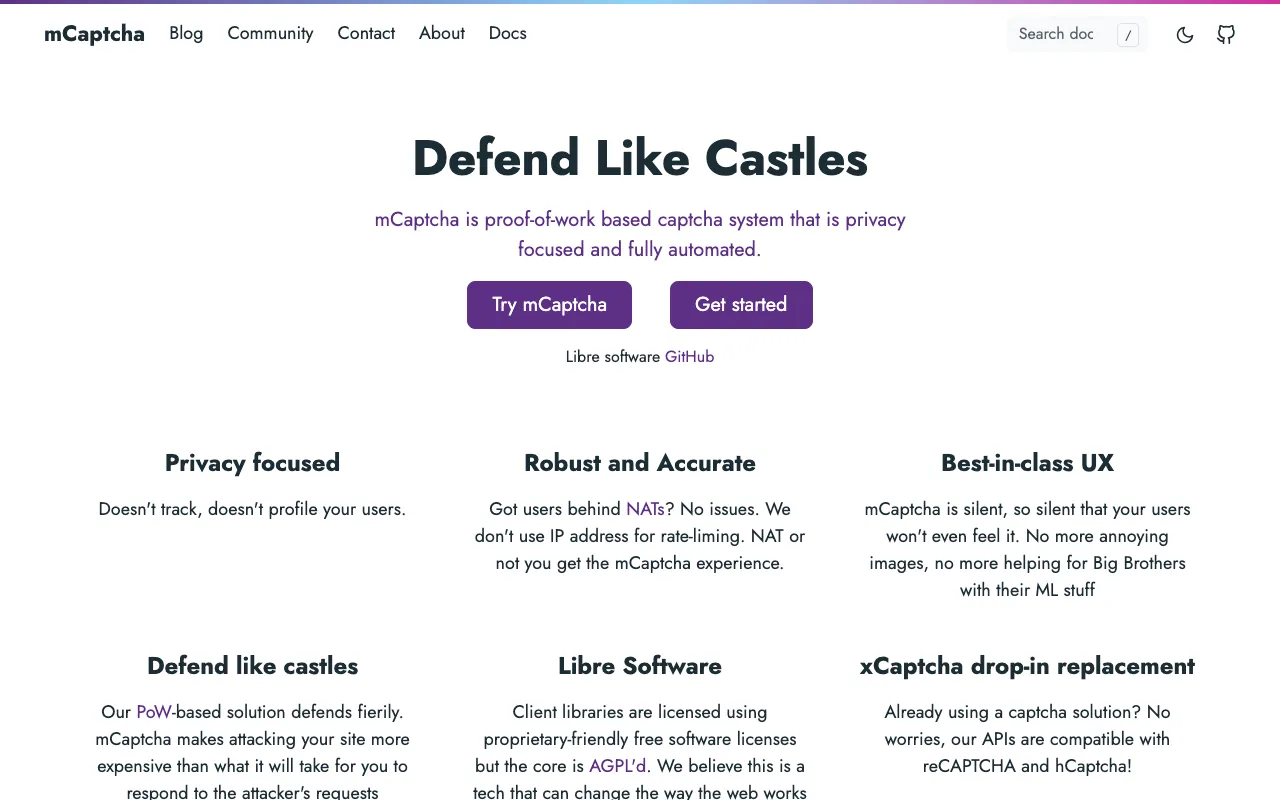
mCaptcha is a proof-of-work CAPTCHA backend that limits abuse without image puzzles. Sites validate tokens through its API before accepting user requests.
Overview
mCaptcha is a CAPTCHA system built around SHA256 proof-of-work instead of image challenges. When someone interacts with a protected site, their client computes work, submits it for validation, and receives a token to send with the actual form or request. The protected application checks that token with mCaptcha before handling the submission.
From the visitor’s perspective the flow is largely automatic: they start the process with a click while the computer does the computation. PoW difficulty can vary with load, so legitimate users may see little or no delay under moderate traffic and more delay under attack. Attackers who hammer a site must spend more CPU per request than the server spends answering them.
The design emphasizes privacy: CAPTCHA routes are cookie-free, and rate limiting does not rely on IP addresses, which helps users behind NAT. Proof-of-work configurations have short lifetimes and single use to resist replay. A client-side widget integrates with the backend for site operators.
This directory entry tracks the backend server component. Operators can run their own instance using container-based setup, or try public demo servers while development continues.
Key features
- SHA256 proof-of-work validation
- Cookie-free CAPTCHA routes
- IP-independent rate limiting
- Short-lived single-use PoW configs
- Token issuance for protected requests
- Variable PoW difficulty under load
- Client widget for one-click flow
- reCAPTCHA and hCaptcha compatible APIs
Use cases
- Protecting login and signup forms
- Reducing automated spam submissions
- DDoS and abuse mitigation on web apps
- Replacing image-based CAPTCHA UX
Does the same job as
mCaptcha doesn't name these products itself, but its own description shows it does the same job.
 reCAPTCHA


 hCaptcha