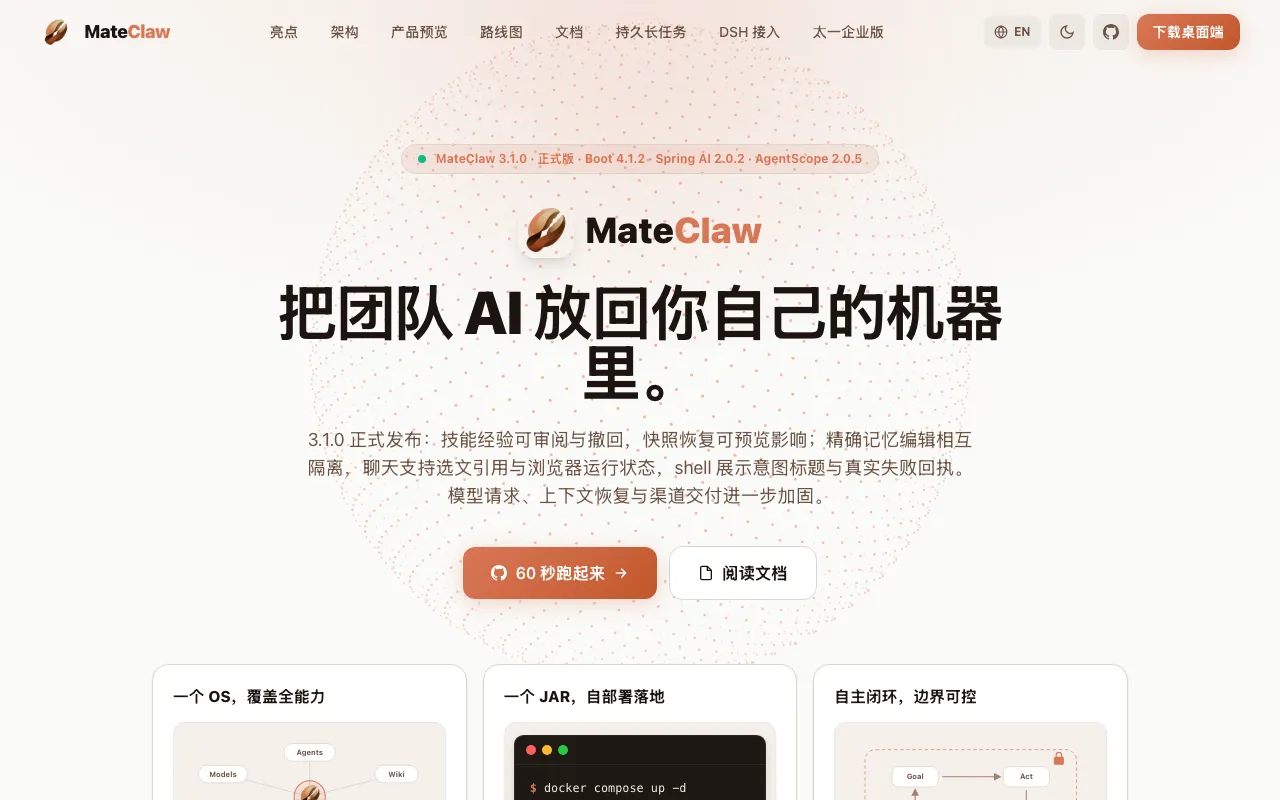
MateClaw deploys as one JAR or Docker stack for workspaces of digital employees, wiki knowledge, memory, tools, and IM or web chat. Built on Spring Boot and AgentScope with approvals, audit trails, and model failover.
Overview
MateClaw is a self-hosted team AI system that combines multi-agent orchestration, knowledge, durable memory, tool calling, and chat delivery in one deployment. Organizations run a single backend (JAR or Docker) on their own infrastructure, with data and API keys staying under their control while task content goes only to models, channels, and tools they configure.
Digital employees are first-class entities with role, goal, backstory, avatar, and an interchangeable agent runtime. The native AgentScope path supports ReAct, plan-and-execute, persistent goals, and team runs; DeepSeek Harness can run as a managed external loop over SDK JSON-RPC while sharing the same conversations, workspaces, tool guard, and lifecycle controls. Team runs link a user objective to a task graph, worker executions, synthesis, and deliverables with governance, approvals, and roster rules.
Knowledge flows through an LLM Wiki that turns uploads into linked pages with citations, plus workspace memory files and dreaming or consolidation workflows. Skills (SKILL.md packages), MCP servers, and ACP coding agents extend capabilities per employee. Tool Guard applies RBAC, approvals, and path protection. When a model provider fails, configured fallback providers retry the current request before surfacing an error.
Users reach the same backend through a web admin console, an Electron desktop app with bundled JRE, an embeddable webchat widget, and enterprise IM channels including DingTalk, Feishu, WeChat Work, Telegram, Discord, Slack, and others. Multi-user workspaces, approval-gated sensitive actions, and actuator health monitoring are aimed at teams that need operable AI rather than a single-user chat tab.
Key features
- Multi-user workspaces with audit trail
- Native or DeepSeek Harness agent runtime
- LLM Wiki with citations and entity graph
- Persistent goals across restarts
- Team runs with task DAG and approvals
- MCP, skills, and ACP tool integration
- Model provider failover and health routing
- Eight-plus IM channels plus web console
Use cases
- IT-governed team AI on private servers
- Customer support via enterprise IM
- Research and document workflows with wiki
- Long-running goals with checkpoint recovery
- Multi-agent projects with lead and workers

 Fathom
 Fireflies.ai