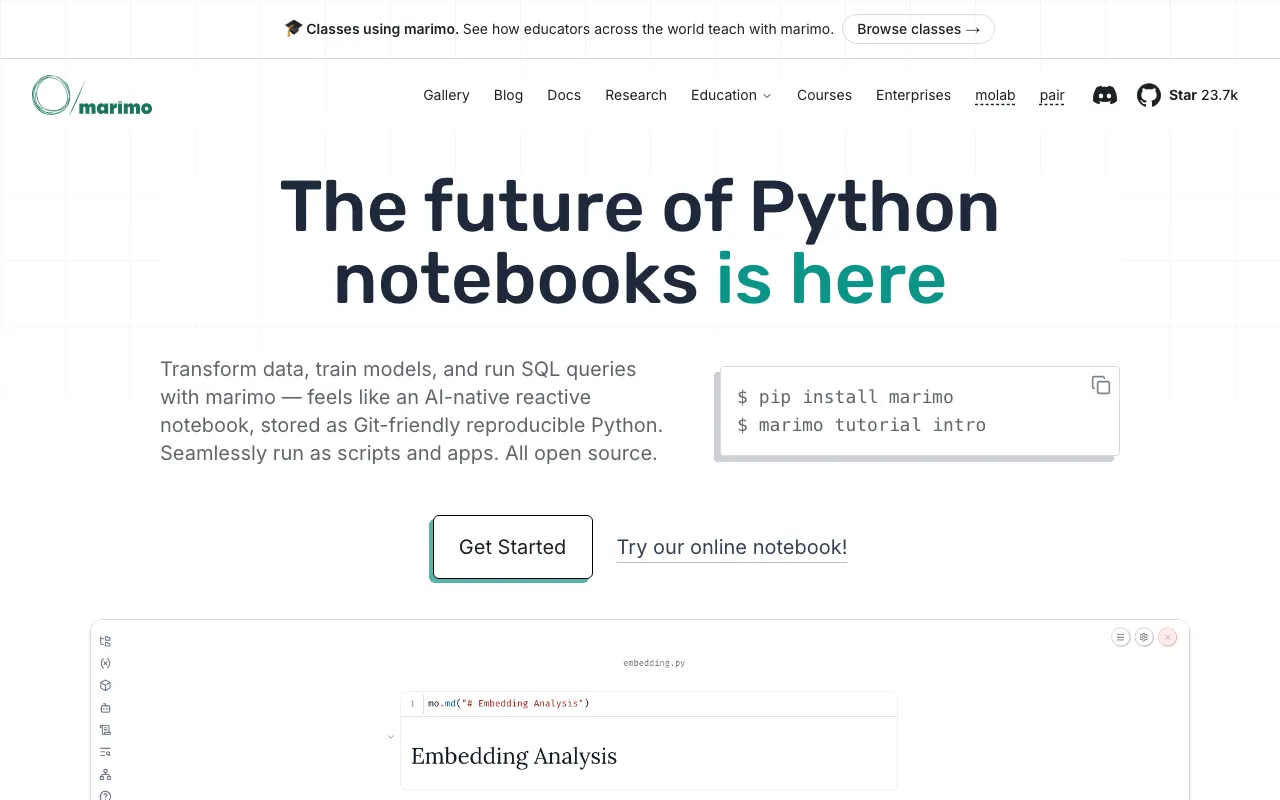
marimo is a Python notebook environment that reruns dependent cells automatically, stores work as .py files, and can export notebooks as scripts or web apps.
Overview
marimo treats a notebook as a reactive program: executing or editing one cell triggers dependent cells or marks them stale, which aims to keep outputs aligned with code and reduce hidden state. Notebooks serialize as plain Python sources with optional SQL cells, package metadata, and tooling-friendly layout.
The editor adds sliders, tables, plots, and similar controls that re-execute downstream logic when values change. Built-in SQL can query dataframes and external databases, while interactive dataframe views support paging and filtering without extra code. AI helpers and agent pairing tools are integrated for code generation and in-notebook assistance.
You install via pip, open notebooks with the CLI editor, run them headlessly as scripts with arguments, or serve them as read-only web apps. Notebooks can also run in the browser through WebAssembly, and a hosted molab service offers cloud notebooks comparable to Colab-style sharing.
The runtime analyzes references to decide execution order, supports lazy modes for costly cells, and includes editor conveniences such as formatting, completion, and extensions for VS Code and PyCharm.
Key features
- Reactive dependency-aware cell execution
- Pure Python .py notebook storage
- Built-in SQL and dataframe tools
- UI widgets tied to Python state
- CLI edit, run, and app serving
- Script and pytest execution paths
- Optional lazy stale-cell mode
- AI pairing and in-editor assistance
Use cases
- Reproducible data science notebooks
- Internal analytics dashboards as apps
- SQL exploration over warehouses
- Git-versioned computational reports
Open-source alternative to

 Retool