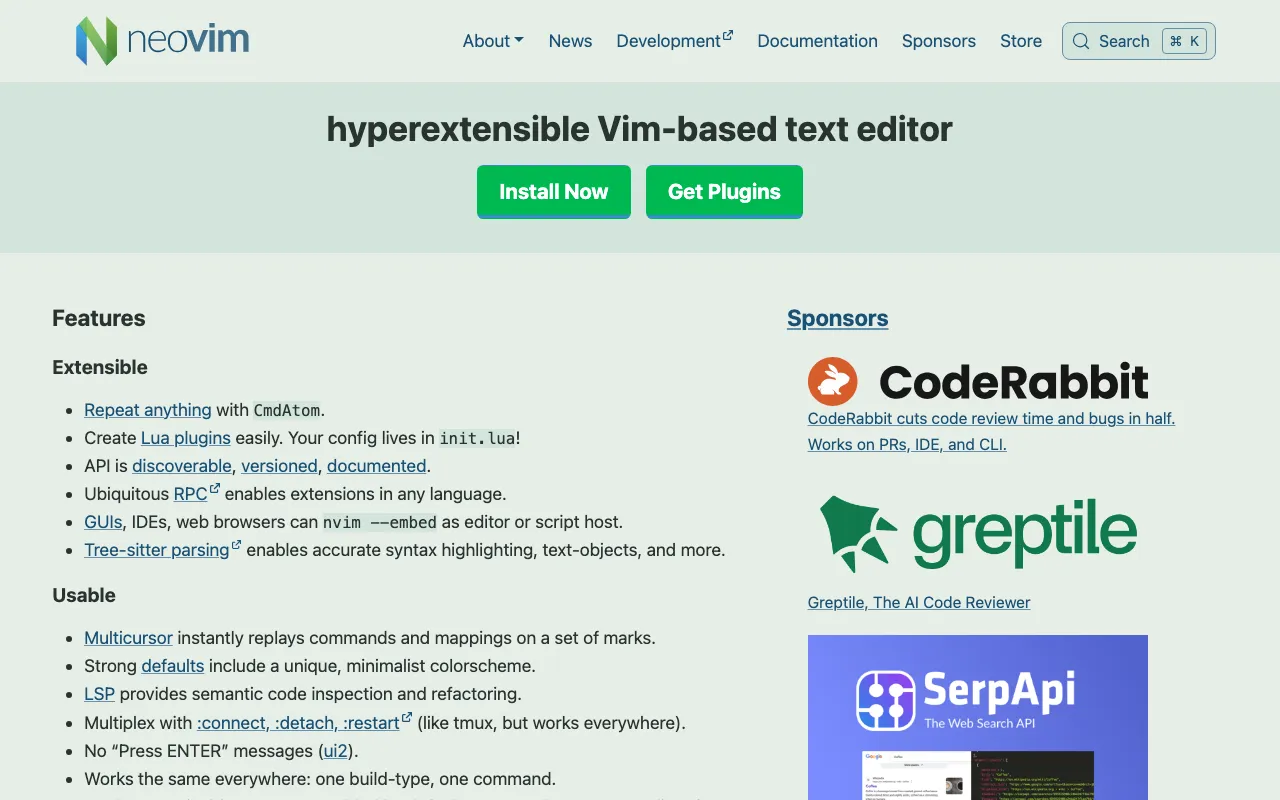
Neovim refactors Vim for easier maintenance, stronger extensibility, and modern UIs. It keeps Vim's editing model while adding Lua config, LSP, and a language-agnostic RPC API.
Overview
Neovim is a Vim fork aimed at simplifying maintenance, splitting development work, and maximizing extensibility while allowing advanced user interfaces without changing the core editor.
It offers API access from many programming languages, an embedded scriptable terminal emulator, asynchronous job control, and shared session data across editor instances. Configuration can live in init.lua, with discoverable and documented APIs and support for Lua plugins.
Tree-sitter parsing supports syntax highlighting and text objects. Built-in LSP integration provides semantic code inspection and refactoring. The editor supports modern GUIs, multicursor workflows, a built-in terminal, and multiplexing with connect, detach, and restart commands.
It remains compatible with most Vim plugins, including Ruby and Python plugins, and follows XDG base directory conventions. Pre-built packages are available for Windows, macOS, and Linux, and GUIs or other tools can embed Neovim via RPC.
Key features
- Language-agnostic RPC API
- Built-in Lua configuration
- Tree-sitter parsing support
- LSP integration
- Asynchronous job control
- Embedded terminal emulator
- Vim plugin compatibility
- Modern GUI support
Use cases
- Terminal-based code editing
- Vim users migrating workflows
- Custom editor UIs via embed
- Lua-based editor plugins
- Remote multiplexed editing sessions