
TensorFlow
End-to-end machine learning platform and tooling ecosystem
TensorFlow is a machine learning platform with Python and C++ APIs, optional GPU packages, and companion libraries for data, training, deployment, and visualization.
KV cache management layer for scalable LLM inference
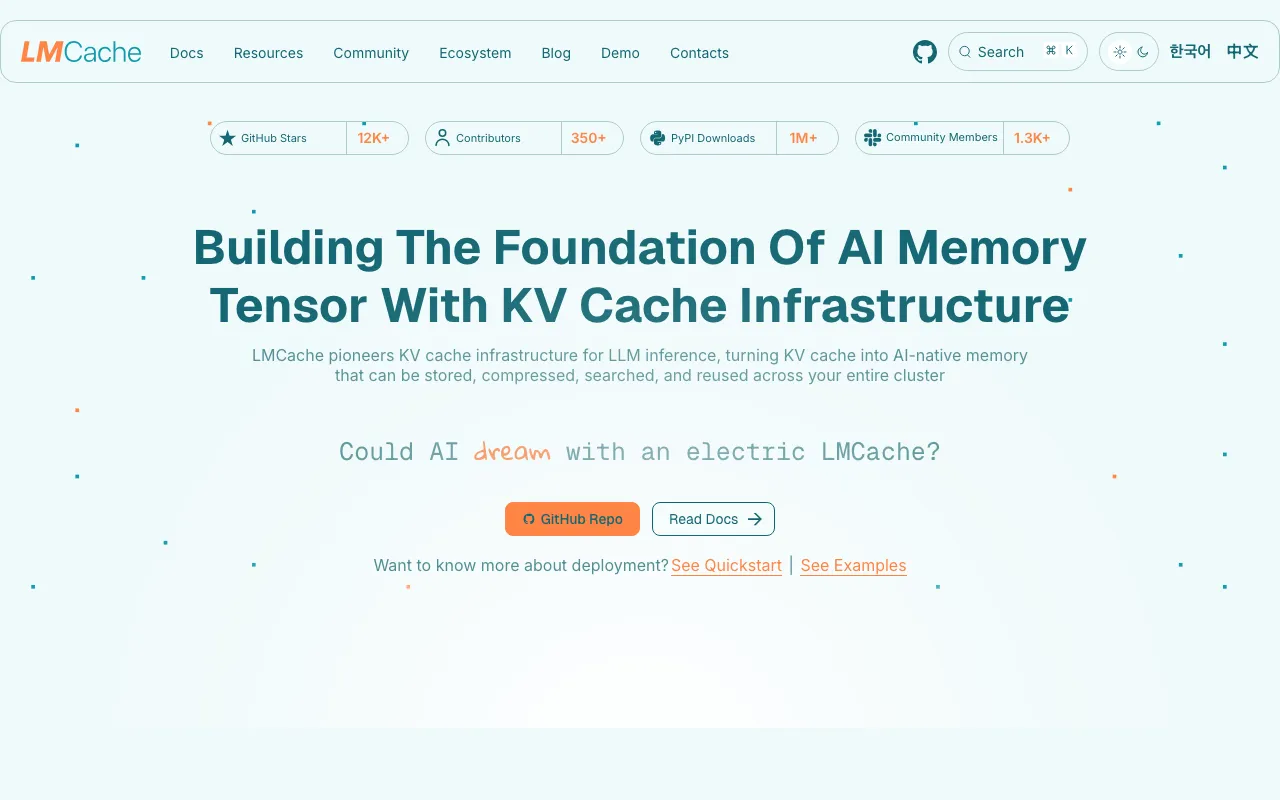
LMCache offloads and reuses transformer KV cache across requests and engines to cut prefill cost and time-to-first-token on long contexts.
LMCache is a KV cache management layer for large language model inference. It treats key-value cache as durable, reusable state rather than ephemeral GPU memory, so repeated prefixes, multi-turn chats, and retrieval-augmented prompts need less repeated prefill work.
It can run as an in-process library or as a standalone multiprocess server separated from the inference engine, so cache survives engine restarts and avoids fate-sharing with a single worker. Tiered storage moves cache from GPU memory into CPU RAM, local disk, and pluggable remote backends such as Redis, object storage, and specialized KV stores.
Observability hooks expose health, prefix hit rates, lifecycle metrics, and usage patterns suited to production Kubernetes deployments. Features include non-prefix reuse via CacheBlend, prefill-to-decode KV transfer for disaggregated serving, and extension points for compression and custom serialization.
The project integrates with common open inference stacks and hardware targets and installs from Python packaging for experimentation or production deployment patterns documented in its quickstart and recipes.
End-to-end machine learning platform and tooling ecosystem
TensorFlow is a machine learning platform with Python and C++ APIs, optional GPU packages, and companion libraries for data, training, deployment, and visualization.

Run open AI models locally or in the cloud
Ollama runs open language models such as Gemma, Qwen, DeepSeek and gpt-oss on macOS, Windows and Linux, locally or in the cloud. It offers a CLI, a REST API, and Python and JavaScript libraries.

Shared model definitions for multimodal ML workloads
Transformers is a Python library that defines pretrained text, vision, audio, and multimodal models once in PyTorch for shared inference and training across the ecosystem.

LLM inference engine in C/C++ for local and cloud hardware
llama.cpp runs large language models and multimodal models locally or in the cloud with minimal setup. It includes a CLI, an OpenAI-compatible server with a built-in chat app, and a C library API.

General-purpose speech recognition and translation model
Whisper is a speech recognition model trained on diverse audio. It supports multilingual transcription, speech-to-English translation, and language identification via Python or the command line.

High-throughput, memory-efficient inference and serving engine for LLMs
vLLM is a library and server for running and serving large language models. It uses PagedAttention and continuous batching for throughput, offers an OpenAI-compatible API, and runs on many GPU, CPU and accelerator types.