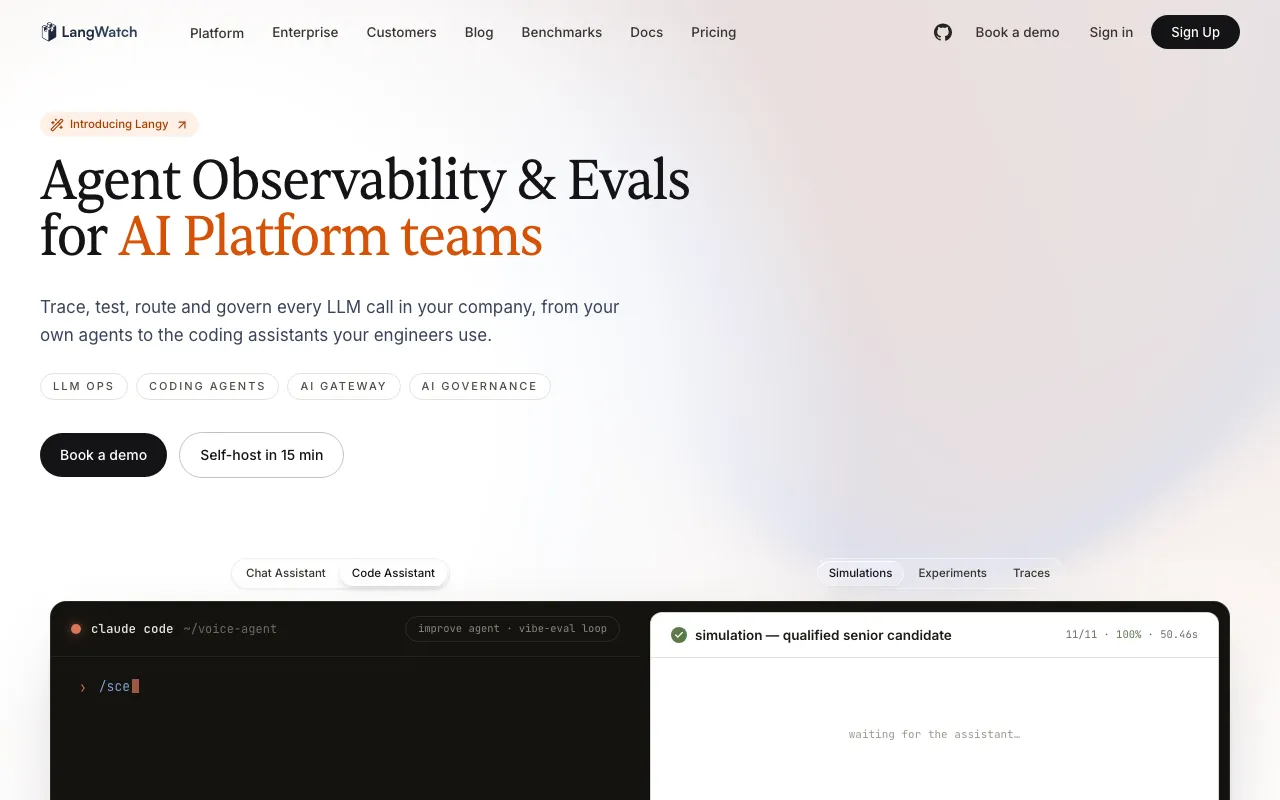
LangWatch is an open-source platform for tracing, testing, routing and governing LLM calls, covering both agents you build and coding assistants your engineers use. It includes simulations, evaluations, prompt management and an AI gateway.
Overview
LangWatch is a platform for running AI in production. It traces LLM calls from agents a team builds and from coding assistants such as Claude Code, Codex, GitHub Copilot and opencode. The product is organised into four areas: LLM Ops, Coding Agents, AI Gateway and AI Governance.
For LLM Ops, it provides observability, agent testing, evaluations and prompt management. Agent testing uses simulations, where a simulated user holds text or voice conversations with the agent and a judge scores the result against a rubric. Evaluations can run offline from a notebook or the UI, and online against production traffic, using LLM judges, custom code or workflows. Traces are OpenTelemetry native and can be viewed as waterfall, flame graph, topology or sequence diagrams, with saved views, AI search and topic clustering.
For coding agents, it tracks sessions and reports cost per pull request and per team, with privacy controls. The AI Gateway offers one OpenAI and Anthropic compatible endpoint with virtual keys, budgets and routing across providers such as OpenAI, Anthropic, Google, Bedrock and Mistral. The governance side inventories AI tools used across a company, shows who uses them, and supports anomaly rules, with sources such as Copilot Studio and compliance APIs.
It integrates with frameworks including LangChain, LangGraph, Vercel AI SDK, Mastra, CrewAI, Google ADK and DSPy, and with no-code tools such as LangFlow, Flowise and n8n. It can be used as a managed cloud service, self-hosted with Docker or Kubernetes/Helm, or in a hybrid setup. Enterprise features include RBAC, SCIM and SSO, and audit log export to a SIEM. Some enterprise modules need a commercial license in production.
Key features
- Tracing with OpenTelemetry support
- Simulation-based agent testing, text and voice
- Offline and online evaluations
- Prompt management
- Coding agent sessions and cost per pull request
- AI gateway with virtual keys and budgets
- AI governance and anomaly rules
- Topic clustering and AI search
Use cases
- Trace and debug LLM agents in production
- Test agents with simulated users before release
- Track coding assistant cost per pull request or team
- Issue budgeted virtual keys to employees or customers
- Find unused AI subscriptions across a company
Does the same job as
LangWatch doesn't name these products itself, but its own description shows it does the same job.