
TensorFlow
End-to-end machine learning platform and tooling ecosystem
TensorFlow is a machine learning platform with Python and C++ APIs, optional GPU packages, and companion libraries for data, training, deployment, and visualization.
Differentiable computer vision library for PyTorch
Kornia provides GPU-friendly, differentiable image processing and geometry operators built on PyTorch. It spans augmentation, feature matching, camera models, and pretrained vision models.
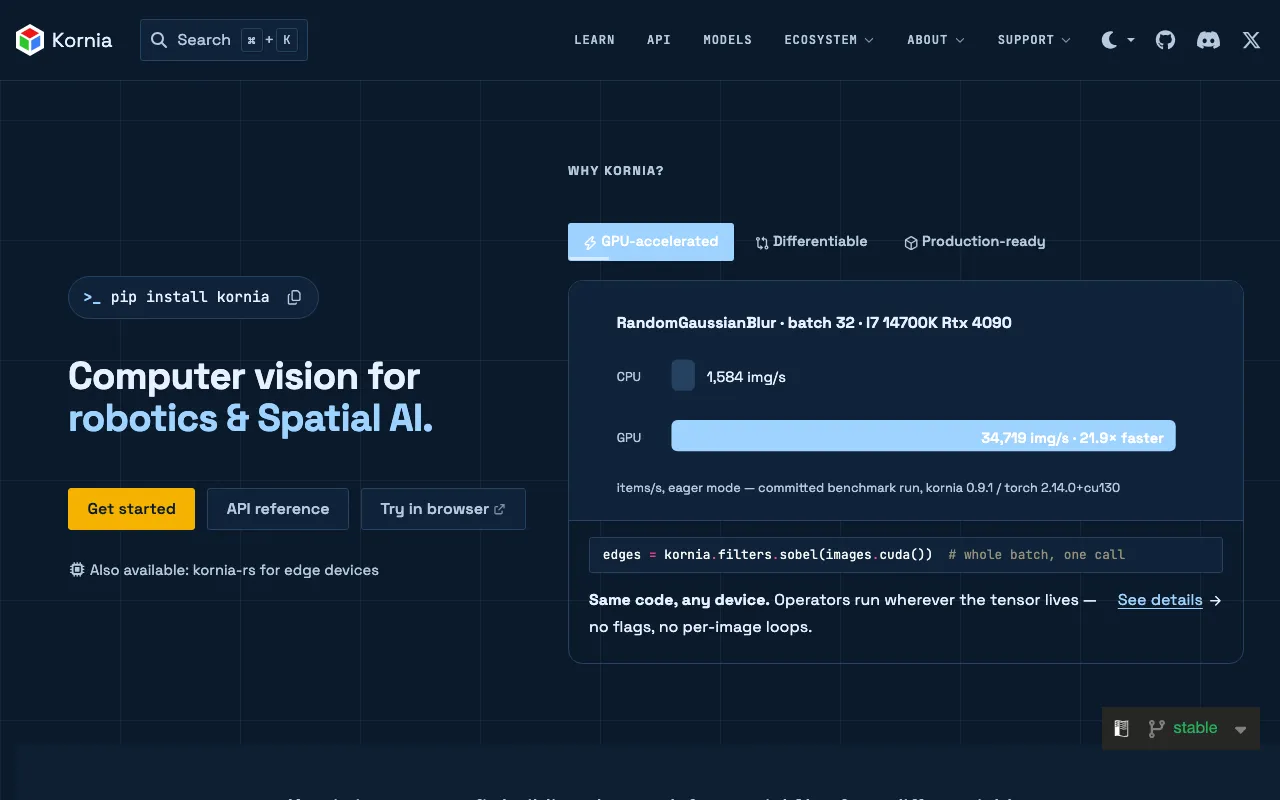
Kornia is a Python library for geometric computer vision and spatial AI workflows inside PyTorch. Operators run on the same device as input tensors, support batching with per-sample parameters, and participate in autograd so vision steps can sit inside models or losses.
Coverage includes filtering, color transforms, edge detection, morphology, warps and homographies, epipolar geometry, minimal solvers, RANSAC on device, Lie groups, depth-to-3D utilities, and augmentation pipelines that keep images, masks, boxes, and keypoints aligned. Learned matchers such as LoFTR and LightGlue and classical SIFT-style tooling live alongside pretrained detectors and segmenters.
The project emphasizes conventions, conformance tests, and published benchmarks against CPU libraries and torchvision where overlap exists. Many operators export to ONNX and run under torch.compile on supported PyTorch versions. CPU, CUDA, and MPS tensors are supported with documented half-precision limits.
Install via pip, with optional extras for ONNX and related features. A separate kornia-rs project targets edge devices. Sponsorship and community contributions sustain ongoing maintenance.
End-to-end machine learning platform and tooling ecosystem
TensorFlow is a machine learning platform with Python and C++ APIs, optional GPU packages, and companion libraries for data, training, deployment, and visualization.

Run open AI models locally or in the cloud
Ollama runs open language models such as Gemma, Qwen, DeepSeek and gpt-oss on macOS, Windows and Linux, locally or in the cloud. It offers a CLI, a REST API, and Python and JavaScript libraries.

Shared model definitions for multimodal ML workloads
Transformers is a Python library that defines pretrained text, vision, audio, and multimodal models once in PyTorch for shared inference and training across the ecosystem.

LLM inference engine in C/C++ for local and cloud hardware
llama.cpp runs large language models and multimodal models locally or in the cloud with minimal setup. It includes a CLI, an OpenAI-compatible server with a built-in chat app, and a C library API.

General-purpose speech recognition and translation model
Whisper is a speech recognition model trained on diverse audio. It supports multilingual transcription, speech-to-English translation, and language identification via Python or the command line.

High-throughput, memory-efficient inference and serving engine for LLMs
vLLM is a library and server for running and serving large language models. It uses PagedAttention and continuous batching for throughput, offers an OpenAI-compatible API, and runs on many GPU, CPU and accelerator types.