
TensorFlow
End-to-end machine learning platform and tooling ecosystem
TensorFlow is a machine learning platform with Python and C++ APIs, optional GPU packages, and companion libraries for data, training, deployment, and visualization.
Python library for composable numerical and ML computations
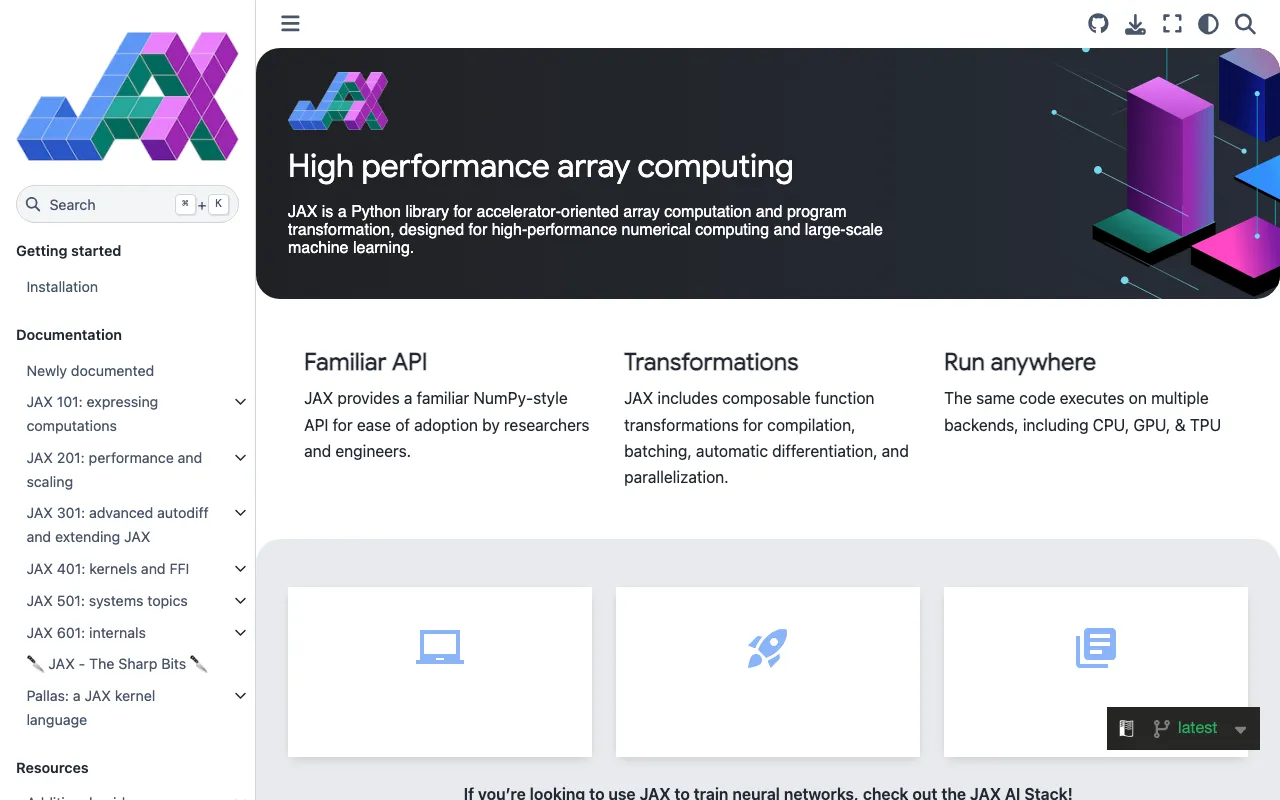
JAX is a Python package for accelerator-oriented array work and program transformation, aimed at numerical computing and large-scale machine learning.
JAX offers a NumPy-style API while targeting high-performance runs on CPUs, GPUs, TPUs, and other accelerators. It treats user code as a system of composable function transformations rather than only imperative array ops.
Core transformations include automatic differentiation (reverse and forward modes, composable to high order), JIT compilation via XLA, and vectorization with vmap. Grad, jit, and vmap can be combined—for example to obtain Jacobian matrices or per-example gradients efficiently.
For scaling across many devices, JAX supports compiler-based automatic parallelization with a global programming view, explicit sharding with inspectable types, and manual per-device programming with explicit collectives.
Installation is via pip on Linux, macOS, and Windows with optional extras for NVIDIA GPU, Google TPU, AMD ROCm, and Intel oneAPI. Docker-based installation is mentioned in the docs. An ecosystem of ML and numerics libraries is built around JAX for neural networks, optimizers, probabilistic programming, and related workloads.
End-to-end machine learning platform and tooling ecosystem
TensorFlow is a machine learning platform with Python and C++ APIs, optional GPU packages, and companion libraries for data, training, deployment, and visualization.

Run open AI models locally or in the cloud
Ollama runs open language models such as Gemma, Qwen, DeepSeek and gpt-oss on macOS, Windows and Linux, locally or in the cloud. It offers a CLI, a REST API, and Python and JavaScript libraries.

Shared model definitions for multimodal ML workloads
Transformers is a Python library that defines pretrained text, vision, audio, and multimodal models once in PyTorch for shared inference and training across the ecosystem.

LLM inference engine in C/C++ for local and cloud hardware
llama.cpp runs large language models and multimodal models locally or in the cloud with minimal setup. It includes a CLI, an OpenAI-compatible server with a built-in chat app, and a C library API.

General-purpose speech recognition and translation model
Whisper is a speech recognition model trained on diverse audio. It supports multilingual transcription, speech-to-English translation, and language identification via Python or the command line.

High-throughput, memory-efficient inference and serving engine for LLMs
vLLM is a library and server for running and serving large language models. It uses PagedAttention and continuous batching for throughput, offers an OpenAI-compatible API, and runs on many GPU, CPU and accelerator types.