qmetrics.net

impress.js

CSS3 transform-based presentation framework for browsers

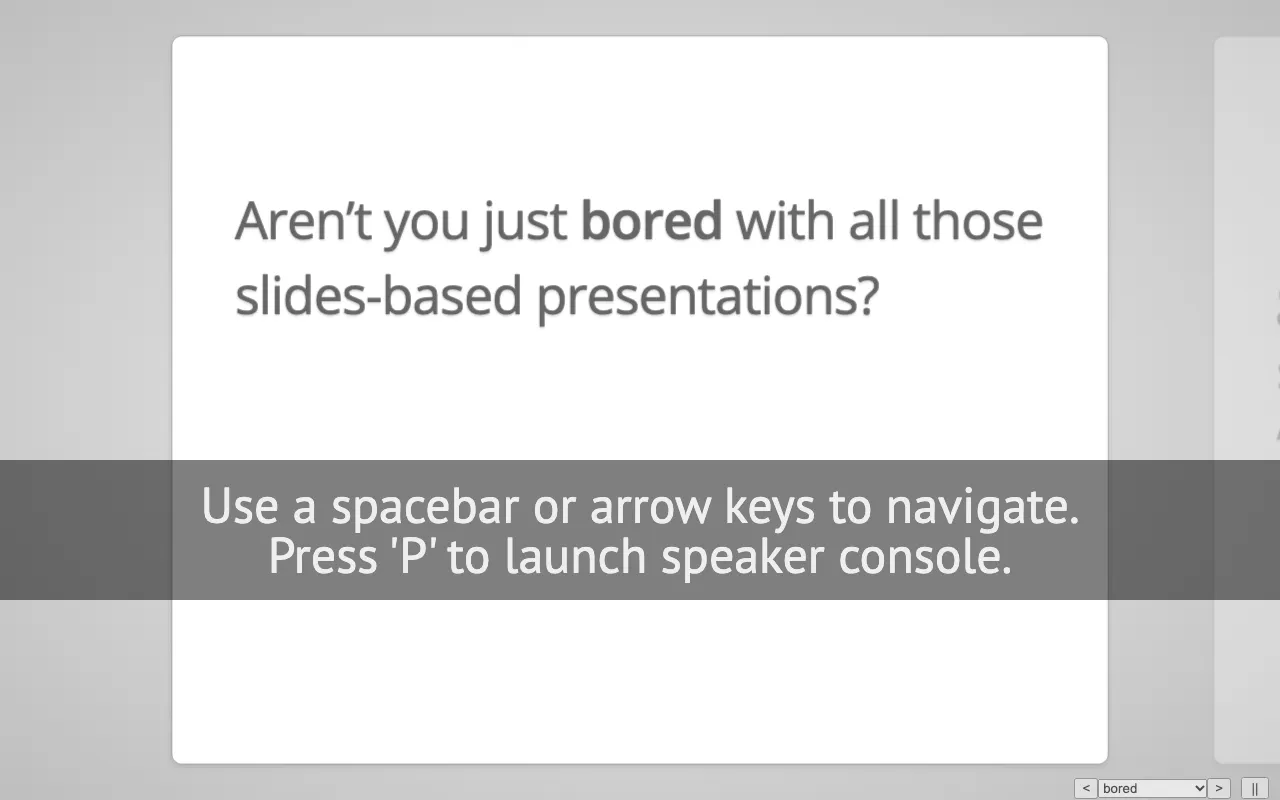
impress.js screenshot

impress.js builds browser presentations using CSS3 transforms and transitions instead of traditional slide decks. Content lives on a canvas you position, rotate, and scale in 3D space.

Overview

impress.js is a presentation framework that relies on CSS3 transforms and transitions in modern browsers. It targets talks where slides are laid out on an infinite canvas rather than mirroring classic deck metaphors, with navigation via keyboard or on-screen controls.

You author HTML that impress.js enhances at runtime, generating the CSS it needs dynamically so a bundled demo stylesheet is optional for your own decks. Reference documentation, a heavily commented official demo, additional example decks such as Classic Slides, and plugin APIs extend the core script.

The project emphasizes recent Firefox and Chrome support and notes Internet Explorer compatibility in community reports, with the understanding that embedded web presentations may not render identically for all visitors. A speaker console is available from the keyboard during presentations.

Inspiration is credited to the presentation style popularized by prezi.com, while impress.js itself remains an open framework you self-host as static HTML opened locally or published on the web.

Key features

  • CSS3 transform-driven slides
  • Infinite canvas positioning
  • 3D rotation and scaling effects
  • Keyboard and speaker console navigation
  • Plugin extension API
  • Classic rectangular slide template
  • Runtime-generated presentation CSS
  • Reference demo and example decks

Use cases

  • Conference talks with spatial layouts
  • Non-linear presentation storytelling
  • Embedding animated decks in web pages
  • Teaching CSS3 transform capabilities
  • Offline laptop-driven presentations

Similar software

Excalidraw

Open-source collaborative whiteboard for hand-drawn style diagrams

Excalidraw is a virtual whiteboard for sketching diagrams and wireframes in a hand-drawn style. It offers an infinite canvas, real-time collaboration with end-to-end encryption, and is also published as an npm package for embedding.

★ 136.4k⟳ todayMIT
Open Source Alternative to:Miro

three.js

Cross-browser JavaScript library for 3D graphics

Three.js is a lightweight JavaScript 3D library for browsers. Default builds target WebGL and WebGPU, with optional SVG and CSS3D renderers as add-ons.

★ 119.5k⟳ todayMIT
Design & VisualizationDesktop/CLI app

Archify

Agent skill for interactive HTML diagrams and explainers

Archify is an open-source agent skill that turns descriptions, plans, or repositories into validated, self-contained interactive HTML maps and one-page explainers for Claude Code, Codex, Cursor, OpenCode, and Copilot.

★ 100.9k⟳ 2 days agoApache-2.0

Manim

Programmatic animation engine for explanatory math videos

ManimGL drives precise programmatic animations for explanatory math videos. The 3Blue1Brown variant installs via the manimgl package

★ 97k⟳ 2 months agoMIT
Frameworks & PlatformsDesktop/CLI app

Mermaid

Text-defined diagrams from Markdown-like syntax

Mermaid turns plain-text diagram definitions into flowcharts, sequence charts, Gantt charts, and many other diagram types. It renders in browsers, documentation tools, and GitHub Markdown.

★ 91.3k⟳ 5 days agoMIT

ImGui

Minimal immediate-mode C++ graphical user interface library

Dear ImGui is a portable C++ GUI library that emits draw batches for your renderer. It targets debug tools, editors, and in-engine tooling rather than consumer-facing apps.

★ 77.3k⟳ yesterdayMIT
Frameworks & PlatformsDesktop/CLI app