
Concrete ML
Privacy-preserving machine learning with homomorphic encryption
Concrete ML from Zama wraps fully homomorphic encryption for data scientists, with scikit-learn-like models and PyTorch conversion for encrypted inference and training.

Training-free local language model behavior modification
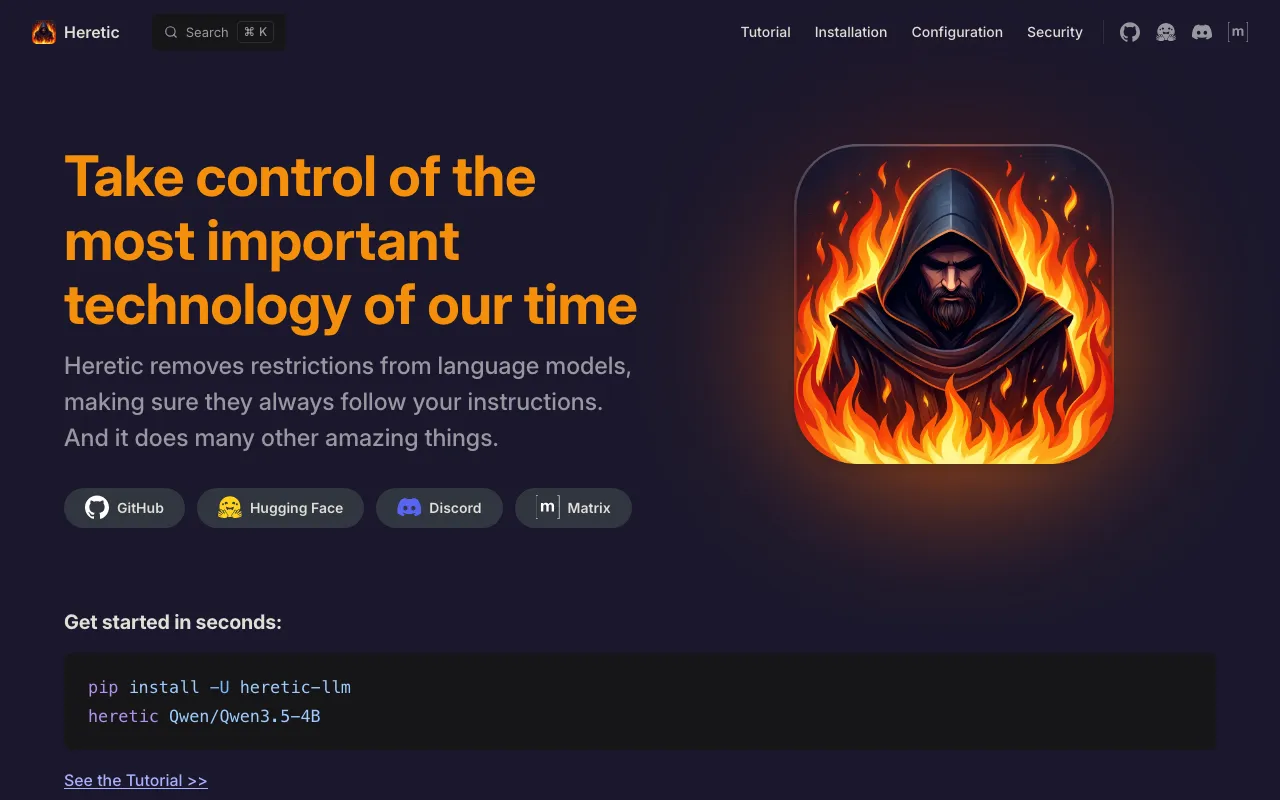
Heretic steers LLM behavior without full retraining, using mathematical techniques and configurable scorers. Run it on your own hardware to adjust censorship, tone, and other traits.
Heretic is a command-line tool for modifying language models you can run locally, without expensive training runs. It applies mathematical steering methods driven by contrasting prompts and scorer plugins, so you can change how a model responds while keeping the same base weights.
Default workflows target refusal suppression and censorship removal, with additional bundled profiles for reducing sycophancy, humor, verbose phrasing, and similar traits. You pick a Hugging Face model ID, optional quantization (including 4-bit loading to cut VRAM), and a TOML configuration file that selects modifiers, scorers, and optimization goals.
Processing combines pluggable modifiers such as Arbitrary-Rank Ablation and directional abliteration with a hyperparameter optimizer to hunt for parameters that minimize or maximize your chosen scores. Built-in scorers cover refusal rate and KL divergence, and you can add custom scorer and modifier plugins via configuration paths without patching core code.
After a run completes, you can save the adjusted weights, upload to Hugging Face, chat for manual checks, or run standard benchmarks. Optional reproducibility metadata helps recreate byte-identical exports when the environment matches, and a manifest library lets you fetch public reproduction recipes from Hugging Face.
Privacy-preserving machine learning with homomorphic encryption
Concrete ML from Zama wraps fully homomorphic encryption for data scientists, with scikit-learn-like models and PyTorch conversion for encrypted inference and training.

End-to-end machine learning platform and tooling ecosystem
TensorFlow is a machine learning platform with Python and C++ APIs, optional GPU packages, and companion libraries for data, training, deployment, and visualization.

Run open AI models locally or in the cloud
Ollama runs open language models such as Gemma, Qwen, DeepSeek and gpt-oss on macOS, Windows and Linux, locally or in the cloud. It offers a CLI, a REST API, and Python and JavaScript libraries.

Shared model definitions for multimodal ML workloads
Transformers is a Python library that defines pretrained text, vision, audio, and multimodal models once in PyTorch for shared inference and training across the ecosystem.

LLM inference engine in C/C++ for local and cloud hardware
llama.cpp runs large language models and multimodal models locally or in the cloud with minimal setup. It includes a CLI, an OpenAI-compatible server with a built-in chat app, and a C library API.

General-purpose speech recognition and translation model
Whisper is a speech recognition model trained on diverse audio. It supports multilingual transcription, speech-to-English translation, and language identification via Python or the command line.